Redefining "Event" as the Rights-Buying Filter
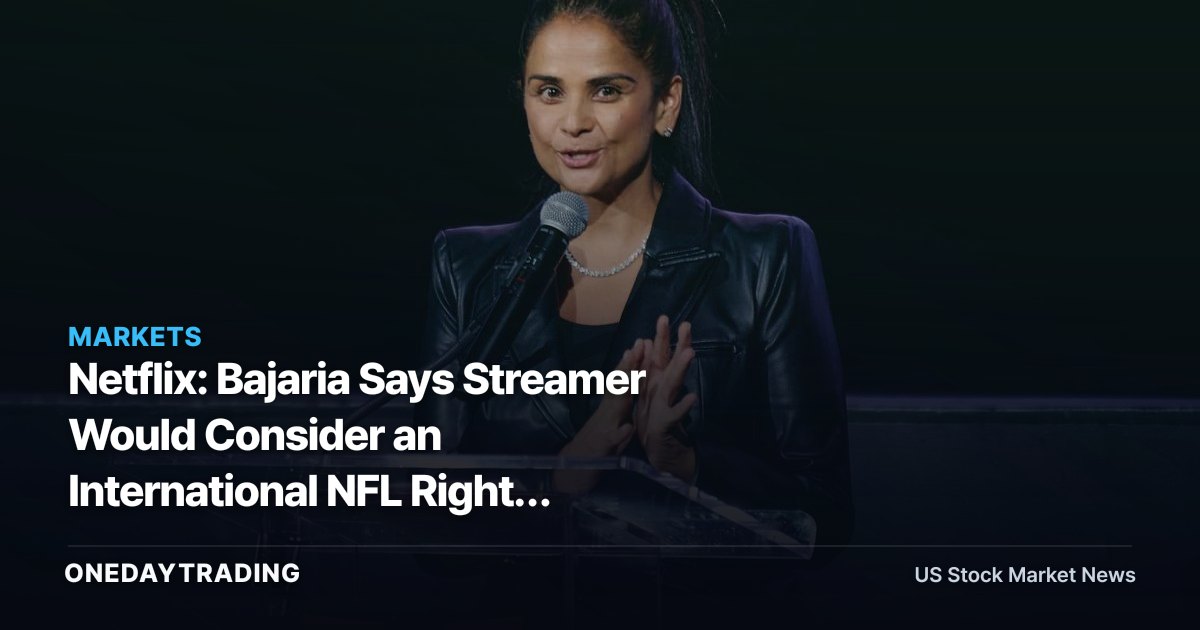
Bajaria's framing of an "event" — "fuzzy, cultural, zeitgeist... that really sort of unmissable moment," as she described it to CNBC Sport — functions less as marketing language than as a purchasing rule. It explains why Netflix is airing only five NFL games in the 2026-27 season: last week's Australia game, a first-ever Thanksgiving Eve game, two Christmas Day games, and a Week 18 game guaranteed to carry playoff or seeding stakes. Each slot is chosen for calendar or cultural weight, not volume, which is the opposite approach from NBC's full-season "Sunday Night Football" package, the most-watched primetime program for 15 consecutive years.
That selectivity has a shelf life. The NFL holds an opt-out clause that lets it renegotiate media rights for games starting after the 2029-30 season, and Commissioner Roger Goodell told CNBC the league would consider reworking its existing game packages. The league does not currently sell a standalone international package — nine games this year, ten scheduled next season — but Bajaria said Netflix would find one "appealing" if it existed, citing the streamer's "large global audience and a very engaged global audience." That is a statement of interest, not a bid; no terms, price, or timeline were disclosed.
The FIFA angle follows the same logic. Netflix already holds U.S. and Canadian Women's World Cup rights for 2027 and 2031, a relationship Bajaria called a foundation for "always" continuing conversations about the men's tournament in 2030 and 2034 — interest CNBC first reported earlier this year and that Bajaria confirmed again here. Separately, Netflix is testing content "ingestion" from outside partners: an existing arrangement with France's TF1 Group that Bajaria labeled a "test," alongside an exclusive film licensing deal with Universal and NBC Sports' production of the Australia broadcast. She pointed to those NBCUniversal ties as evidence both companies are comfortable experimenting further, a dynamic that gained urgency after YouTube said in July it would ingest NBCUniversal's Peacock content into its own Premium platform.
The Numbers Behind the Pitch
The commercial backdrop Bajaria cited is a $20 billion content budget — large enough, she joked, that a dollar for every time she's asked about matching NBC's Sunday Night Football "would just pay for" it without touching that budget. The Melbourne game itself, a 27-7 San Francisco 49ers win over the Los Angeles Rams, is the proof point Netflix is using for its "event" thesis: a first-of-its-kind international regular-season game, globally rights-held by Netflix and produced by NBC Sports.
Against that, the competitive scoreboard cuts the other way. Nielsen's July data puts YouTube at 14.2% of U.S. streaming viewership, almost double Netflix's 7.8% share, even as Netflix expands into marquee live sports. Sports rights add cultural cachet and appointment viewing; they have not, on this data point, closed the catalog-viewership gap with YouTube's user-generated and short-form library.
Who Gains, Who's Squeezed
- Netflix (NFLX) — gains optionality: it can add high-profile sports "events" (NFL windows, a potential FIFA bid) without committing to a full-season rights package, preserving the $20 billion content budget for scripted series and film, which Bajaria said remains the platform's core.
- Alphabet (GOOGL), via YouTube — holds the largest U.S. streaming viewership share (14.2% in July) and is separately absorbing NBCUniversal's Peacock content into YouTube Premium, positioning it as an aggregator even as Netflix and traditional broadcasters court the same live-sports audience.
- Comcast's NBCUniversal (CMCSA) — sits on both sides of the shift: NBC Sports produced Netflix's Australia NFL broadcast and NBC still runs "Sunday Night Football," while Peacock content is simultaneously being ingested into YouTube Premium, a two-platform distribution strategy for the same library.
What Could Break the Thesis
- No pricing, term length, or timeline exists for any prospective NFL international package or FIFA World Cup bid — Bajaria confirmed interest, not a deal.
- The NFL's opt-out on media rights doesn't arrive until after the 2029-30 season, so any renegotiated international package is years away from Netflix's income statement.
- Netflix's own executives, including co-CEO Ted Sarandos previously, have signaled a large NFL package doesn't fit the strategy — meaning the streamer could stay a selective buyer even if a package becomes available.
- YouTube's viewership-share lead (14.2% versus 7.8% in July) is a standing headwind to the idea that live sports alone reverses Netflix's relative position in total streaming minutes.
Bottom Line
Bajaria's comments confirm Netflix wants more optionality in live sports — an international NFL package if one comes to market, a possible FIFA Men's World Cup bid, and continued experiments in content "ingestion" with partners like TF1 and NBCUniversal — without disclosing what any of it would cost or when it would happen. The upside case is a broader menu of appointment-viewing events layered onto Netflix's $20 billion content budget; the offsetting risk is that none of these are signed deals, the NFL's next rights window doesn't open until after the 2029-30 season, and YouTube's viewership-share lead shows the competitive gap sports rights are meant to close hasn't closed yet.
📊 Analysis
Signal Neutral
Why Bajaria's comments show Netflix pursuing selective live-sports rights without confirmed deal terms, while Nielsen data show YouTube still leads Netflix in U.S. streaming share.
This article was independently written by OneDayTrading from public reporting. Read the original (CNBC)