Costco’s Motor-Oil Value Proposition Tightens
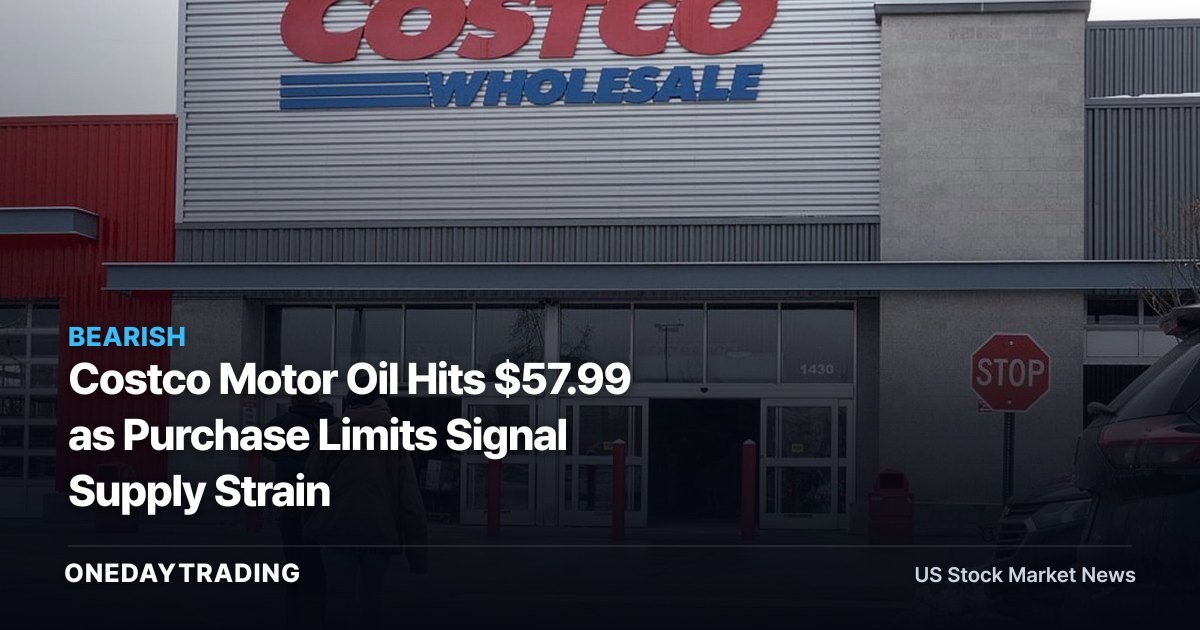
Costco raised Kirkland Signature full-synthetic motor oil to $57.99 per 10-quart case and limited purchases amid a reported global lubricant shortage, according to Yahoo Finance. The decision matters to Costco investors because a higher price paired with rationing creates a direct test of the retailer’s value proposition in an automotive staple. The exact start date, duration and geographic scope of the limits have not been specified.
A purchase limit is a form of rationing that caps how much each customer or member may buy. Costco set the Kirkland ceiling at two units per customer per week and imposed a separate five-unit-per-member limit on Mobil 1. Limits across both Kirkland Signature and Mobil 1 make availability—not merely one private-label price—the central issue.
From a Roughly $30 Case to $57.99
The Kirkland package contains 10 quarts in two 5-quart bottles, an amount described as sufficient for a typical V6 or V8 oil change. The Drive placed the previous customary price at approximately $30 per case. At $57.99, the product still needs to be evaluated against the alternative on Costco’s own shelves: Mobil 1 was priced at $44 for six quarts.
Those package sizes prevent a clean comparison based only on the shelf totals. The more important retail signal is that Costco raised the Kirkland price while restricting unit volume. For investors, that combination may indicate an effort to allocate constrained stock, but the fact sheet does not disclose sales volume, member response, procurement cost or margin effects.
The consumer behavior question is therefore precise: do members continue buying the available oil at the higher price, shift between Kirkland and Mobil 1, or defer purchases? Each path would affect product mix differently. None can be treated as the reported outcome until Costco supplies evidence.
Why Fuel Economics Matter to Lubricant Supply
Base oil shares its crude-oil origins with gasoline and diesel. That physical connection provides the transmission mechanism from the wider oil market to packaged motor oil: pressure affecting crude-derived products can also reach lubricant availability and pricing.
EIA data showed the gasoline crack spread—an indicator tied to the value difference between gasoline and its crude input—at approximately $1 per gallon above the same point in 2025. The figure gives investors a concrete comparison for the refinery environment, although the fact sheet does not establish the exact cause or expected duration of the reported lubricant shortage.
The macro backdrop remains tight. In August, the International Energy Agency cut its 2026 global oil-supply forecast to 102 million barrels per day and projected a 1.8 million-barrel-per-day global deficit for the third quarter of 2026. Cumulative global inventory draws since the start of the U.S.-Iran conflict exceeded 500 million barrels, according to Yahoo Finance.
Chevron Chief Executive Mike Wirth described the condition by saying “the cushions that had softened earlier price increases have been exhausted,” Yahoo Finance reported. The statement reinforces the shortage thesis, but its exact date is not provided. Investors should treat it as context for constrained inventories, not as a quantified forecast for Costco’s motor-oil costs.
Certification Adds a Separate Cost Layer
Kirkland 5W-30 displays GM’s dexos1 Gen 3 certification. GM owns the dexos1 specification, while manufacturers seeking the certification must use GM’s independent testing protocol and obtain a license. That requirement separates technical compliance from the crude-derived supply issue: even if base-oil conditions improve, certification remains part of the product structure.
Industry testing requirements also changed around 2020, when the API SP category took effect with seven additional laboratory tests. These details do not quantify Costco’s current cost increase, but they show why finished motor oil cannot be analyzed as an undifferentiated barrel of crude. Its economics include formulation, testing and licensing as well as base-oil availability.
That distinction limits the easy counterargument that softer crude conditions alone would restore the previous customary price. They could ease one input channel, but the supplied facts do not reveal how much of the $57.99 price reflects base oil, certification, testing, procurement or another component.
The Wider Cost Signal for Drivers
AAA reported that U.S. diesel reached $6.06 per gallon on Monday, crossing the $6-per-gallon threshold. The price rose 8 cents from Sunday and stood 21 cents above the week-earlier level. Diesel does not determine Costco’s motor-oil price by itself, but the move provides another observable measure of stress among crude-derived products.
For Costco, the immediate risk is not simply that one automotive product costs more. Kirkland Signature carries the retailer’s own brand, so a conspicuous increase from the approximately $30 customary case price to $57.99 can sharpen members’ attention to value. The counterpoint is that purchase limits may reflect restricted availability rather than weak demand; without unit sales or member-behavior data, the direction of the earnings effect cannot be established.
Investor Debates Around Costco and Oil Supply
- Availability versus pricing: Limits on both Kirkland and Mobil 1 support the view that supply is constrained, while the size of Costco’s underlying cost pressure remains undisclosed.
- Private-label value: Kirkland’s $57.99 price is far above the approximately $30 customary case price reported by The Drive, creating a test of whether members still perceive sufficient value.
- Oil-market persistence: The IEA’s projected 1.8 million-barrel-per-day deficit applies to the third quarter of 2026, but it does not specify when lubricant availability might normalize.
- Structural versus cyclical costs: Base-oil conditions may change with the oil market, whereas dexos1 Gen 3 licensing and API SP testing represent distinct product requirements.
Stocks and Sectors in the Transmission Chain
- Costco: The retailer is the direct subject because it set the $57.99 Kirkland price and imposed the purchase limits. The key stock question is whether constrained inventory and higher pricing alter member purchasing behavior.
- Retail: The event tests how a membership retailer manages limited supply while protecting the perceived value of a private-label product.
- Oil and energy: The IEA supply forecast, global inventory draws and diesel-price data define the physical-market backdrop. They do not, on their own, quantify Costco’s exposure.
- Autos and consumer maintenance: The affected product is full-synthetic motor oil, including Kirkland 5W-30 with dexos1 Gen 3 certification, linking the shortage to vehicle-maintenance purchases.
What Would Change the Costco Motor-Oil Thesis
- Purchase-limit updates: A removal, tightening or extension of the two-unit Kirkland cap and five-unit Mobil 1 cap would provide the clearest evidence on availability.
- Shelf pricing: Movement in the $57.99 Kirkland case price or the $44 Mobil 1 six-quart price would show whether pressure is easing or persisting.
- Physical oil balances: Compare subsequent supply expectations with the IEA’s 102 million-barrel-per-day 2026 forecast and its third-quarter deficit projection.
- Fuel-market indicators: Track whether the gasoline crack spread remains about $1 per gallon above the same point in 2025 and whether diesel holds above the $6-per-gallon threshold.
Outlook: A Bearish Signal, Not Yet an Earnings Verdict
The evidence supports a bearish directional read for Costco’s automotive-oil category: the retailer has raised the price of a Kirkland staple and restricted purchases of two motor-oil brands while global oil inventories and supply forecasts point to strain. That combination can pressure the value equation members encounter at the shelf.
The offset is equally important. Scarce availability may sustain demand for whatever inventory Costco can secure, and the supplied facts contain no evidence of lost sales, weaker membership behavior or a specific margin outcome. The next decisive signal will come from changes in purchase limits and shelf prices, followed by evidence that the global oil deficit and inventory draws are either intensifying or reversing.
📊 Analysis
Signal Bearish
Why Higher motor-oil prices and purchase limits indicate supply pressure that could weaken Costco’s value proposition for affected members, although the financial impact is not disclosed.
This article was independently written by OneDayTrading from public reporting. Read the original (Yahoo Finance)