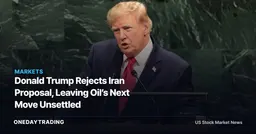
Donald Trump’s Rejection Keeps the Oil Risk Premium Alive
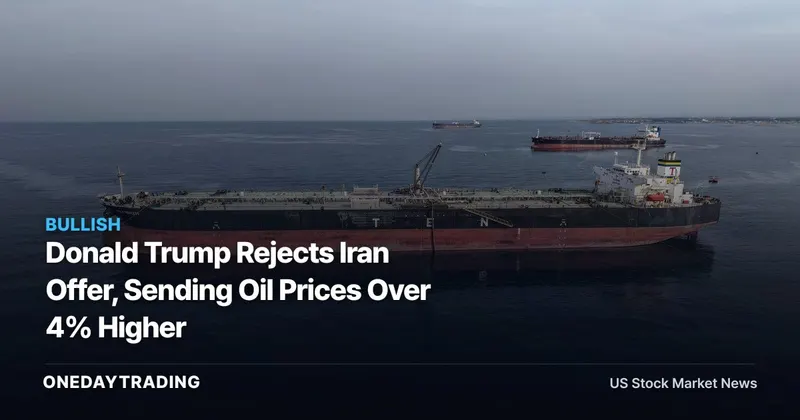
Oil prices rose over 4% on Monday after U.S. President Donald Trump rejected Iran’s conditional proposal to reopen the Strait of Hormuz and restart nuclear negotiations. For energy investors, the decisive point is not that negotiations produced no immediate agreement; it is that the proposal linked the shipping route directly to political and economic conditions that remain unresolved.
CNBC reported that Brent crude futures with November expiry traded 4% higher at $108.48 per barrel at 11:35 a.m. London time, or 6:35 a.m. ET. U.S. West Texas Intermediate futures with November expiry also rose 4% to $96.16. The parallel move across both contracts shows that the market response was not confined to a single benchmark.
The central thesis is straightforward: the oil market is assigning value to unresolved access through the Strait of Hormuz. The tape already reflects the rejection and the absence of an agreed reopening. It does not settle whether the route will reopen, whether nuclear negotiations will restart, or how the conflict will develop.
What Donald Trump Rejected
Iran’s proposal was a conditional offer to reopen the Strait of Hormuz and resume nuclear negotiations with Washington. Donald Trump confirmed the rejection to reporters, saying, “They made a proposal but I rejected it.” That confirmation moved the story beyond an account based solely on unnamed officials.
On Friday, Abbas Araghchi offered to reopen the shipping route and restart talks within seven days if the Trump administration accepted Tehran’s conditions. He said, “If certain conditions are met, the Strait of Hormuz will be open at the end of seven days, and talks will be restarted.” The wording matters because neither reopening nor renewed negotiations were unconditional commitments.
Esmaeil Baghaei described the conditions as an end to what Tehran calls U.S. acts of aggression, the lifting of the naval blockade and economic warfare, and the release of Iranian assets. The complete proposal and all of its terms are not available, limiting any assessment of how close the parties were to an agreement.
Why Brent and U.S. West Texas Intermediate Moved Together
CNBC said Brent crude futures with November expiry gained 4% on Monday, reaching $108.48 per barrel and their highest level since Sept. 15. The November-expiry U.S. West Texas Intermediate contract rose by the same percentage, although its quoted level was lower at $96.16.
The common signal is renewed concern about the conditions governing a key shipping route, not proof of a specific future supply outcome. Reopening the Strait formed part of Iran’s offer, so rejection left that proposed change unrealized. In a physical commodity market, uncertainty over route access can be reflected in futures prices before the eventual political or operational result is known.
That distinction separates the observed move from the unresolved scenario. The 4% increases are confirmed market prices for Monday’s November-expiry contracts. They are not evidence that the Strait will remain closed permanently, that negotiations cannot resume under different terms, or that oil prices must continue rising.
The Conflict Signals Behind Monday’s Oil Prices
The conflict began with U.S. and Israeli airstrikes on Iran on Feb. 28. Against that background, The Wall Street Journal reported on Saturday that Trump had rejected the conditional offer, citing unnamed U.S. officials. Those officials were not identified, and the precise date on which U.S. strikes might resume is unknown.
A separate security signal came from Yemen’s Saudi-led coalition, which said on Saturday that it had intercepted projectiles launched by Iran-backed Houthi rebels. This does not establish what will happen next in the U.S.-Iran conflict, though it adds another confirmed development to the security backdrop surrounding the oil move.
Cornelia Meyer, CEO of Meyer Resources, described the possibility of renewed U.S.-Iran hostilities as a “clear and present danger.” Speaking to CNBC, she also warned that countries were relying on inventories, saying, “I think everybody hopes that this is not the case because, you know, we are living off borrowed barrels. A lot of countries are living off their inventories.” Azhar Sukri contributed to CNBC’s report.
Market Impact Across the Two Oil Benchmarks
- Brent crude futures: The November-expiry contract traded 4% higher at $108.48 per barrel at the stated London and ET observation time. Its highest level since Sept. 15 indicates that Monday’s repricing also cleared the supplied recent reference point.
- U.S. West Texas Intermediate futures: The November-expiry contract advanced 4% to $96.16. Its matching percentage gain reinforces the interpretation that the event affected the broader crude complex represented by both benchmarks.
- Oil-sector exposure: Higher crude prices are directionally supportive for the commodity itself, which supports a bullish sector sentiment here. The fact sheet provides no company-level production, revenue, cost, or share-price data, so it cannot support conclusions about individual U.S.-listed stocks.
- Risk balance: Continued uncertainty over the Strait and negotiations could sustain a premium in oil futures. A reopening agreement or a restart of talks could weaken the premise behind that premium, although neither outcome is confirmed.
Investor Checkpoints After the Iran Proposal
- Strait status: Check for confirmed evidence that the Strait of Hormuz will reopen. The rejected proposal referred to action within seven days only if Iran’s conditions were met; it did not establish that reopening would occur.
- Negotiation status: Watch for a confirmed restart of nuclear negotiations between Iran and Washington. The offer tied talks to the same conditional framework as the shipping route.
- Contract pricing: Compare subsequent moves in November-expiry Brent crude futures and U.S. West Texas Intermediate futures. A shared move would provide a cleaner signal than a divergence isolated to one contract.
- Conflict developments: Look for attributed confirmation of any further hostilities rather than relying on an unspecified timetable. The exact timing of possible U.S. strikes is not known.
What Could Change the Oil Thesis
The bullish case for oil rests on unresolved route access, stalled negotiations and the possibility of renewed hostilities. Monday’s move shows that traders assigned those risks meaningful value: oil rose over 4%, with both supplied November-expiry benchmarks gaining 4%.
The counter-scenario is equally concrete. If Iran’s conditions become the basis for an agreement, the Strait could reopen and negotiations could restart, removing part of the uncertainty reflected in futures. The available facts do not establish that either side will accept such an arrangement.
The next useful signal is therefore not another political slogan or an unattributed forecast. It is confirmation of a change in the Strait’s status, the resumption of nuclear talks, or a new conflict development, followed by the response in Brent crude and U.S. West Texas Intermediate futures. Until one of those conditions changes, Monday’s prices measure the market’s risk assessment—not the conflict’s final outcome.
📊 Analysis
Signal Bullish
Why The rejection preserved uncertainty around the Strait of Hormuz and coincided with a sharp rise in Brent crude and U.S. West Texas Intermediate futures.
This article was independently written by OneDayTrading from public reporting. Read the original (CNBC)