Donald Trump’s Rejection Leaves Oil Between Diplomacy and Escalation
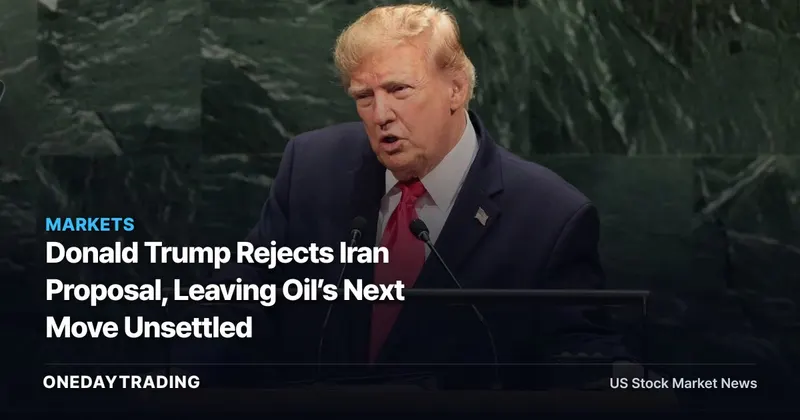
Donald Trump rejected Iran’s latest proposal on Saturday, leaving oil investors with neither a confirmed reopening of the Strait of Hormuz nor a settled path back to nuclear talks. The market signal is divided: crude prices fell during the week, while the diplomatic conditions and reported projectile interceptions kept the physical-security outlook unresolved.
CNBC reported on 2026-09-26 that West Texas Intermediate closed at $92.41 per barrel after dropping 2.3%, while Brent declined 2.1% to settle at $104.32. Those declines show what the tape already reflected at the close: some value had come out of crude even though the central political dispute remained open.
The harder question is what prices do not settle. Donald Trump confirmed the rejection by saying, “They made a proposal but I rejected it.” That decision removed Iran’s offered route to reopening the strait under its stated conditions, without establishing whether another proposal will emerge or whether those conditions could eventually be accepted.
Abbas Araghchi’s Seven-Day Offer and Tehran’s Conditions
Iran’s proposal was a conditional diplomatic framework, meaning that reopening the Strait of Hormuz and restarting nuclear talks depended on the Trump administration accepting Tehran’s terms. Abbas Araghchi proposed on Friday that the strait could reopen and talks with the U.S. could resume within seven days if those conditions were met.
Esmaeil Baghaei said this week that Iran’s conditions included a halt to U.S. acts of aggression, an end to the naval blockade and economic warfare, and the release of Iranian assets. The conditions matter because the proposed timetable was not an unconditional commitment: the seven-day period depended first on U.S. acceptance.
For investors, that distinction separates a negotiable path from an achieved outcome. No reopening has been confirmed, no resumption of nuclear talks has been confirmed, and the available facts do not establish that Iran’s conditions will be accepted. Treating the proposal as completed de-escalation would therefore run ahead of the evidence.
The Wall Street Journal Report Carries a Clear Verification Limit
The Wall Street Journal reported that Donald Trump privately expected renewed U.S. bombing of Iran after November’s midterm elections, citing unnamed U.S. officials. CNBC said it could not immediately confirm that report, and the identities of the officials were not disclosed.
That leaves two different levels of certainty. Trump’s rejection of the latest offer is confirmed by his public statement; his reported private expectation about a renewed bombing campaign is not independently confirmed by CNBC. The evidence also does not establish whether or when U.S. bombing will resume.
The distinction is important for positioning. A public rejection is an observable policy decision, while an anonymously sourced expectation is a reported possibility. Markets may react to both, though the latter should carry a wider uncertainty range because its timing and eventual outcome remain unknown.
Saudi-Led Interceptions Add a Separate Security Signal
CNBC reported that the Saudi-backed Coalition to Support Legitimacy in Yemen said it intercepted and destroyed two drones aimed toward Riyadh and two ballistic missiles aimed at the Khamis Mushait region. Colonel Turki Al-Maliki described the projectiles as “intercepted and destroyed.”
The report adds a second source of uncertainty alongside the U.S.-Iran dispute. It does not prove that the Strait of Hormuz will remain closed, that talks will fail, or that a wider campaign will follow. It does show that the diplomatic proposal arrived while the Saudi-backed coalition was reporting active projectile threats.
Independent confirmation of the interceptions and destruction was not available in the supplied evidence. That limitation should be applied once and directly: the coalition’s account is confirmed as a statement by the coalition, not as an independently verified account of the projectiles’ destruction.
What the WTI and Brent Tape Has Already Priced
CNBC said U.S. crude finished the week 7.9% lower, while Brent was flat for the week. Across a longer baseline, WTI remained up nearly 61% year to date and Brent crude was more than 71% higher over the same period.
The contrast between the weekly moves and the year-to-date advances frames the market tension. The weekly decline in U.S. crude shows near-term price pressure, while the larger year-to-date gains show that crude still carried a substantially different price level from the start of the year. The facts do not identify how much of either move came from diplomacy, restricted shipments, or another factor, so a precise causal allocation would be unsupported.
West Texas Intermediate and Brent also sent different weekly signals: U.S. crude declined 7.9% over the week, while Brent was flat. That divergence argues against reducing the story to a single directional verdict. Investors have a confirmed drop at the latest close and unresolved conditions around the strait, negotiations, and regional security.
Oil-Sector Transmission Without an Unsupported Stock Call
- Crude-price exposure: WTI and Brent are the clearest market instruments in the supplied facts. Their closing and settlement moves provide the direct measurement of the market response; no company-level revenue, production, cost, or guidance figures were provided.
- Energy-shipment conditions: A reopening of the Strait of Hormuz could change the operating backdrop for shipments, though the proposal remains conditional and the outcome is unknown. The evidence supports monitoring the decision, not assuming the reopening.
- Regional security: The reported drones and ballistic missiles add uncertainty around physical infrastructure and transport conditions. The supplied facts do not identify damage, disruption, or a measurable company-specific financial effect.
- Broader market interpretation: Oil-price changes can affect investor assessments of energy costs and inflation, though the fact sheet supplies no equity-index move, company result, or quantified inflation outcome. A stock-specific conclusion would therefore exceed the evidence.
Bull and Bear Cases for Crude
The higher-price case rests on unresolved constraints rather than a confirmed new disruption. Trump rejected the proposal, the strait has not been confirmed as reopened, and the Saudi-backed coalition reported intercepting projectiles. If the conditions remain unacceptable and security pressure persists, the uncertainty embedded in physical energy flows could remain relevant to crude pricing.
The lower-price case begins with the tape: WTI fell 2.3% at the close, Brent declined 2.1% at settlement, and U.S. crude lost 7.9% for the week. A future acceptance of conditions, reopening of the strait, or restart of nuclear talks could reinforce de-escalation expectations, though none of those outcomes is confirmed.
Neither scenario supports certainty. The bearish weekly move is observable, while the diplomatic and security outcomes that could determine its durability are still conditional or unverified.
Next Checkpoints for Oil Investors
- Iran’s conditions: Check whether the Trump administration accepts, rejects, or seeks changes to the terms described by Esmaeil Baghaei.
- Strait status: Look for confirmation that the Strait of Hormuz has reopened; the seven-day timetable proposed by Abbas Araghchi applies only if Iran’s conditions are met.
- Nuclear talks: Verify whether discussions with the U.S. formally restart rather than treating the proposal itself as a resumption.
- Security reports and crude prices: Compare further independently verified projectile reports with the next WTI close and Brent settlement. The live question is whether the latest declines persist while the underlying diplomatic conditions remain unresolved.
📊 Analysis
Signal Neutral
Why Crude prices declined during the week, while the rejected proposal and reported projectile interceptions leave supply conditions unresolved.
This article was independently written by OneDayTrading from public reporting. Read the original (CNBC)