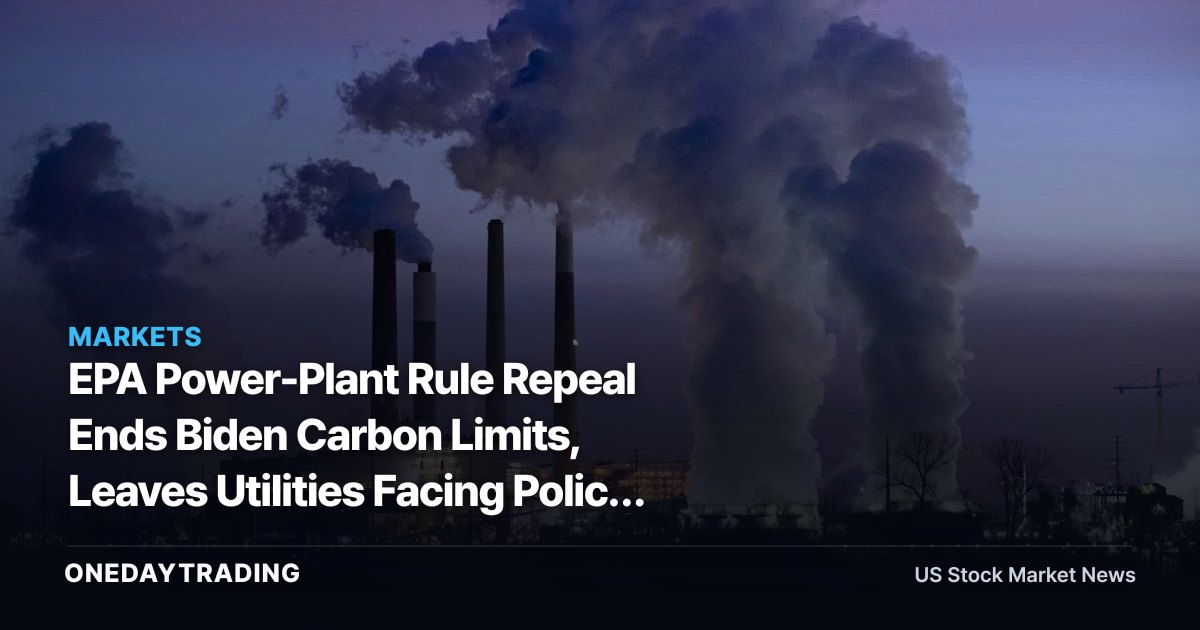
EPA Repeal Puts Utility Regulation Back Into Legal and Policy Flux
For U.S. utilities, the Environmental Protection Agency’s Sept. 14, 2026 repeal removes carbon-dioxide limits imposed by the Biden administration while opening a broader fight over whether federal power-plant greenhouse-gas rules can exist at all. The immediate investor issue is not a proven change in electricity prices or emissions; it is a shift in compliance obligations whose commercial value will depend on what the EPA ultimately finalizes and how future administrations can act.
The Biden framework required existing coal plants and new natural gas plants to control 90% of their carbon-dioxide emissions. The EPA has now proposed eliminating all remaining greenhouse-gas rules for the power-plant sector, arguing that the federal government lacks authority under the Clean Air Act to regulate those emissions on the basis of climate change.
That proposal remains subject to finalization. Until the broader action is finalized, utilities and power producers face a policy transition rather than a settled long-term rulebook. Capital planning, plant-retirement decisions and emissions-control investments therefore carry a regulatory variable that cannot be resolved from the announcement alone.
What the Policy Channel Changes
Repealing the Biden limits can reduce the federal compliance requirement attached to covered coal and gas generation. In mechanism terms, fewer mandated controls could alter the relative operating burden between fossil-fuel plants, but the supplied evidence does not quantify any company’s costs, power prices or dispatch changes.
The proposed action would also seek to prevent future administrations from regulating power-plant emissions to fight climate change, according to the EPA’s position. That would make the legal interpretation itself an important policy variable: the value of any regulatory relief depends on the proposal surviving finalization and remaining durable across administrations.
EPA Administrator Lee Zeldin framed the repeal as a way to reduce electricity prices for American families. That is an agency argument, not a measured outcome in the available evidence. No data supplied here establishes whether household bills will fall, remain unchanged or rise after the rule change.
By the Numbers: A 90% Requirement Repealed
The central quantified fact is the 90% carbon-dioxide control requirement for existing coal plants and new natural gas plants under the Biden administration. The figure describes the required level of control for those plant categories; it does not represent an achieved emissions reduction, a forecast, or a projected change after repeal.
The EPA’s action was reported on Sept. 14, 2026. The date for finalizing the broader proposed repeal is unknown, so the legal and operating consequences cannot be assigned a firm timetable. The EPA also revoked a finding in February that classified carbon dioxide as a threat to public health, another step affecting the regulatory basis described by the agency.
Utility Implications and Risk Checkpoints
- Potential relief for covered fossil generation: Removing the Biden requirement could lower the compliance burden for existing coal plants and new natural gas plants, but the evidence provides no plant-level cost estimates or utility exposure.
- Renewed policy uncertainty: The broader repeal is still a proposal. Its final text and legal durability are the next decisive checkpoints for utility capital plans and emissions strategies.
- Electricity-price claim unverified: Zeldin linked the repeal to lower prices, while the supplied evidence contains no measured price effect. Investors should separate that policy rationale from reported customer outcomes.
- Emissions outcome unknown: The available facts do not show how greenhouse-gas emissions will change. Any market thesis built on a specific emissions trajectory would exceed the evidence.
Bottom Line for Investors
The EPA’s repeal is a clear negative for the Biden-era compliance regime and potentially supportive of continued coal and natural-gas operation, but it is not yet a quantified earnings catalyst for utilities. The broader proposal must still be finalized, and the key observable tests are its final legal scope, the treatment of covered plants and subsequent evidence on electricity prices and greenhouse-gas emissions. Until those arrive, the policy direction is clear while the financial payoff remains unmeasured.
📊 Analysis
Signal Neutral
Why The repeal changes compliance requirements, but its effects on electricity prices, emissions and utility performance are not yet measured.
This article was independently written by OneDayTrading from public reporting. Read the original (CNBC)