Xi’s BRICS Appeal Meets the Physical Oil Market
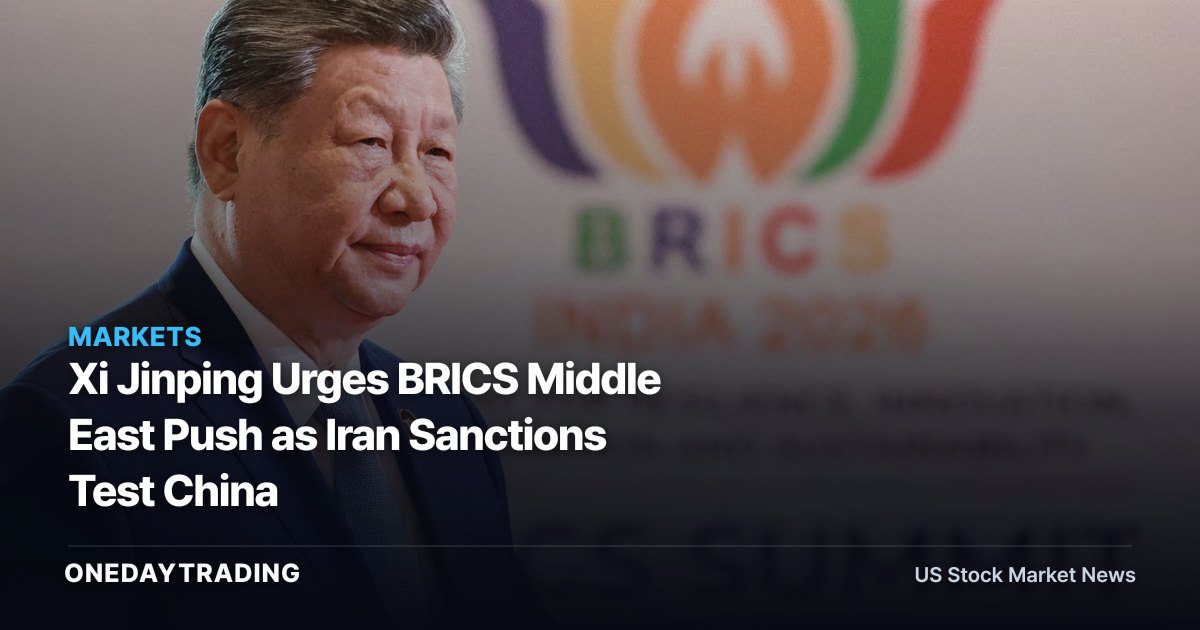
The investor relevance of Xi Jinping’s BRICS speech lies less in the diplomatic language than in the connection between China, Iranian energy exports and U.S. sanctions. According to CNBC, Xi called for a political solution, a permanent and comprehensive ceasefire, and greater attention to the conflict’s root causes. China also said it was willing to work with other BRICS members toward peace in the Middle East and Gulf region.
BRICS is a grouping established in 2009 as a counterweight to Western dominance, according to CNBC. Its original members were Brazil, Russia, India, China and South Africa; the bloc later expanded to include Egypt, Ethiopia, Indonesia, Iran and the United Arab Emirates. That membership gives Xi’s proposal political breadth, but CNBC reported no negotiated agreement, ceasefire commitment or implementation mechanism arising from the speech.
On the facts reported by CNBC, the commodity-market signal is therefore conditional. A political resolution could reduce conflict-related pressure surrounding energy trade, while continued conflict or tighter enforcement of financial restrictions could preserve uncertainty around Iranian exports and Chinese purchases. The report supplies no amount for trade, oil purchases, sanctions exposure or energy-price changes, so it does not support a quantified price forecast.
China-Iran Trade Is the Main Transmission Channel
China’s role matters because it is Iran’s biggest trading partner and a key buyer of Tehran’s energy exports, according to CNBC. That relationship links diplomacy to the physical economy: any change in China’s purchases would affect a commercial channel directly identified in the report. CNBC did not provide volumes, values or purchasing schedules, preventing a company-level revenue or margin estimate.
Economists cited by CNBC said China’s earlier stockpiling and subsequent pullback in oil purchases helped keep energy prices from rising even further. For investors, that account makes Chinese purchasing behavior a critical variable, but it does not establish the size or duration of the effect. It also leaves open how inventories, future purchases and sanctions enforcement might interact.
The distinction is important. Xi announced a willingness to play a diplomatic role; he did not announce a change in energy purchases, sanctions policy or trade arrangements. On CNBC’s evidence, treating the speech itself as a confirmed supply change would get ahead of the facts.
Sanctions Put Diplomacy and Commerce on the Same Calendar
The Trump administration imposed a new wave of economic sanctions on Iran last month, CNBC reported. The Treasury Department named the measures Operation Economic Outcast and said they aim to sever Iran’s financial connections around the world. Scott Bessent suggested at the operation’s launch that China would not be exempt.
According to CNBC’s reporting, this creates the clearest counterweight to Xi’s peace initiative. China’s importance to Iranian trade makes the scope of U.S. enforcement material to the commercial relationship, while Xi’s BRICS remarks establish China’s stated diplomatic position. The source does not report an exemption, settlement or change in the sanctions campaign.
Donald Trump is scheduled to host Xi at the White House later this month, according to CNBC. That meeting is the next identified event at which the overlap among Middle East diplomacy, Iran sanctions and China’s economic ties could receive greater definition. CNBC did not provide the meeting’s exact date or confirm that these subjects will produce an agreement.
By the Numbers: A Sparse Record Limits the Market Call
BRICS was established in the year 2009 as a counterweight to Western dominance, CNBC reported. The bloc’s subsequent expansion brought Iran and the United Arab Emirates into the same grouping as China, Brazil, Russia, India, South Africa, Egypt, Ethiopia and Indonesia.
Xi stressed a solution involving 2 states for Israel and the Palestinian question, which he described as central to the Middle East issue, according to CNBC. Those are the only concrete figures supplied. CNBC reported no quantitative amount for Iranian energy exports, Chinese oil purchases, sanctions, trade flows or energy-price changes, leaving no defensible basis for calculating earnings sensitivity or a commodity-price target.
Winners & Losers
- Potential energy-market beneficiaries: On CNBC’s facts, a permanent and comprehensive ceasefire could ease conflict-related uncertainty around the Middle East and Gulf region. That remains a conditional interpretation because no ceasefire or supply outcome was reported.
- Iranian energy-export channels: China’s position as Iran’s biggest trading partner and a key customer of Tehran’s energy exports makes this relationship directly exposed to Operation Economic Outcast, according to CNBC. The report does not quantify the exposure or identify affected listed companies.
- Oil-price upside: CNBC reported that China’s stockpiling and later pullback in purchases helped prevent energy prices from rising even further. Continued restraint in purchases could therefore limit additional price pressure, although the report provides neither purchase volumes nor a measured price effect.
- BRICS diplomacy: Xi’s proposal could give the expanded bloc a role in pursuing a political solution, based on CNBC’s account. It is not yet an investable outcome because the report identifies no agreement, timetable or enforcement mechanism.
Risk Check
- Speech-versus-action risk: Xi expressed willingness to work with BRICS, but CNBC reported no completed peace initiative, ceasefire or alteration to physical energy flows.
- Sanctions risk: Operation Economic Outcast seeks to cut Iran’s financial connections, and Scott Bessent indicated that China would not be exempt, according to CNBC.
- Measurement risk: Without trade values, oil volumes, sanctions amounts or energy-price changes, directional conclusions cannot be converted into estimates for commodities or listed equities.
- Diplomatic risk: The White House meeting later this month is scheduled, but its exact date and any resulting policy decisions are not provided in CNBC’s report.
Bottom Line
Xi Jinping’s BRICS appeal introduces a possible diplomatic path toward a political settlement, but CNBC’s reporting does not establish that the path has changed sanctions, trade or oil supply. The constructive scenario is progress toward the permanent and comprehensive ceasefire Xi advocated; the opposing scenario is continued conflict alongside broader enforcement of Operation Economic Outcast against Iran’s financial connections, including its dealings with China. For investors, the next concrete checkpoint is Trump’s planned White House meeting with Xi later this month: the relevant evidence would be any stated change in sanctions treatment, Chinese energy purchases or a defined BRICS peace process, none of which has yet been reported.
📊 Analysis
Signal Neutral
Why Xi’s diplomatic proposal offers no confirmed market outcome, while China’s Iran ties and the U.S. sanctions campaign create opposing energy-market risks.
This article was independently written by OneDayTrading from public reporting. Read the original (CNBC)