What Changes
The tape moved before the microphones in New Delhi did. Crude cleared the $100-a-barrel level on Thursday for the first time since May, and by Friday that move had already reached the pump: U.S. diesel hit $6 a gallon, also a first, per CNBC. Diesel is the input cost that shows up fastest in freight, agriculture and industrial activity, so a print like that reads as a real-economy tax before it reads as a market headline.
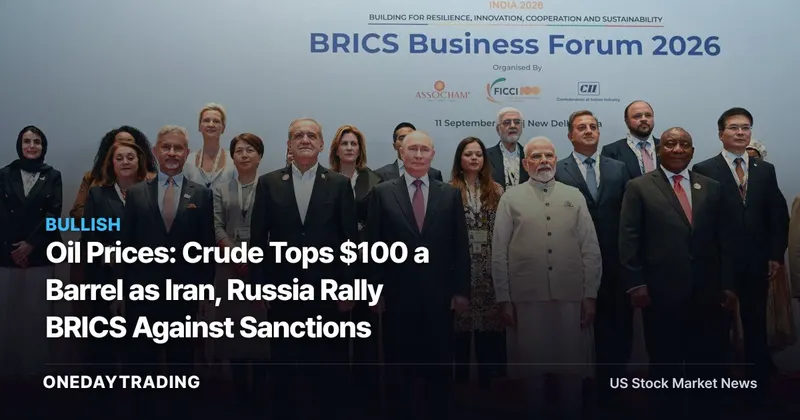
Pezeshkian used his remarks to frame the moment as an escalation, not a plateau — telling the forum that pressure on Iran has entered a "dangerous phase," shifting from sanctions to what he described as military aggression by the U.S. and Israel. Iran is a major energy producer, and traders typically attach a geopolitical risk premium to crude when a producer of that size describes itself as under direct military pressure. CNBC's reporting doesn't quantify how much of the move to $100 is attributable to that dynamic specifically, so that link is a mechanism to watch, not a measured cause.
Putin's contribution was less about the war and more about the wallet: 30,000-plus sanctions on Russia, by his count, more than every other sanctioned country combined — a number he used to argue the West is protecting a "competitive edge" it's losing on fundamentals, not gaining one on trade. Whether that argument moves capital toward BRICS members or simply hardens the standoff is the open question the forum didn't answer.
By the Numbers
Two prices anchor this story: crude oil futures above $100 a barrel Thursday — a level last touched in May — and U.S. diesel at $6 a gallon Friday, a first-ever print per CNBC. Both are levels, not percentage moves, so the size of the jump that got them there isn't in the reporting; treat the direction as confirmed and the magnitude of the increase as unstated.
On the sanctions side, Putin cited more than 30,000 sanctions on Russia — roughly double the count against every other country combined, in his telling — and argued BRICS economies produced over 40% of global incremental GDP in the last five years against 29% for the G7. Those are Putin's framing numbers, offered to justify deeper BRICS trade integration, not independently verified growth-accounting figures.
Winners & Losers
- U.S. oil producers (XOM, CVX): a benchmark above $100 a barrel lifts realized prices on every barrel sold, the direct mechanical benefit for integrated majors when crude re-rates higher.
- Diesel-intensive sectors broadly: a $6-a-gallon print raises input costs for freight, farming and industrial operators that can't quickly pass the increase through, the mirror image of the producer benefit above.
- Russia's trade posture: Putin's pitch for deeper BRICS integration is an attempt to route around Western sanctions exposure, though the forum itself didn't produce a concrete mechanism beyond rhetoric.
Risk Check
- CNBC's reporting doesn't specify how much global energy prices have risen beyond the two data points cited, so the broader inflation read-through is incomplete.
- Moscow resumed air attacks on major Ukrainian cities after pausing during a visit from U.S. peace negotiators, an escalation that sits awkwardly next to Trump's Wednesday comment that a swift resolution could restore trade ties — the two signals point in opposite directions.
- The outcome or even the current status of U.S.-Russia peace negotiations isn't established in the reporting, which limits how much confidence to place in the trade-normalization scenario.
- Putin's sanctions and GDP-share figures are his own framing at a forum designed to build BRICS solidarity, not independently audited statistics.
Bottom Line
The immediate, verifiable move is in the price of crude and diesel, not in the geopolitics: $100-plus oil and $6 diesel are firsts that matter on their own, regardless of how the BRICS rhetoric plays out. The upside case is straightforward for producers riding a higher benchmark; the risk case is that elevated fuel costs squeeze the same freight and industrial names that don't get a pricing offset, while the Ukraine track — a pause, a resumption of strikes, and a presidential comment about swift resolution, all within days of each other — shows how quickly the backdrop can reverse in either direction.
FAQ
Why did U.S. diesel prices hit $6 a gallon?
CNBC reported the $6-a-gallon print on Friday as a first-time level, arriving the same week U.S. crude oil futures topped $100 a barrel for the first time since May. The reporting ties the two prices together in timing but does not quantify a specific cause for the size of the increase.
What is the BRICS Business Forum and who spoke there?
It's a forum held in New Delhi where, on Friday, Iranian President Masoud Pezeshkian and Russian President Vladimir Putin addressed attendees, both criticizing Western sanctions and calling for the bloc to deepen trade ties. Pezeshkian said food and energy security are "two fundamental pillars of economic security," while Putin argued BRICS has outgrown the G7 as a growth engine.
How many sanctions has Russia faced, according to Putin?
Putin told the forum that more than 30,000 sanctions have been imposed on Russia, which he said is twice as many as those against all other countries in the world combined. That figure was presented as part of his argument that Western sanctions policy reflects the sanctioning countries' own "industrial decline and budget deficit" rather than Russia's isolation.
📊 Analysis
Signal Bullish
Why Crude clearing $100 a barrel and diesel reaching $6 a gallon improve the price realization backdrop for U.S. oil producers, even as the same move raises costs elsewhere in the economy.
This article was independently written by OneDayTrading from public reporting. Read the original (CNBC)