Key Takeaways
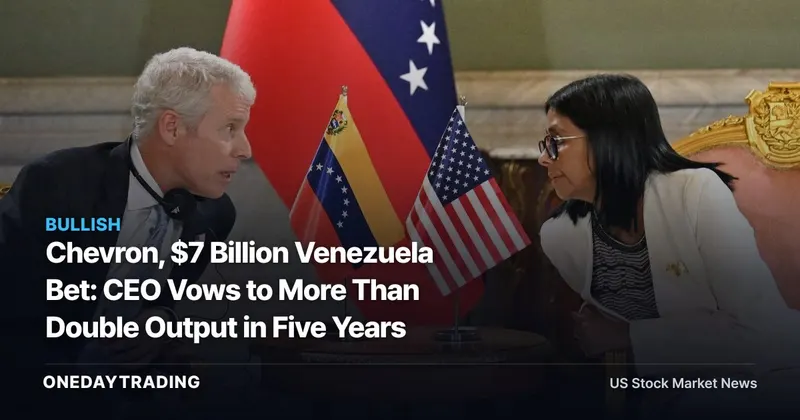
Chevron CEO Mike Wirth announced plans to more than double the company's Venezuela oil production over the next five years, backed by roughly $7 billion across three projects, according to CNBC. Separately, the U.S. government is taking a stake in North American Blue Energy Partners (NABEP), a private operator run by Alejandro Betancourt, alongside Italy's ENI and private firm Aspect Energy, in a bid to lift Venezuela's output back toward 2 million barrels a day.
What Happened
CNBC was among a handful of news organizations permitted to travel to Caracas with U.S. Secretary of Energy Chris Wright to cover the signing of oil deals last week between Venezuela's government and a mix of Venezuelan and Western oil companies, per the outlet's reporting. Chevron's arrangement is distinct from the rest: the company, which has operated in Venezuela for more than 100 years, is expanding its own production under a roughly $7 billion commitment spread across three projects, with Wirth announcing plans to more than double output there over five years.
The other agreements center on the U.S. government acquiring a stake in NABEP, which it will trade for future oil production, CNBC reported. ENI and Aspect Energy are named alongside NABEP as investors in the new production push. Wright told CNBC he is confident Venezuela's output can scale up by "a couple hundred thousand" barrels per day, and that between that increment and Chevron's investment, there is what the outlet called cautious optimism the country could reach 2 million barrels a day relatively soon. Betancourt was investigated for potential financial crimes in Switzerland but was not charged, CNBC noted.
Background & Context
The capital-cycle case for these deals rests on how far Venezuela has fallen. Production peaked near 3.5 million barrels per day in 1997, then collapsed to under 1 million barrels per day through much of 2025 under the Chavez and Maduro governments, per CNBC. Output has only recently climbed back above 1 million barrels per day, meaning the 2-million-barrel target represents roughly a doubling from a base that itself only just stabilized. CNBC's trip was tightly constrained — the visit ran barely 24 hours, and Simón Bolívar International Airport was still limited by a June earthquake at the time.
Market & Stock Impact
- Chevron (CVX): Directly named with a dollar figure — roughly $7 billion committed across three Venezuela projects — and a specific management target (more than double output in five years). That is new capital deployed into a country with a documented history of output collapse, which is the core variable for how the market should size this bet.
- ENI (E): Named alongside NABEP and Aspect Energy as an investor in the new Venezuela production push, giving it direct exposure to whether the roughly 1-million-barrel-per-day base can scale without the private-operator and political risk CNBC flagged around NABEP's Betancourt derailing execution.
- Broader oil complex: CNBC's reporting places the Venezuela deals inside a tape where U.S. oil is trading above $100 a barrel and diesel has hit $6 a gallon for the first time — a backdrop that raises the strategic value of any incremental non-OPEC, non-Russian supply, including a Venezuela recovery.
Investor Checkpoints
- Whether Chevron's roughly $7 billion actually converts into barrels: watch for updates on the pace of spending across the three named projects as Wirth's five-year doubling target moves from announcement to execution.
- Whether Venezuela's output — only recently back above 1 million barrels per day after collapsing under 1 million for much of 2025 — shows a sustained climb toward the 2-million-barrel level Wright described as achievable "relatively soon."
- The structure of the U.S. stake in NABEP: CNBC did not report the financial terms, and how that equity converts into future oil production is a mechanism investors should watch for as details emerge.
- The U.S. Federal Reserve's meeting on September 16, given Fedwatch Advisors' Ben Emons noted the spot-oil-to-bond-yield correlation has risen to 0.75 — higher than during the financial crisis — which ties Venezuela-driven supply outcomes to the broader cost of capital for energy investment.
Outlook
The bull case is straightforward: Barclays, per CNBC, called the global energy sector outlook "the most attractive it has been for two decades," and a Venezuela recovery toward 2 million barrels per day would add supply into a market where diesel just hit $6 a gallon and Brent forecasts from JPMorgan ($87 next year), UBS ($95 this year, $90 by March), and Bank of America ($85 this year, $75 next year, $70 by 2028) all still sit above where crude traded for most of the past decade. Chevron's century-plus operating history in the country is a real asset if the political and logistical environment holds.
The risk side is just as concrete. Venezuela's own production history — a fall from 3.5 million barrels per day to under 1 million within a generation — is the base rate against which any new target should be measured, and CNBC's own sourcing flagged Betancourt's Swiss financial-crimes investigation as a governance overhang even absent charges. Kaneva's view that the futures curve is "$6 too high up front and $10 too low at the back," also cited by CNBC, suggests the market itself is unsettled on how durable current pricing is — the same pricing that makes the Venezuela bet economically attractive in the first place.
FAQ
What did Chevron agree to do in Venezuela?
Per CNBC, Chevron CEO Mike Wirth announced plans to more than double the company's oil production in Venezuela over the next five years, backed by roughly $7 billion invested across three separate projects. This is described as a separate deal from the other Venezuela agreements involving the U.S. government.
Who is NABEP and why is the U.S. government investing in it?
NABEP, or North American Blue Energy Partners, is a private oil operating company run by Alejandro Betancourt, according to CNBC. The U.S. government is taking a stake in NABEP that it will trade for future oil production, alongside co-investment from ENI and Aspect Energy; CNBC noted Betancourt was investigated for potential financial crimes in Switzerland but was not charged.
How much oil does Venezuela produce now compared with its historical peak?
Venezuela's oil production peaked at about 3.5 million barrels per day in 1997, per CNBC, before collapsing to under 1 million barrels per day for much of 2025 under the Chavez and Maduro governments. Output has only recently returned above 1 million barrels per day, and U.S. Secretary of Energy Chris Wright told CNBC he believes the country could reach 2 million barrels per day relatively soon.
📊 Analysis
Signal Bullish
Why Chevron's $7 billion, three-project expansion plan and the broader U.S.-brokered Venezuela deals signal fresh capital deployment and production upside, tempered by Venezuela's history of output collapse and unresolved deal terms.
This article was independently written by OneDayTrading from public reporting. Read the original (CNBC)