Key Takeaways
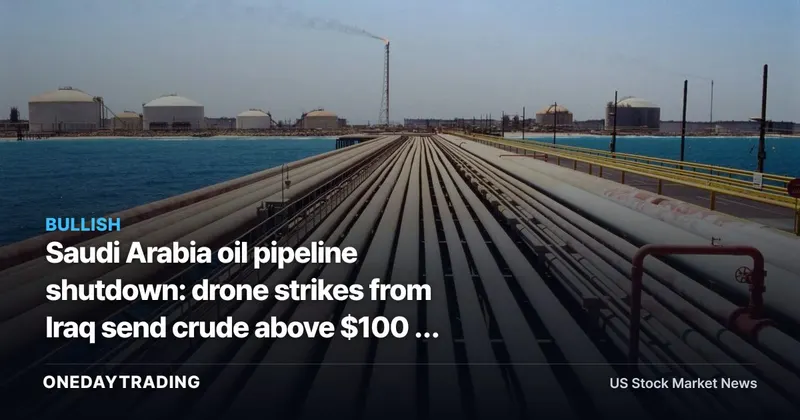
Saudi Arabia shut down its East-West crude pipeline as a precaution after drone attacks launched from Iraq hit the line in the Riyadh and Medina regions on Thursday, causing fires and damage and injuring several people, according to the Saudi government. The line normally carries up to 7 million barrels per day to export terminals on the Red Sea. Oil prices broke above $100 a barrel this week for the first time in months and closed more than 8% higher, and the more useful investor question is not that the price moved, but what kind of capacity just went offline and why Riyadh chose not to hit back yet.
What Happened
Saudi Arabia said Friday it had shut down the East-West pipeline as a precautionary measure following multiple drone attacks launched from Iraqi territory. The drones struck the pipeline route in the Riyadh and Medina regions Thursday morning, starting fires and causing damage, with several people injured, the Saudi government said. Emergency teams were deployed afterward to secure the pipeline and assess its safety, according to the Saudi Energy Ministry, which said only that "any further developments will be announced in due course."
Riyadh has opted against retaliating for now. The Saudi Foreign Ministry said the kingdom is giving the Iraqi government time to take measures preventing further attacks from its own territory. That is a meaningful capital-allocation signal in itself: a government that believed its core export infrastructure was existentially threatened would not typically choose patience over a visible response. The identity of the specific group or groups that launched the drones from Iraq has not been disclosed, and the extent of the pipeline damage and the timeline for restoring flow are both unstated.
The shutdown lands on top of a separate, larger wave of attacks. Houthi militants in Yemen, described by the reporting as Iran-allied, launched strikes on Saudi Arabia earlier in the week that hit energy facilities and other civilian assets, injuring more than 70 people, the Saudi government said.
Background & Context
The East-West pipeline is not incidental infrastructure — it is the kingdom's overland hedge against exactly this kind of disruption. Saudi Aramco Chief Executive Amin Nasser said last month that the pipeline has done more to mitigate oil supply disruption tied to the Iran war than the release of emergency crude reserves has. That framing matters now: the line that Aramco's own CEO credited as the more effective shock absorber is the one now offline, even if only as a precaution rather than a confirmed rupture.
The attacks also sit inside a wider effort to squeeze Saudi export routes on multiple fronts. The Houthis declared a maritime embargo against Saudi Arabia in July and have separately sought to disrupt the kingdom's oil exports through the Bab el-Mandeb Strait, which connects the southern Red Sea to global markets — the same body of water the East-West pipeline feeds into via its Red Sea terminals. Layered on top of that is the broader contest between the U.S. and Iran for control over the Strait of Hormuz, the kingdom's other major export gateway on the Persian Gulf side.
Market & Stock Impact
- Oil majors with unhedged production (e.g., XOM, CVX): a sustained move above $100 a barrel lifts realized prices on production not locked into forward contracts, but the benefit is a function of duration — a short-lived risk premium that unwinds once the pipeline restarts adds little to full-year earnings power.
- Crude price levels broadly: prices closing the week more than 8% higher and above $100 a barrel for the first time in months reflects a market pricing in the possibility that a redundant export route — not the primary Gulf route through the Strait of Hormuz — is now constrained, on top of an already-elevated risk backdrop from the Iran-related conflict.
Investor Checkpoints
- Watch for the Saudi Energy Ministry's promised follow-up statement on "further developments," which should clarify pipeline damage and any restart timeline — neither has been disclosed yet.
- Track whether Iraq's government takes visible action to curb attacks launching from its territory; Riyadh has explicitly tied its restraint from retaliation to that outcome.
- Monitor whether Houthi strikes on Saudi energy and civilian targets continue or escalate beyond this week's reported activity, since that campaign is running in parallel to the pipeline attack.
- Watch whether crude holds above the $100-a-barrel level or gives back this week's more-than-8% gain, as a quick reversal would suggest the market judged the pipeline shutdown as precautionary noise rather than a lasting supply constraint.
Outlook
The bull case for continued price support rests on the East-West pipeline being Aramco's preferred tool for absorbing supply shocks, per Nasser's own comment last month — taking it offline, even briefly and by precaution, removes a buffer at a moment when Houthi attacks and the U.S.-Iran contest over the Strait of Hormuz are already layering risk onto Saudi export capacity from multiple directions. The counterweight is that Saudi Arabia has not confirmed the pipeline was destroyed or that flow is stopped for an extended period — this is explicitly a precautionary shutdown, damage extent is undisclosed, and Riyadh's choice to withhold retaliation suggests officials do not yet see the threat as severe enough to demand an immediate military response. Whether this week's price move holds or fades will likely track the two things officials have not yet said: how much of the pipeline is actually damaged, and how long it stays shut.
FAQ
Why did Saudi Arabia shut down the East-West pipeline?
Saudi Arabia shut the pipeline as a precautionary measure after multiple drone attacks launched from Iraq struck the line in the Riyadh and Medina regions on Thursday, causing fires, damage, and injuries. Emergency teams were sent to secure the pipeline and assess its safety before any resumption.
How much oil capacity does the East-West pipeline carry?
The pipeline has a capacity of up to 7 million barrels per day and runs across Saudi Arabia to export terminals on the Red Sea. Aramco's CEO said last month it plays a bigger role in cushioning oil supply disruption from the Iran war than releasing emergency crude reserves does.
Why did oil prices rise more than 8% this week?
Oil prices broke above $100 a barrel this week for the first time in months and closed more than 8% higher amid escalating Middle East attacks, including Houthi strikes on Saudi energy facilities that injured more than 70 people and the drone attack on the East-West pipeline. The exact contribution of the pipeline shutdown versus the broader attack pattern to the price move has not been quantified.
📊 Analysis
Signal Bullish
Why A precautionary shutdown of a major Saudi export pipeline amid escalating regional attacks tightens perceived supply and has coincided with oil prices breaking above $100 a barrel, more than 8% higher on the week.
This article was independently written by OneDayTrading from public reporting. Read the original (CNBC)