What Changes
The headline out of New Delhi is diplomatic, but the transmission mechanism into markets is physical: a shipping lane. Pezeshkian's declaration that "Iran has successfully stood against Israel and the U.S." and that Tehran "will not yield in front of bullying arrogance" signals no near-term de-escalation from the Iranian side, per CNBC's account of his remarks to a gathering of Indian religious leaders in New Delhi. That matters for energy markets because the Strait of Hormuz has functioned as a bottleneck since the war began Feb. 28, with oil and cargo shipments reduced to a trickle, CNBC reported.
Modi's response, appealing for "dialogue and diplomacy" while flagging seafarer safety and freedom of navigation and commerce, is the posture of an economy that cannot control the chokepoint but is fully exposed to it. India's position here is capital-cycle logic in miniature: the country does not set the supply of transit capacity through Hormuz, it only consumes it, and that capacity is currently constrained. When a war restricts a shipping lane rather than physical oil production itself, the shortage shows up first in freight risk and insurance, and only later in reported price data.
Trump's Thursday remarks, that Iran "would have wiped out Israel and the Middle East" and started hitting U.S. cities absent American military action, and that "if I had it to do again, I would do exactly what I did," reinforce that Washington is not signaling a near-term reversal either. An unyielding Tehran paired with an unapologetic Washington is what keeps a risk premium embedded in crude rather than fading, per CNBC's account of both leaders' public statements this week.
By the Numbers
CNBC reports that global crude oil prices have surged this month amid the escalation of U.S.-Iran fighting, though the source does not specify the magnitude of that move. The more measurable exposure sits on the India side of the ledger: the country imports nearly 85% of its fuel needs and relies on the energy supply chain running through the Strait of Hormuz, per CNBC. In July, two vessels carrying a combined 30 Indian seafarers were attacked while transiting the strait, and the Indian government has said 10 seafarers have died as a result of the Middle East conflict, CNBC reported.
Those figures matter for how the disruption gets priced. An 85% import-dependency ratio means India's energy bill is a direct function of both the benchmark crude price and the freight and insurance premium layered on top of it by a contested chokepoint, and the seafarer casualty count is the kind of leading indicator that shippers and insurers react to well before benchmark price data catches up.
Winners & Losers
- Winners: Oil producers positioned to sell into a higher global crude price stand to capture margin from the supply-disruption premium CNBC describes, without themselves carrying Strait of Hormuz transit risk.
- Losers: India, as a net energy importer covering nearly 85% of its fuel needs through the Hormuz supply chain, absorbs both the higher crude price and the freight and insurance premium tied to a contested chokepoint.
- Losers: Shipping crews and operators transiting the strait carry the direct physical risk; CNBC's reporting of the July attack on two vessels and 30 seafarers, and the Indian government's count of 10 seafarer deaths, is the cost side of that exposure.
Risk Check
- CNBC does not specify the magnitude of the crude price increase this month, so the size of the margin benefit to producers and the added cost to importers like India cannot be quantified from this reporting.
- The current status and any end date for the U.S.-Israel-Iran war are not established in this reporting, and an unresolved conflict extends the transit-risk premium on an open-ended timeline rather than a fixed one.
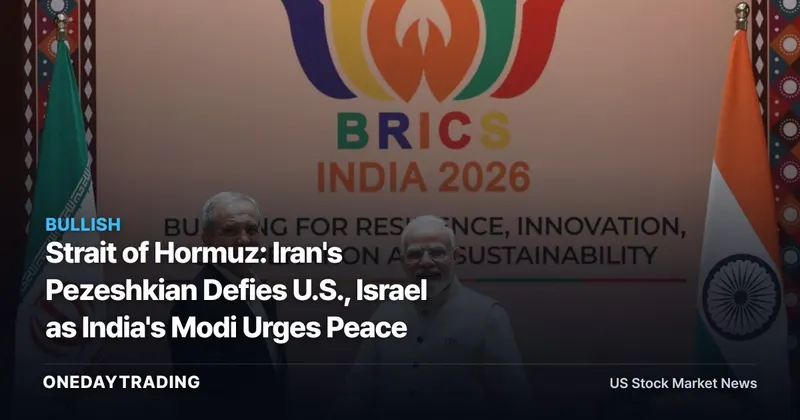
- Diplomatic gestures, such as Modi and Pezeshkian's photographed handshake exiting the BRICS Business Forum and the Iranian embassy's statement on "historic friendship," do not by themselves change the physical throughput of the Strait of Hormuz.
- No outcomes or agreements from the BRICS Summit in India this weekend are confirmed in this reporting, leaving open whether the gathering produces any statement on the conflict or on shipping-lane safety.
Bottom Line
The mechanism here is straightforward and already visible: a war that constrains the Strait of Hormuz raises the cost of everything that has to move through it, and India, at nearly 85% import dependency, sits at the sharp end of that cost curve, per CNBC. The counterweight is that none of this is new information landing overnight; the strait has been constrained since Feb. 28, and Friday's exchange between Pezeshkian and Modi is a diplomatic data point layered on a supply situation markets have been adjusting to for months. Whether the risk premium in crude expands or fades from here depends on developments this reporting does not yet resolve, chiefly whether the underlying conflict itself de-escalates.
FAQ
Why does the Strait of Hormuz matter for oil prices?
The Strait of Hormuz is the shipping lane between Iran and Oman through which oil and cargo shipments transit, and CNBC reports that flows through it have slowed to a trickle since the U.S. and Israel began their war on Iran on Feb. 28. When transit through a chokepoint like this is constrained, the reduced and riskier throughput contributes to the kind of crude price increase CNBC reports has occurred this month.
How exposed is India to the Strait of Hormuz disruption?
India imports nearly 85% of its fuel needs and relies on the energy supply chain that runs through the Strait of Hormuz, according to CNBC. That dependency is why Prime Minister Modi raised seafarer safety and freedom of navigation directly with Pezeshkian, and why the Indian government has reported 10 seafarer deaths tied to the Middle East conflict.
What did Pezeshkian and Modi actually agree on?
CNBC's reporting does not describe a specific agreement; it describes Pezeshkian stating that Iran will not surrender to the U.S. and Israel, and Modi urging "dialogue and diplomacy" while raising seafarer-safety and navigation concerns during their Friday meeting. The two leaders were photographed holding hands while exiting the BRICS Business Forum, and the Iranian embassy in India characterized the meeting as reflecting a "historic friendship," per CNBC.
📊 Analysis
Signal Bullish
Why Escalating U.S.-Iran conflict and Strait of Hormuz shipping disruption have driven a surge in global crude oil prices, a tailwind for oil producers even as it raises costs for import-dependent economies like India.
This article was independently written by OneDayTrading from public reporting. Read the original (CNBC)