At a Glance
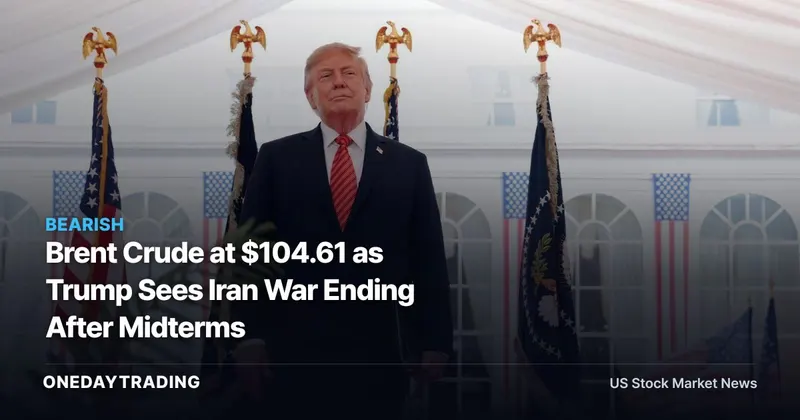
Oil investors are balancing President Donald Trump’s prediction that the Iran war will likely end soon after November’s mid-term elections against fresh evidence of physical supply and shipping risk. CNBC reported that Brent crude futures settled down 2.8% at $104.61 a barrel on Friday, while U.S. West Texas Intermediate settled down 2.4% at $100.05 per barrel.
Trump said Saturday, “I think very soon, I think it’ll be right after the mid-terms, actually,” and added that oil would “come tumbling down” after the conflict ends. CNBC’s reporting leaves the war’s actual end date, the future direction of oil prices and the outcome of diplomacy unresolved.
Why It Matters Now for Oil Markets
Friday’s retreat did not erase the week’s shock. CNBC reported that Brent crude had reached around $108 a barrel on Thursday, while WTI rose above $104 per barrel. Prices also moved above $100 a barrel during the week, creating a market that is pricing immediate disruption while simultaneously considering a political path toward lower risk.
That tension matters for oil equities because the same barrel can carry two opposing signals. If the conflict ends and transport routes normalize, a lower crude price would reduce upstream revenue and cash-flow assumptions for producers. If attacks continue around export infrastructure or maritime chokepoints, the risk premium could remain embedded in prices even while diplomatic headlines improve. CNBC’s account supports both possibilities and confirms neither outcome.
Iranian state media said Tehran would meet Gulf states in Oman to discuss the Strait of Hormuz. MS NOW reported that Iranian and Gulf officials would meet in Muscat on Monday to sign an agreement establishing an Iran-Oman shipping route through the strait. CNBC also reported that Iranian President Masoud Pezeshkian said Iran would not surrender and had resisted aggression from the U.S. and Israel, underscoring the gap between negotiations and a verified settlement.
Infrastructure Risk Extends Beyond Hormuz
Saudi Arabia said Friday that it shut the East-West crude oil pipeline as a precaution after multiple drone attacks launched from Iraq. The drones targeted the pipeline in the Riyadh and Medina regions on Thursday morning, causing fires and some damage, while several people were injured, according to CNBC’s report. Trump said Iran was likely responsible, but whether Iran caused the attacks remains unknown.
The East-West pipeline has a capacity of 7 million barrels per day and runs across Saudi Arabia to Red Sea export terminals. CNBC describes it as a way for Saudi Arabia to shift crude exports away from the Persian Gulf while the U.S. and Iran battle for control over the Strait of Hormuz. For energy investors, the mechanism is direct: a precautionary shutdown does not establish a lasting outage, but damage to a major alternative route can keep supply fears elevated even when futures prices fall for a session.
The Saudi Energy Ministry said emergency teams were deployed to secure the pipeline and assess its safety. Trump said he spoke with Saudi Crown Prince Mohammed bin Salman after the attack. The identities of the injured people and the pipeline’s eventual operating status were not established in the supplied reporting.
Key Debates
- Can diplomacy lower the risk premium? The reported Monday Muscat meeting could signal an effort to establish an Iran-Oman shipping route through the Strait of Hormuz, but CNBC says the outcome is unknown.
- Is the political timetable reliable? Trump linked a likely end to the war to the period after November’s mid-term elections. CNBC did not confirm an end date, so the statement is a forecast rather than a completed event.
- Are infrastructure threats contained? Saudi Arabia described the East-West pipeline shutdown as precautionary after drone attacks. The source confirms fires, damage and injuries but does not determine whether exports were permanently reduced.
- Could a second chokepoint worsen the risk? Several news agencies reported that Yemen’s Iran-backed Houthi rebels advanced to Perim Island on Friday and seized Mokha one day earlier. CNBC could not independently confirm the Perim Island report.
Related Stocks & Sectors
- Exxon Mobil (XOM): As an integrated oil company, XOM is directly exposed to crude-price conditions. CNBC’s reported Brent settlement at $104.61 a barrel and WTI settlement at $100.05 support a currently elevated commodity backdrop, while Trump’s postwar forecast creates downside risk to future price assumptions.
- Chevron (CVX): CVX also has upstream exposure to crude prices, so a sustained geopolitical premium could support realized prices, while a confirmed end to the war could work in the opposite direction. The article provides no company-specific production, earnings or guidance figures.
- Oil and maritime infrastructure: The East-West pipeline, the Strait of Hormuz and the Bab el-Mandeb Strait are the relevant physical channels in CNBC’s account. The source does not establish a publicly listed operator for the named pipeline or a specific stock-level earnings impact.
What to Watch
- Monday’s Muscat meeting: Check whether the reported Iran-Gulf discussions produce the proposed Iran-Oman shipping-route agreement and whether the outcome changes Strait of Hormuz risk.
- Saudi pipeline status: Monitor official updates from Saudi Arabia and its Energy Ministry on safety assessments and whether the 7 million-barrel-per-day East-West pipeline resumes normal operations.
- Verification of Houthi reports: CNBC could not independently confirm the reported Perim Island advance. Confirmation or contradiction would alter the assessment of Bab el-Mandeb shipping risk.
- Oil’s response to political statements: Compare Brent and WTI with the reported Thursday peaks of around $108 and more than $104 per barrel, respectively, rather than treating one Friday settlement as a trend.
Overall Outlook
The bullish case for oil producers rests on continuing disruption: attacks on Saudi infrastructure, uncertainty around the Strait of Hormuz and possible Houthi pressure near the Bab el-Mandeb Strait can sustain a premium in crude prices. CNBC also reported that Saudi Arabia backs Yemeni forces opposing the Houthis and that the Houthi advance prompted the crown prince to press Trump for U.S. military intervention, according to MS NOW.
The bearish case is the political one Trump presented. If the Iran war ends after November’s mid-term elections and shipping risks ease, his prediction that oil prices will fall sharply would challenge the elevated assumptions implied by Brent at $104.61 a barrel and WTI at $100.05 per barrel on Friday. That scenario is not confirmed: Pezeshkian said Iran would not yield, and CNBC lists the war’s end date and oil’s future direction as unknown.
For XOM, CVX and the wider oil sector, the next decisive information is operational and diplomatic rather than rhetorical: the Muscat meeting’s outcome, the East-West pipeline’s safety status and independently verified developments around Perim Island and Mokha.
FAQ
What did Trump say about when the Iran war will end?
Trump said Saturday that the Iran war will likely end soon after November’s mid-term elections. CNBC did not confirm the actual end date, so the statement remains a prediction.
Where did Brent and WTI settle on Friday?
CNBC reported that Brent crude futures settled down 2.8% at $104.61 a barrel on Friday. U.S. West Texas Intermediate settled down 2.4% at $100.05 per barrel.
What happened to Saudi Arabia’s East-West pipeline?
Saudi Arabia said it shut the pipeline as a precaution after multiple drone attacks launched from Iraq targeted the Riyadh and Medina regions on Thursday morning. The pipeline has a capacity of 7 million barrels per day, and CNBC did not establish whether Iran was responsible or when normal operations would resume.
📊 Analysis
Signal Bearish
Why A potential postwar oil-price decline could pressure energy-sector revenue expectations, while unresolved Strait of Hormuz and pipeline risks keep the outlook unstable.
This article was independently written by OneDayTrading from public reporting. Read the original (CNBC)