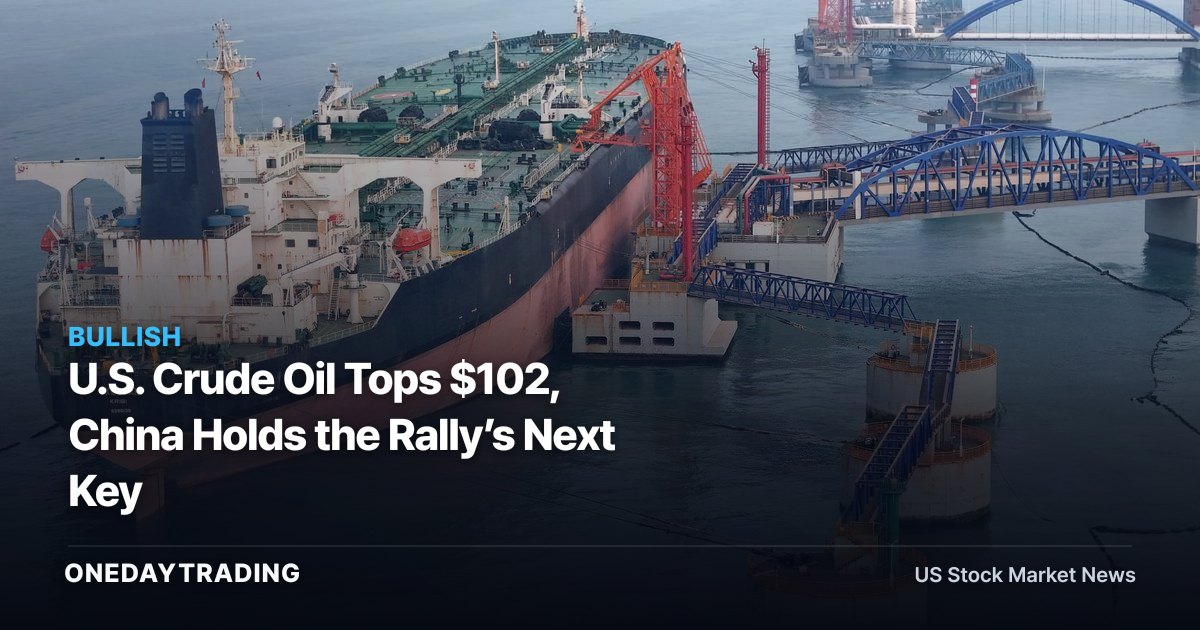
What China Changes for the U.S. Crude Oil Rally
The market move says more than a return above a round-number threshold. CNBC reported that fighting escalated in the Middle East, Saudi Arabia’s East-West oil pipeline was shut after multiple attacks, and the United States reimposed its naval blockade of Iran in July. In CNBC’s account, those developments helped restore a risk premium after the June 17 memorandum of understanding signed by Washington and Tehran failed.
China’s role is different because it concerns physical demand rather than only the market’s assessment of conflict risk. A swing consumer is a buyer whose changing purchases can materially alter the balance between available supply and demand. According to CNBC, China reduced crude imports by between 3 million and 5 million barrels per day during the Iran war, helping contain the price response while Beijing relied on a petroleum reserve of more than 1 billion barrels.
Rebecca Babin, senior energy trader at CIBC Private Wealth, told CNBC on Friday that a stronger pull from Chinese refiners might not be fully reflected in prices. CNBC’s evidence supports a conditional interpretation: if refiners lift crude purchases, the market could tighten further; if Beijing continues using inventories and restraining refinery runs, the demand impulse could remain limited.
By the Numbers: Imports Recover, but Not to Prewar Levels
China’s crude imports fell to around 6 million barrels per day at their June wartime low, nearly 50% below the 11.5 million barrels per day recorded in February, according to CNBC and the Kpler data it cited. Imports then increased to around 7 million barrels per day in July and August. Amrita Sen, founder of Energy Aspects, told CNBC that purchases had risen from spring levels but were not expected to return to prewar levels.
Matt Smith, Kpler’s director of commodity research, told CNBC that China’s purchases this month were running at a level similar to July and August. His view supplies the central counterweight to the stronger-demand thesis: Beijing may lean on inventories and keep refinery runs in check rather than buy crude at prices above $100 per barrel. CNBC did not report an exact import volume for this month, so the July-August comparison is the available benchmark rather than proof of another acceleration.
The broader buffer has also narrowed. Global inventories declined by 400 million barrels after more than six months of war, according to CNBC, citing the U.S. Energy Information Administration. CNBC also reported that emergency stockpile releases were nearing an end, though it did not provide an exact end date.
What the Price Already Reflects—and What It May Not
CNBC reported that U.S. crude oil topped $102 per barrel on Thursday after the futures contract advanced about 50% from its summer low of $68.55 per barrel. That move indicates that the market had already incorporated at least part of the renewed conflict risk described in CNBC’s reporting. Bob McNally, president of Rapidan Energy, told CNBC that the risk premium had gradually returned after the Washington-Tehran memorandum failed and the U.S. naval blockade resumed in July.
The unpriced—or incompletely priced—element identified by Babin is a larger Chinese demand pull. That remains an interpretation attributed to CNBC’s interview, not an established outcome. The price gap between Thursday’s level above $102 per barrel and the April 7 wartime closing high of $112.95 per barrel shows that the prior high had not yet been retested.
Diesel refining profit margins had risen as the Iran and Ukraine wars reduced global refining capacity, according to CNBC. Babin argued that those margins gave Chinese refiners an incentive to purchase crude and sell refined products. Smith’s competing assessment was that China could preserve flexibility by using its reserves and controlling refinery activity instead of materially expanding purchases at triple-digit oil prices.
Winners & Losers: Sector Read-Through
- Oil-price exposure: CNBC’s reported advance above $102 per barrel and the decline in global inventories create a bullish directional signal for crude as a commodity. The fact sheet does not establish a direct impact on any specific listed company, so no individual equity beneficiary can be identified without adding unsupported assumptions.
- Chinese crude demand: A material increase beyond the roughly 7 million barrels per day reported for July and August could reinforce market tightness, according to the demand mechanism discussed by Babin on CNBC. Purchases merely holding near that level would weaken the case that China is providing a new incremental catalyst.
- Chinese refiners: CNBC reported that higher diesel refining margins created an incentive to process more crude. The opposing constraint is the cost of buying oil above $100 per barrel, which Smith said could lead Beijing to rely more heavily on inventories and controlled refinery runs.
- Consumers of refined products: The fact sheet provides no measured price, volume or company-level outcome for these users. Any specific earnings or margin conclusion would therefore exceed CNBC’s reported evidence.
Risk Check: Four Conditions Around the Rally
- China may stop at the current plateau. Purchases this month were similar to the roughly 7 million barrels per day recorded in July and August, according to Smith’s comments reported by CNBC. A failure to move materially above that range would challenge the stronger-demand scenario.
- Beijing retains a large buffer. China has a petroleum reserve of more than 1 billion barrels, according to CNBC. Smith said that reserve could allow Beijing to limit purchases and keep refinery runs under control while oil trades in triple digits.
- Conflict risk is already partly represented. CNBC reported that the market had priced in escalating Middle East fighting, while Babin argued that stronger Chinese demand might not be fully reflected. That distinction makes import data more informative than another restatement of known geopolitical stress.
- The inventory cushion is smaller. Global inventories fell by 400 million barrels after more than six months of war, according to CNBC’s citation of the U.S. Energy Information Administration. With emergency releases nearing an end, the timing of their conclusion becomes important, but CNBC did not provide an exact date.
Bottom Line: China Must Confirm the Next Leg
CNBC’s figures support a bullish but conditional view of U.S. crude oil. The contract had gained about 50% from its $68.55-per-barrel summer low and closed above $102 per barrel on Thursday, while shrinking global inventories and the approaching end of emergency releases reduced reported buffers. Yet China’s imports were still around 7 million barrels per day in July and August, well below February’s 11.5 million barrels per day, and this month’s purchases were reportedly similar to that recent pace.
The next decisive checkpoint is therefore China’s next reported crude-import volume: a material rise beyond the July-August level would support Babin’s tighter-market thesis, while another reading near that level would align more closely with Smith’s restraint scenario. Investors should also compare U.S. crude with the April 7 wartime closing high of $112.95 per barrel and monitor the disclosed timing of the end of emergency stockpile releases. CNBC’s fact set does not establish that the rally will persist or that the wartime high will be tested.
FAQ
Why can China influence whether oil prices keep rising?
China reduced crude imports by between 3 million and 5 million barrels per day during the Iran war, according to CNBC. A reversal of that reduction could add demand, while continued use of Beijing’s petroleum reserve of more than 1 billion barrels could limit new purchases.
What would show that China is materially increasing crude demand?
The relevant checkpoint is whether China’s next reported import volume moves materially above the roughly 7 million barrels per day recorded in July and August, according to CNBC and Kpler data. CNBC reported that this month’s buying was at a similar level, but the exact volume was not provided.
Could U.S. crude oil retest its wartime high?
CNBC reported that U.S. crude remained below its April 7 wartime closing high of $112.95 per barrel after topping $102 per barrel on Thursday. Whether it retests that high is unknown and depends, in the interpretations reported by CNBC, on factors including Chinese imports, conflict conditions, inventories and emergency stockpile releases.
📊 Analysis
Signal Bullish
Why CNBC’s reported price recovery, lower global inventories and China’s rebound from its June import low support an upward oil-price bias, although further Chinese buying is uncertain.
This article was independently written by OneDayTrading from public reporting. Read the original (CNBC)