Summary
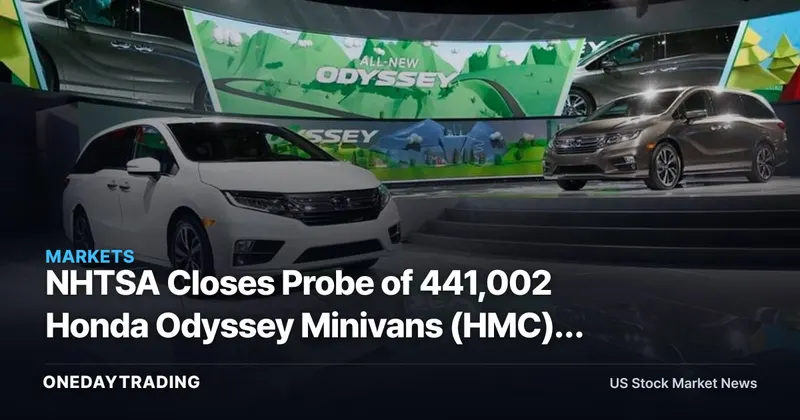
The US auto-safety regulator has closed its evaluation of 441,002 Honda Odyssey vehicles after Honda issued a recall, ending one open regulatory file. For Honda Motor (HMC), the practical effect is the removal of an escalation path, not a fresh catalyst. The financial stake is modest against Honda's global volume, but the resolution mechanism matters more than this single case.
The Full Story
A regulator closing an evaluation after the manufacturer recalls is the system working as designed: the agency opens a query, the automaker addresses the defect population with a remedy, and the file shuts once coverage is judged adequate. The 441,002-unit figure defines the affected Odyssey population, not a new liability. With the recall already issued, the cost of remedy is the variable that hits Honda's warranty and recall reserves, and that obligation exists whether or not the agency keeps the file open.
What changes today is risk, not revenue. A closed evaluation means no engineering analysis upgrade, no expanded recall order, and no civil-penalty track tied to this matter. For a minivan that competes directly with Toyota's Sienna and Chrysler's Pacifica, the more durable question is reputational: Odyssey buyers skew toward families who weight safety heavily, so the speed and completeness of the fix influences repurchase intent more than the headline count.
Structural Background
Recalls are a recurring cost of running an auto franchise at scale, and the industry absorbs millions of recalled units annually. The market generally distinguishes between a routine, manufacturer-initiated remedy that a regulator signs off on, and an unresolved defect that forces repeated expansions. This case lands in the first bucket. Honda's exposure here is bounded by the size of the affected fleet and the per-vehicle remedy cost, both of which sit inside normal warranty provisioning rather than representing a balance-sheet shock.
Stock & Sector Ripple
- Honda Motor (HMC) — Direct subject. Closing the file removes one regulatory overhang and caps this matter's cost at the already-booked recall remedy; immaterial to group earnings given Honda's multi-million annual unit volume.
- Toyota (TM) — Sienna is the Odyssey's closest minivan rival; a clean Honda resolution keeps competitive dynamics unchanged rather than handing share.
- Stellantis (STLA) — Pacifica competes in the same shrinking minivan segment; the category's structural decline matters more to all three than any single recall.
- Auto parts and warranty suppliers — Recall remedies flow revenue to component and service providers executing the fix, a marginal positive at the supplier tier.
Bull vs Bear Scenarios
Bull: The closure confirms Honda contained the issue with a regulator-accepted remedy, protecting the Odyssey brand among safety-sensitive family buyers and avoiding penalty risk. Bear: The event is too small to move HMC; the real pressure on Honda remains elsewhere — minivan demand erosion as buyers migrate to crossovers and three-row SUVs, plus broader margin questions from EV transition spend and tariff exposure. A single closed file does not address those.
Investor Action Points
- Track Honda's next earnings for warranty and recall-related provisioning trends, not this one case in isolation.
- Watch Odyssey and total minivan segment volumes versus crossover demand for the structural read on the franchise.
- Monitor the regulator's open-investigation list for any new Honda files that could carry larger affected populations.
- Weigh HMC on group fundamentals — North America mix, EV capex and currency — where the actual share-price drivers sit.
Market data check: HMC
HMC last traded near $26.83 (+2.64%). Our composite signal — blending price momentum and news flow — reads 🟡 neutral. Price momentum scores 71/100 (firm).
Data as of publication. Price via market feeds; for reference only, not investment advice.
📊 Analysis
Signal Neutral
Why Closing a regulatory evaluation after an already-issued recall removes a minor overhang but is immaterial to Honda's group earnings and provides no new revenue catalyst.
This article was independently written by OneDayTrading from public reporting. Read the original (Investing.com)