At a Glance
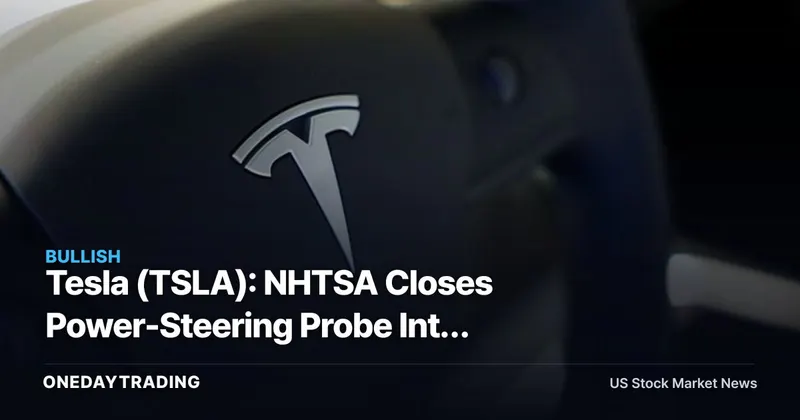
The US auto-safety regulator has closed its investigation into power-steering loss on roughly 376,000 Tesla vehicles without forcing a recall. For TSLA, the immediate read is the removal of a binary regulatory risk: a probe that could have ended in a costly fix instead ends in no mandated action.
Why It Matters Now
Power-steering complaints sit close to the core of a vehicle-safety case because loss of steering assist is a control issue, not a cosmetic one. When a regulator opens such a probe across 376,000 units, the tail risk for the manufacturer is a hardware or component recall that carries unit-level cost and, more damaging, brand drag at the exact moment buyers weigh an electric vehicle against legacy autos. Closing it without a recall caps that exposure.
The mechanism that matters to Tesla's income statement is warranty and recall accrual. Each open federal probe is a contingent liability the market discounts into the stock; resolving one shrinks the range of bad outcomes. Tesla already runs a software-first remediation model, often patching issues over the air rather than pulling cars into service centers, which lowers the cost curve of any given defect versus a conventional automaker that must touch physical parts in a dealer network.
The counterweight: a closed probe does not erase Tesla's demand problem. The investigation's end is a risk-removal event, not a volume catalyst, and it says nothing about pricing, margin, or the cadence of deliveries that actually drive the multiple.
FAQ
- How many vehicles were involved? The probe covered about 376,000 Tesla EVs.
- Did it end in a recall? No mandated recall resulted from the regulator closing the investigation.
- Why does a steering probe carry weight? Steering-assist loss is a vehicle-control defect, the category most likely to trigger an expensive fix and reputational damage.
- Is this a reason for the stock to re-rate? It removes a downside risk rather than adding upside; the fundamental drivers remain deliveries, price, and margin.
Related Stocks & Sectors
- Tesla (TSLA) — direct beneficiary; one regulatory overhang lifts, narrowing the warranty-liability range priced into shares.
- Legacy automakers (GM, Ford) — read-through on the cost gap, since over-the-air remediation lets Tesla resolve defects without the dealer-service expense traditional OEMs absorb.
- EV and auto suppliers — steering and electronic-component vendors face less near-term recall-driven order disruption tied to this fleet.
What to Watch
- Whether any new federal investigations open on other Tesla systems, which would re-introduce regulatory tail risk.
- The next delivery report and any change in warranty-accrual disclosure in upcoming filings.
- Margin trend, the real driver of the stock, independent of this resolved probe.
- Pricing actions across the lineup as demand signals evolve.
Overall Outlook
Closing a 376,000-vehicle steering probe with no recall is a clean negative removed from Tesla's risk ledger and a quiet validation of its software-led remediation cost structure. The bull case is that fewer open investigations mean a tighter band of outcomes; the sober case is that this is housekeeping, not growth, and the variables that actually move TSLA — unit volume, average selling price, and operating margin — sit untouched by a regulator's decision to walk away.
Market data check: TSLA
TSLA last traded near $379.71 (+1.22%). Our composite signal — blending price momentum and news flow — reads 🟡 neutral. Price momentum scores 60/100 (firm).
Data as of publication. Price via market feeds; for reference only, not investment advice.
📊 Analysis
Signal Bullish
Why Closing a 376,000-vehicle power-steering probe without a recall removes a regulatory and warranty-liability overhang from Tesla.
This article was independently written by OneDayTrading from public reporting. Read the original (Investing.com)