Key Takeaways
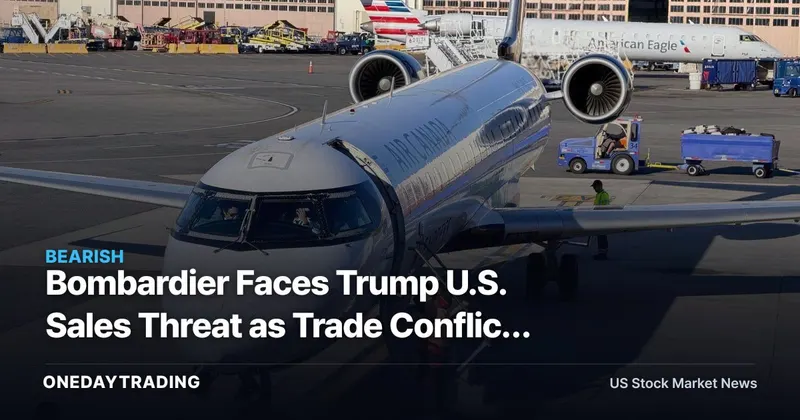
Bombardier now faces a market-access threat rather than a conventional tariff dispute: President Donald Trump said the Canadian aircraft manufacturer should not sell in the United States unless it builds there. For investors, the crucial issue is whether Bombardier’s existing U.S. workforce, facilities and American-sourced components satisfy the administration’s demand—or whether Washington applies a stricter final-assembly test.
The immediate read-through is bearish for Bombardier because political uncertainty can delay customer decisions before any formal restriction takes effect. The counterweight is a deeper American footprint than Trump’s statement acknowledged, giving the company, its employees and elected officials a concrete case against excluding its aircraft.
What Happened
Trump wrote on Truth Social on Monday, according to CNBC, that Bombardier could no longer sell in the United States and must build in America if it wants access to the market. The statement did not specify a legal mechanism, implementation date or definition of what would qualify as building domestically. That distinction matters: a political declaration can alter purchasing behavior immediately, while an enforceable restriction ordinarily requires details that determine its scope.
Bombardier responded by emphasizing that it directly employs workers in more than 20 U.S. states and operates sites in 10, including California, Texas and Arizona. It also said its aircraft contain American-made engines, avionics and other key systems. In capital-cycle terms, Bombardier’s defense is that an aircraft’s economic footprint extends beyond the location of final assembly to the suppliers, service operations and skilled labor supporting it.
The company also plans to expand its U.S. defense activities and service network and to open a facility in Fort Wayne, Indiana, later in 2026. Those plans strengthen its political argument, but they do not establish that the administration will treat service, defense work or component sourcing as equivalent to domestic aircraft production.
Background & Context
The dispute arrived as Canada prepared retaliatory tariffs for Tuesday on more than 700 U.S. goods valued at about $20 billion. Ottawa announced the measures on Aug. 25 to mirror the size of Trump’s latest import taxes on Canadian wine, cement, hockey sticks and other products. Those U.S. tariffs were set at 50% after trade negotiations broke down.
A retaliatory tariff is an import tax imposed in response to another country’s trade measures, designed to impose comparable economic pressure. Bombardier was not identified in the report as part of Canada’s tariff list; its exposure comes from Trump linking access to the U.S. aircraft market with domestic production amid the wider U.S.-Canada conflict.
U.S. Commerce Secretary Howard Lutnick told CNBC that Canada had disrupted a nearly completed trade agreement for political reasons. Canadian Prime Minister Mark Carney said Canada would resume negotiations when the United States was ready. That gap leaves aerospace policy tied to a broader negotiation whose timetable and terms remain undefined.
Market & Stock Impact
- Bombardier: The primary downside channel is commercial uncertainty. Customers considering Bombardier aircraft may hesitate if they cannot determine whether future sales, deliveries or support will remain permitted in the United States. Even without a published rule, hesitation can affect the timing and conversion of orders.
- Bombardier’s U.S. operations: Direct employment across more than 20 states and facilities in 10 create an internal constituency against a blanket exclusion. The planned Fort Wayne opening, along with defense and service expansion, could reinforce the company’s case that it is adding American capacity rather than merely exporting finished aircraft into the market.
- American aerospace suppliers: Bombardier said U.S. companies provide engines, avionics and other important systems. If a restriction reduced Bombardier’s U.S. sales or production volume, those suppliers could lose component demand; if negotiations instead produce additional U.S. investment, they could benefit from a larger domestic operating base. The source did not name individual suppliers, so company-specific exposure cannot be quantified.
- Wichita employment: Republican Sen. Jerry Moran said Bombardier supports more than 1,000 workers in Wichita, Kansas, and contacted Trump to explain its local contribution. That figure turns the policy question into a visible employment trade-off: pressure intended to bring production into the country could also put existing American aerospace jobs at risk if sales contract.
Why the U.S. Footprint Matters
Aircraft manufacturing is a distributed industrial system. Final assembly is highly visible, but engines, avionics, maintenance, defense modifications and service capacity also support revenue and skilled employment. Bombardier’s response targets that broader value chain because the economic cost of restricting its products would not stop at the Canadian border.
That argument has limits. Trump’s wording focused on where Bombardier builds, and the report does not say where the company performs final assembly for aircraft sold to U.S. buyers. Investors therefore cannot infer that employment in 20-plus states or component purchases automatically meet the administration’s condition.
The Fort Wayne facility is similarly important but not dispositive. A new site demonstrates incremental U.S. commitment, yet the source does not provide its investment amount, employment target, production role or capacity. Until those details and the government’s criteria are known, the facility is negotiating evidence rather than a complete answer to the market-access threat.
Investor Checkpoints
- Formal policy language: Check whether the administration converts Trump’s post into an executive, regulatory or customs action. The definition of “build” and the treatment of orders, deliveries, components and services will determine the operational exposure.
- Trade negotiations: Track whether Washington and Ottawa resume talks after Canada’s tariffs take effect Tuesday. A broader settlement could reduce the threat; another escalation could pull aerospace more deeply into the dispute.
- Customer and order commentary: At Bombardier’s next operating update, focus on U.S. order activity, cancellations, delivery timing and any change in backlog conversion. These indicators would show whether political uncertainty is altering demand before formal restrictions appear.
- Fort Wayne execution: When Bombardier inaugurates the Indiana facility later in 2026, examine its function, staffing and capacity. Those facts will indicate how much additional U.S. industrial activity the company can credibly place on the negotiating table.
Outlook
The bear case is straightforward: an explicit threat against U.S. sales can impair order confidence, complicate delivery planning and force capital allocation toward political compliance rather than the highest-return industrial projects. Escalating tariffs between two closely connected economies increase the chance that Bombardier becomes leverage in negotiations extending well beyond aerospace.
The more constructive case rests on physical facts. Bombardier already employs people across more than 20 states, maintains sites in 10, sources critical American systems and plans further U.S. expansion. Moran’s intervention also shows that a restriction would encounter opposition from a state with more than 1,000 Bombardier-supported jobs.
The next decisive signal will not be another broad statement. It will be formal language defining acceptable U.S. production, evidence of changed aircraft orders, or renewed U.S.-Canada negotiations. Until one arrives, Bombardier’s American footprint reduces the political simplicity of a sales ban but cannot remove the risk attached to it.
FAQ
Did the United States formally ban Bombardier aircraft sales?
The source reports Trump’s statement that Bombardier should no longer sell in the United States unless it builds there. It does not report a formal rule, effective date or enforcement process, so the confirmed event is a presidential threat rather than a detailed implemented ban.
Does Bombardier already operate in the United States?
Yes. Bombardier said it directly employs workers in more than 20 states and has sites in 10 states, including California, Texas and Arizona. Sen. Jerry Moran separately said its Wichita presence supports more than 1,000 employees.
How could the U.S.-Canada tariff dispute affect Bombardier stock?
The clearest risk is that uncertainty over U.S. market access delays orders or deliveries, weakening confidence in backlog conversion. The mitigating factors are Bombardier’s existing U.S. employment, American component purchases and planned expansion, but their value depends on whether the administration recognizes those activities as sufficient domestic production.
📊 Analysis
Signal Bearish
Why Trump’s threat to restrict U.S. sales creates material market-access uncertainty that Bombardier’s existing American workforce and supply chain may mitigate but do not resolve.
This article was independently written by OneDayTrading from public reporting. Read the original (CNBC)