What Changes for Rate-Sensitive Markets
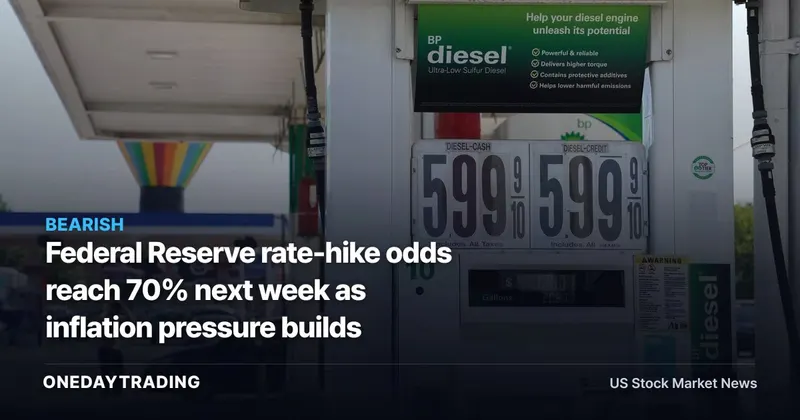
The market is not pricing a confirmed policy decision. It is pricing a 70% chance of an increase at the following week’s meeting, based on the CME Group’s FedWatch gauge as reported by CNBC Markets. That distinction matters: the tape has moved toward a hike, but the fact sheet does not establish that the Federal Reserve subsequently raised rates, the exact date of any increase, or its size.
The transmission mechanism is straightforward. When investors assign a higher probability to a policy-rate increase, the discount rate used to value future cash flows can rise. That tends to create pressure for long-duration equity valuations and other assets whose prices depend heavily on distant earnings. This is a market mechanism, not a reported outcome for any specific company, and the supplied evidence does not identify individual stock winners or losers.
The inflation signal is broad rather than confined to a single consumer measure. CNBC Markets reported that PPI, a gauge of wholesale and pipeline cost pressure, increased 0.4% in August following a revised 0.1% gain in July. The annual PPI level reached 5.4%. Peter Boockvar, chief investment officer at OnePoint BFG Wealth Partners, argued that focusing only on consumer prices can miss supply-chain pressure; the PPI result is the concrete evidence cited for that view.
Oil Adds a Second Inflation Channel
U.S. crude rose 4% to just over $100 per barrel, according to CNBC Markets. A commodity move of that size can matter for the inflation narrative because energy costs feed into transportation, production and household expenses. The source does not quantify those pass-through effects, so the investment implication is conditional: sustained oil strength could make it harder for policymakers to treat the inflation impulse as temporary, while a reversal would weaken that specific pressure.
David Russell, global head of market strategy at TradeStation, said the combination of rising oil and low jobless claims made a hike difficult for the Federal Reserve to avoid. That is an analyst interpretation, not confirmation of the Fed’s decision. Jeffrey Roach, chief economist at LPL Financial, similarly wrote that a hike “appears likely” at the current pricing level.
The European Central Bank’s separate quarter-percentage-point increase and higher inflation forecast provide an additional global policy signal, but they do not determine the Federal Reserve’s action. For U.S. assets, the relevant question remains whether domestic inflation data validate the probability already reflected in rates markets.
By the Numbers: PPI, CPI and PCE
The next scheduled data point in the supplied report is the consumer price index release from the Bureau of Labor Statistics. The Dow Jones consensus cited by CNBC Markets calls for a 3.4% annual headline CPI reading and a 2.4% annual core CPI reading excluding food and energy. Those are forecasts, not the final readings; the fact sheet explicitly leaves the final CPI result unknown.
The Federal Reserve’s stated inflation yardstick, as described in the source, is the Commerce Department’s personal consumption expenditures price index. July core PCE stood at 3.3% and headline PCE at 3.7%. Stephen Juneau, senior U.S. economist at Bank of America, estimated that August core PCE was tracking at a 0.26% monthly rate, which rounds to 0.3%. Juneau said the CPI data could move the outlook significantly and, if his estimate proved correct, could support a hike at the following week’s meeting.
Bank of America expects three Federal Reserve increases at upcoming meetings. That forecast is more hawkish than current futures pricing as described by CNBC Markets, so it represents a scenario rather than an established path. The source also does not establish whether another increase occurred in December, even though traders placed the December probability close to 60%.
Winners & Losers
- Rate-sensitive equity valuations: A higher expected policy rate can compress valuation multiples for assets priced on distant cash flows. The fact sheet supports this mechanism but does not name affected listed companies.
- Energy-linked inflation exposure: U.S. crude’s 4% rise to just over $100 per barrel strengthens the inflation risk channel described by CNBC Markets. The article does not provide company-level revenue, cost or margin data, so no specific energy stock can be classified as a winner.
- Policy-sensitive financial conditions: A 70% hike probability signals tighter expected monetary conditions. Whether that benefits or hurts any particular bank, insurer or other financial company cannot be determined from the supplied facts.
Risk Check
- The final CPI reading is unknown. A result different from the 3.4% headline and 2.4% core forecasts could materially change the market-implied probability.
- The final August core PCE reading is also unknown. Juneau’s 0.26% monthly tracking estimate, rounded to 0.3%, is an estimate rather than a reported final result.
- The Federal Reserve’s subsequent decision is unknown, including the exact date and size of any prospective increase.
- December pricing near 60% does not establish that another increase occurred. BofA’s expectation of three increases at upcoming meetings is a forecast, not a confirmed policy outcome.
Bottom Line
The immediate read-through is a market leaning, not a completed Fed action: traders raised the following week’s hike probability to 70% as August PPI accelerated to 0.4%, annual PPI reached 5.4%, and crude moved 4% above $100 per barrel. That combination can keep pressure on rate-sensitive valuations if the incoming CPI and later PCE data reinforce it. A softer inflation print could reduce the probability, while persistent producer-price and energy pressure would support the more hawkish scenario described by Roach, Russell and Juneau. The next concrete checkpoint is the Bureau of Labor Statistics CPI release; the final decision and any December move remain unknown.
FAQ
What is the market-implied chance of a Fed rate hike next week?
Traders placed the probability at 70% in morning action on Sept. 10, 2026, according to the CME Group FedWatch gauge cited by CNBC Markets. This is a futures-market probability, not confirmation that the Federal Reserve will raise rates.
Why did rate-hike odds rise?
CNBC Markets reported that August PPI rose 0.4% after a revised 0.1% increase in July, taking annual PPI to 5.4%. U.S. crude also rose 4% to just over $100 per barrel, adding to the inflation pressure cited by market strategists.
What inflation data come next?
The Bureau of Labor Statistics is due to release CPI data referenced in the report, with consensus at 3.4% annual headline inflation and 2.4% annual core inflation excluding food and energy. The final CPI reading and final August core PCE reading are not provided in the fact sheet.
📊 Analysis
Signal Bearish
Why Higher market-implied rates can pressure equity valuations, while persistent producer-price and oil inflation increase policy uncertainty.
This article was independently written by OneDayTrading from public reporting. Read the original (CNBC Markets)