At a Glance
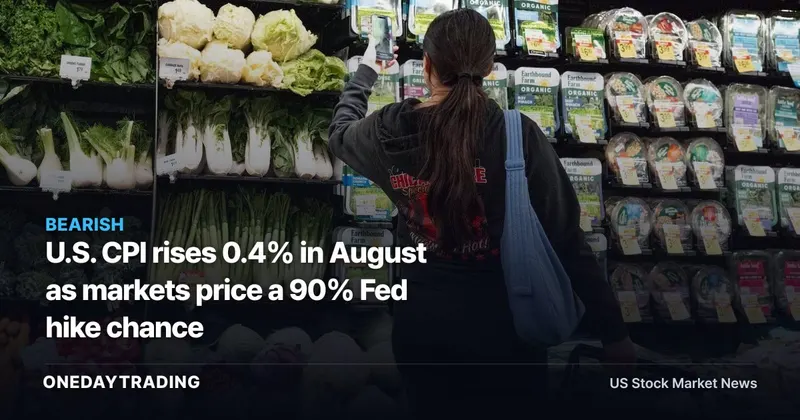
U.S. consumer prices rose in August, and the August 11, 2026 CNBC Markets report said the data pushed investors toward expecting a Federal Reserve interest-rate increase at the following week’s policy meeting. The all-items consumer price index increased 0.4% in August and 3.4% over the 12 months through August, while core CPI rose 0.3% for the month, 0.1 percentage point above the forecast, and 2.4% annually, according to the Bureau of Labor Statistics as reported by CNBC Markets.
For markets, the central issue is not simply the headline number. It is whether broad price pressure is strong enough to keep policy restrictive, affecting the discount rates used across equity, credit and real-estate valuation models.
Why August CPI Matters for Federal Reserve Policy
CPI, the consumer price index, measures changes in prices paid by consumers for a broad basket of goods and services. Core CPI removes food and energy to show underlying price momentum, although the August report contained notable movements in both the volatile categories and services.
CNBC Markets reported that traders lifted the probability of a quarter-percentage-point Federal Open Market Committee benchmark-rate increase the following week to nearly 90%, from nearly 70% before the CPI release. The probability comes from CME Group’s FedWatch tracker, which reflects fed-funds futures pricing rather than a guarantee of the policy outcome.
The policy transmission is direct. CNBC Markets reported that the federal funds rate was in a 3.5%-3.75% range, where it had remained throughout 2026. A higher policy rate can raise financing costs and reduce the present value assigned to future cash flows; that mechanism is particularly relevant for long-duration growth shares, leveraged borrowers and property-linked assets. The article does not identify individual companies or quantify stock-price effects, so any company-specific conclusion would go beyond the available evidence.
The two-year Treasury note, which is sensitive to expectations for near-term Fed policy, rose 4.6 basis points in morning trading to 4.594%, CNBC Markets reported. One basis point equals 0.01%. That move indicates a repricing in the rate market, even as the report said stock futures surged while oil prices plunged in morning trade.
What Drove the Inflation Reading
Energy supplied a large share of the monthly headline increase. CNBC Markets reported that gasoline prices rose 3.9% in August, accounting for more than one-third of the CPI’s gain. The broader energy index increased 2.1% in August and was up 16.3% year over year; gasoline prices were 27.4% higher over 12 months, while fuel-oil prices increased 52% over the same period.
Those figures create two different analytical questions. The first is mechanical: energy directly raises the all-items index. The second is behavioral: Kathy Bostjancic, chief economist at Nationwide, told CNBC Markets that renewed increases in oil, gasoline and diesel prices could add to concern that higher energy costs spill into other goods and services and inflation expectations. That spillover is a risk described by the source, not an established outcome.
Food prices rose 0.1% in August, and the food index increased 2.7% annually, according to CNBC Markets. Shelter costs climbed 0.3% for the month after moderating over the prior two months. Transportation services rose 0.5%, used cars and trucks increased 0.4%, and new-vehicle prices rose 0.3%.
The breadth matters because the core reading was not driven solely by gasoline. CNBC Markets reported a 0.3% monthly core CPI increase, matching the 2.4% annual estimate but exceeding the monthly forecast by 0.1 percentage point. Motor-vehicle insurance prices fell 0.8% in the source’s account, while tariff-sensitive apparel prices were flat, underscoring that inflation pressures were uneven across categories.
Key Debates
- Is a hike effectively priced? Nearly 90% odds for a quarter-percentage-point increase imply that traders see a high probability, but the source confirms only increased bets, not the final decision. Chris Zaccarelli, chief investment officer at Northlight Asset Management, said there was no guarantee of a hike while arguing that holding rates would be difficult to justify.
- How much weight should the Fed place on core CPI? The 0.3% monthly core gain was 0.1 percentage point above forecast, while the 2.4% annual rate matched the estimate. The contrast leaves room for officials to debate whether the monthly strength signals persistence or a temporary deviation.
- Can energy remain contained? Gasoline, fuel oil and the energy index posted large 12-month increases. Bostjancic’s warning, as reported by CNBC Markets, is that continued energy pressure could broaden inflation; the available facts do not establish whether that transmission will occur.
- What does the chair’s reaction imply? Kevin Warsh has expressed commitment to returning inflation to the Federal Reserve’s 2% target and said, “we have work to do.” CNBC Markets reported that the remark was widely interpreted as favoring a hike, while also noting that several officials had urged patience.
Related Sectors and Market Channels
- Rate-sensitive equities: A higher expected policy rate can pressure valuation multiples by increasing the discount rate applied to future earnings. CNBC Markets provides no company-level earnings, valuation or price data, so the implication remains a sector mechanism rather than a call on a named stock.
- Financial conditions: The federal funds rate is a benchmark for multiple consumer loans, according to CNBC Markets. A hike would therefore affect borrowing conditions, although the source does not quantify changes in loan demand, credit losses or bank profitability.
- Energy exposure: Higher gasoline and fuel-oil prices lifted inflation, but the report also said oil prices plunged in morning trade. That divergence means energy-linked market reactions cannot be inferred from the CPI print alone.
- Treasury markets: The 2-year yield’s move to 4.594% reflects greater sensitivity to near-term policy expectations. The source does not provide a 10-year yield or a complete curve reaction, limiting conclusions about broader duration assets.
What to Watch Next
- The following week’s Federal Reserve meeting and vote: The CPI report was the final major inflation indicator available before the policy meeting. The exact meeting date and the identities of current FOMC voters are not confirmed in the source.
- Core-price momentum: Investors can compare future monthly core CPI outcomes with the August 0.3% gain and the Federal Reserve’s 2% inflation target. The relevant question is whether disinflation resumes, a condition Bostjancic said would be necessary for holding rates.
- Energy persistence: Track whether gasoline, fuel oil and the broader energy index continue rising after their August increases of 3.9%, 52% over 12 months and 2.1% respectively. The source identifies possible spillover risk but does not provide a forecast.
- Short-maturity yields and futures pricing: The 2-year note reached 4.594% after rising 4.6 basis points, while pre-release hike odds were nearly 70% and post-release odds nearly 90%. Changes in those measures will show whether traders maintain or reverse the repricing.
Overall Outlook
The August CPI report strengthens the case for a near-term rate increase in market pricing because headline inflation rose 0.4% monthly, core CPI exceeded its monthly forecast by 0.1 percentage point, and energy prices were elevated. CNBC Markets reported that Nationwide now expected a quarter-point hike and that Bostjancic viewed the report as inconsistent with the continued disinflation required to keep rates on hold.
The countercase is uncertainty. The annual core rate was 2.4%, matching the estimate, food inflation was modest monthly, apparel prices were flat and motor-vehicle insurance declined 0.8% in the source’s breakdown. Stock futures also rose as oil prices fell, showing that markets were balancing inflation data against other immediate price signals.
For investors, the cleanest framework is conditional: a hike would confirm the probability already embedded in futures, while a hold could force markets to reassess the nearly 90% expectation. The next policy decision, subsequent core-price readings and the behavior of energy costs will determine whether August marks persistent inflation pressure or a single month that fails to alter the broader path.
FAQ
What were the August 2026 CPI numbers?
CNBC Markets reported that the all-items CPI rose 0.4% in August and 3.4% over the 12 months through August. Core CPI increased 0.3% monthly and 2.4% annually, with the monthly core result 0.1 percentage point above forecast.
What were markets expecting from the Federal Reserve?
Before the CPI release, markets priced nearly a 70% probability of a benchmark-rate increase. After the report, CME Group’s FedWatch tracker showed nearly 90% odds of a quarter-percentage-point FOMC hike the following week.
Did the Federal Reserve actually raise rates?
The supplied CNBC Markets facts do not confirm the outcome of the following policy meeting. They confirm only that traders increased bets and that Nationwide expected a quarter-point hike.
📊 Analysis
Signal Bearish
Why CNBC Markets reported that above-forecast core inflation increased expectations of tighter Federal Reserve policy, a potential headwind for rate-sensitive valuations.
This article was independently written by OneDayTrading from public reporting. Read the original (CNBC Markets)