Key Takeaways
Amazon's Zoox division is moving from demo to commerce: a redesigned robotaxi, plans for additional markets, and a shift toward charging riders. For Amazon shareholders this is optionality, not yet a needle-mover, but it raises the competitive stakes for Alphabet's Waymo, Tesla and the ride-hail platforms.
What Happened
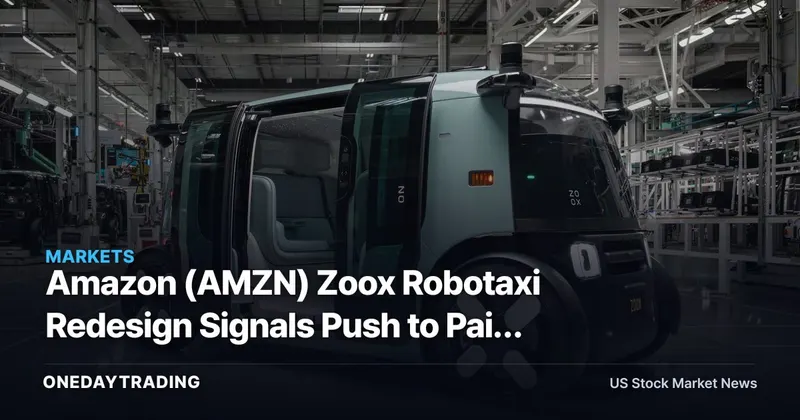
Zoox, the autonomous-vehicle unit Amazon acquired and operates, unveiled an updated version of its purpose-built robotaxi. The redesign lands as the company prepares to widen its footprint into new markets and, critically, begins positioning to charge for rides rather than run free, invite-only pilots.
The pivot to paid service is the meaningful part. Demonstrations prove the technology exists; charging fares is the first test of whether the unit economics, safety record and customer demand can support a real business. A hardware refresh ahead of that step suggests Zoox wants the vehicle locked down before it scales fleet production across cities.
Background and Context
Zoox sits inside Amazon as a long-horizon bet, dwarfed by the retailer's core e-commerce, advertising and AWS cloud earnings. That scale cuts both ways: Amazon can fund a capital-heavy robotaxi program through repeated redesign cycles, but the division is far too small to move consolidated results in the near term.
The field is crowded. Alphabet's Waymo already runs paid driverless rides in several U.S. cities, Tesla is staking its valuation on a robotaxi vision, and Uber and Lyft are partnering with AV developers to fold autonomous supply into their networks.
Market and Stock Impact
- Amazon (AMZN): Incremental positive optionality. The robotaxi push deepens Amazon's logistics and mobility ambitions, but with no disclosed revenue it stays immaterial to a company driven by AWS and ads.
- Alphabet (GOOGL): Direct competitive pressure. A second well-funded operator chasing paid rides challenges Waymo's first-mover lead in driverless commercialization.
- Tesla (TSLA): Validates the robotaxi thesis broadly, but a credible Amazon-backed rival complicates Tesla's claim to own the autonomous-ride opportunity.
- Uber and Lyft (UBER, LYFT): Two-sided risk. More AV capacity can lower costs if routed through their apps, or bypass them entirely if Zoox owns the rider relationship.
- Nvidia (NVDA): Indirect read-through, as expanding AV fleets lift demand for the compute and sensor stacks that power self-driving systems.
Investor Checkpoints
- Which specific cities Zoox names for expansion, and the timing of the first paid commercial service.
- Whether Amazon begins disclosing Zoox metrics (fleet size, ride volume) in segment commentary or earnings calls.
- Waymo's paid-ride city count and pricing as the competitive benchmark.
- Any safety incidents or regulatory permits that gate multi-market scaling.
Outlook
The bull case is that Amazon turns a proven prototype into a paying, multi-city service backed by deep capital and logistics expertise. The risks are concrete: robotaxis are expensive to build and operate, regulatory approval is city-by-city, Waymo is ahead on paid commercialization, and there is no public revenue to underwrite the spend. For now this is a strategic signal about Amazon's long-term mobility intent, not a catalyst for the stock.
Market data check: AMZN
AMZN last traded near $239.97 (+2.50%). Our composite signal — blending price momentum and news flow — reads 🟡 neutral. Price momentum scores 70/100 (firm).
Data as of publication. Price via market feeds; for reference only, not investment advice.
📊 Analysis
Signal Neutral
Why A product redesign and paid-ride ambition are strategically notable but financially immaterial to Amazon today, with no disclosed revenue or scale figures.
Tickers$AMZN$GOOGL$TSLA$UBER$NVDA
This article was independently written by OneDayTrading from public reporting. Read the original (CNBC)