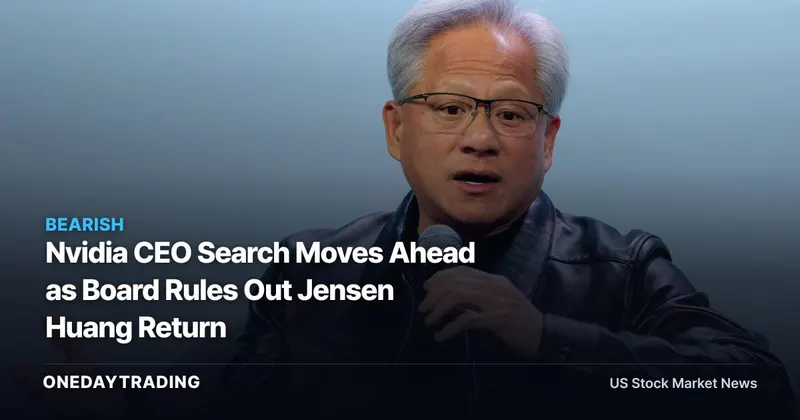
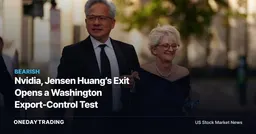
Nvidia investors now face a leadership reset, not a quick restoration of the old order. CNBC reported on 2026-11-16 that the board is not considering bringing Jensen Huang back as CEO and is instead focused on an investigation into his conduct. For NVDA, the central issue is no longer the volume of public support for its founder; it is how the board resolves the probe and identifies the semiconductor company’s next leader.
A CEO succession is the process through which a board selects and installs new executive leadership. In Nvidia’s case, that process is advancing while the investigation remains unresolved, creating two separate checkpoints for investors: the probe’s findings and the board’s choice of chief executive.
Nvidia Board Prioritizes Investigation Over Jensen Huang Comeback
A person familiar with the matter told CNBC that Nvidia’s board is neither discussing nor considering Huang’s reinstatement. The source was not identified because the person was discussing internal matters, making the board’s publicly observable actions especially important.
Nvidia hired Wachtell Lipton to examine Huang’s conduct and whether it compromised national security or company secrets. The investigation has not produced disclosed findings, so neither a breach nor its absence can be treated as established. That distinction matters: the existence of a probe is confirmed, while its outcome and the truth of the underlying allegations are unknown.
Huang admitted to an affair before resigning last week. Other allegations involve Alice Huang, who worked for an unnamed Nvidia customer, Chinese intelligence and Nvidia employees. The available evidence does not establish whether those allegations are true, and the customer’s identity has not been disclosed.
The board’s staffing action points in the same direction as the source’s account. On Friday, a representative said Nvidia was selecting a search firm for the CEO role. A search firm does not identify the eventual choice, though it shows that the board is organizing a succession process rather than publicly committing to Huang’s return.
Jensen Huang’s 33-Year Tenure Meets a Formal Succession Process
CNBC reported that Jensen Huang resigned after serving as Nvidia CEO for 33 years. He also founded Nvidia, making the transition a change in both executive leadership and the company’s relationship with its founder.
The Financial Times reported that Huang had discussed a return with allies, introducing a competing account of his intentions. That report does not establish that Nvidia’s board considered reinstating him. On Monday, Altimeter Capital’s Brad Gerstner told CNBC that Huang had not discussed a comeback with him, while a representative for Huang declined to comment on the speculation on Sunday.
This separation between founder interest, ally discussions and board authority is the key analytical line. Public advocacy can shape attention, and private conversations can indicate preference, but the board controls the CEO selection process. Based on the confirmed information, that process currently consists of an investigation and a search for new leadership.
For a semiconductor company, leadership uncertainty can matter because executive authority reaches strategic priorities, customer relationships and internal accountability. The fact sheet supplies no shipment, order, margin, yield, utilization or capital-spending data, so it cannot support a conclusion that Nvidia’s operating performance has changed. The investable signal is governance uncertainty, not a demonstrated deterioration in the chip business.
Nvidia Investor Response Should Separate Popularity From Board Evidence
CNBC said the online petition calling for Jensen Huang’s reinstatement attracted 180,000 signatures. Elon Musk, Y Combinator CEO Garry Tan and Epic Games CEO Tim Sweeney supported the effort, showing that the campaign extends beyond anonymous petition signers into prominent technology circles.
The petition’s 180,000 signatures do not change the confirmed position attributed to Nvidia’s board. They demonstrate support for Huang, not board approval, investigative clearance or an agreed route back to the CEO role. Investors should therefore avoid treating the petition as a proxy for the succession outcome.
Donald Trump said on Monday that he was open to Huang returning as CEO. Asked about national-security concerns, Trump said, “It was not put at risk, and our country is now stronger than ever before.” His statement adds political support for a return, though the investigation’s findings remain undisclosed and the board has not adopted that position.
The bearish element is the unresolved combination of leadership transition and formal scrutiny. The counter-scenario is straightforward: a completed investigation and a clearly defined succession could narrow uncertainty even if Huang does not return. The evidence does not identify the next CEO, establish when the search will conclude or show how investors have priced either outcome.
What NVDA Investors Can Verify Next
- Investigation findings: Watch for a disclosed conclusion from the Wachtell Lipton probe, particularly whether it finds any compromise of national security or company secrets. Until findings are released, claims about the investigation’s outcome are unsupported.
- CEO-search progress: Track whether Nvidia confirms the selection of a search firm and later identifies leadership candidates or a successor. The board has confirmed the search process, not the identity of the next CEO.
- Board position on Huang: Look for a direct Nvidia statement changing or reaffirming the current position that his return is not under consideration. Comments from supporters do not substitute for a board decision.
- Huang’s own position: A substantive statement from Jensen Huang could clarify whether he seeks to return. His representative’s refusal to comment on Sunday left that question unanswered.
The immediate thesis for NVDA is narrow but consequential: Nvidia is conducting a CEO search under the shadow of an unresolved investigation into the founder who led it for 33 years. A cleanly communicated succession would address one source of uncertainty; an investigative finding would address the other. Until either arrives, the board’s actions carry more analytical weight than petitions, allied speculation or political endorsements.
📊 Analysis
Signal Bearish
Why The unresolved investigation and active CEO search create leadership uncertainty for Nvidia while the board is not considering reinstating its founder.
This article was independently written by OneDayTrading from public reporting. Read the original (CNBC)