What Changes
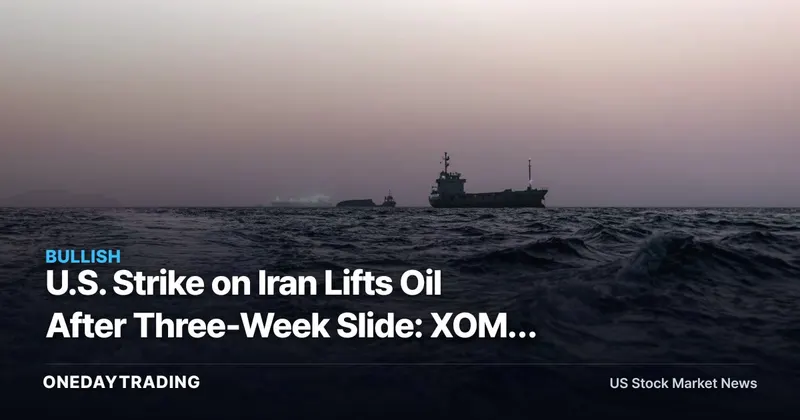
The three-week losing streak had settled one question: the oil market was trading purely on demand-side concerns and OPEC+ supply dynamics, with geopolitical risk effectively priced at zero. A confirmed U.S. military strike on Iran erases that assumption in a single session. The operative mechanism is geographic — Iran sits astride the Persian Gulf and proximate to the Strait of Hormuz, the chokepoint through which a substantial share of global seaborne crude moves. Any escalation that credibly threatens transit through that corridor tightens the physical market faster than any production-cut arithmetic can offset, because spare capacity cannot instantaneously reroute tanker flows.
The after-hours move is the tape pricing that possibility, not the reality. The question investors must answer is whether this strike is a contained, one-off response or the opening move in a sustained campaign. A confined exchange — with no follow-on Iranian retaliation against shipping or regional infrastructure — would see the risk premium fade within days, handing control back to the bearish demand narrative that drove three weeks of losses. A wider escalation changes the cost structure for every oil-consuming sector on earth simultaneously, which is precisely why upstream equities with low break-even production costs respond so asymmetrically to this kind of event.
By the Numbers
Three straight weekly losses represent a clear directional signal that base-case crude sentiment was negative before Friday night. That context matters because it amplifies short-covering mechanics in the after-hours move: traders who were positioned for continued weakness must now manage the tail risk of a geopolitical shock layered on top of their bearish thesis. For U.S. integrated majors like XOM and CVX, upstream segment earnings leverage to the oil price is direct — incremental price improvement above their well-established break-even levels flows through to free cash flow at high marginal rates, supporting both buyback capacity and dividend coverage with no additional capital required.
Winners & Losers
- XOM (ExxonMobil): Largest U.S. upstream producer; highest absolute free-cash-flow sensitivity to oil price among integrated majors, with a buyback program directly funded by realized crude prices.
- CVX (Chevron): Gulf-region production exposure and a fortress balance sheet; benefits from higher realized prices on barrels already flowing without needing incremental capex.
- COP (ConocoPhillips): Pure-play upstream with structurally low break-even costs; the cleanest and most leveraged expression of an oil-price recovery among large-cap U.S. independents.
- OXY (Occidental Petroleum): Elevated debt load makes it the most price-sensitive in both directions — maximum upside in a sustained rally, maximum downside if the premium collapses.
- DAL / UAL / AAL (Airlines): Jet fuel is the largest variable cost for carriers; sustained crude strength compresses operating margins directly, with under-hedged legacy carriers most exposed to a multi-week price elevation.
Risk Check
- Contained-strike scenario: A limited, non-escalating exchange with no Iranian retaliation against shipping would see the geopolitical premium evaporate and oil return to its pre-Friday bearish trajectory.
- OPEC+ spare capacity: Saudi Arabia and the UAE hold meaningful unutilized production capacity that could offset Iranian supply disruption, capping the crude upside and dampening the energy equity rally.
- Dollar safe-haven bid: Middle East escalation typically drives concurrent dollar strength, which creates a structural headwind for dollar-denominated oil prices and partially offsets the supply-risk premium.
- Demand overhang persists: The three-week losing streak reflects real demand-side concerns that do not disappear with a geopolitical spike; if the premium fades, those fundamentals reassert immediately.
Bottom Line
Friday night injects a supply-disruption variable into a crude market that had spent three weeks systematically pricing out geopolitical risk — a setup that creates genuine asymmetric upside for low-cost U.S. upstream producers in the near term, but only if the strike triggers sustained escalation rather than a rapid de-escalation. The 48-to-72-hour window of geopolitical signaling from both Washington and Tehran is now the single most important variable for energy equity positioning — not the next OPEC+ communique, not the next demand print. Investors adding upstream exposure here are making a bet on the escalation path, not the oil fundamental, and that distinction should govern both position sizing and time horizon.
📊 Analysis
Signal Bullish
Why A confirmed U.S. military strike on Iran reintroduces supply-disruption risk premium to oil after three weeks of bearish selling, directly benefiting U.S. upstream producers with high oil-price earnings leverage.
Tickers$XOM$CVX$COP$OXY$DAL
This article was independently written by OneDayTrading from public reporting. Read the original (MarketWatch)