Key Takeaways
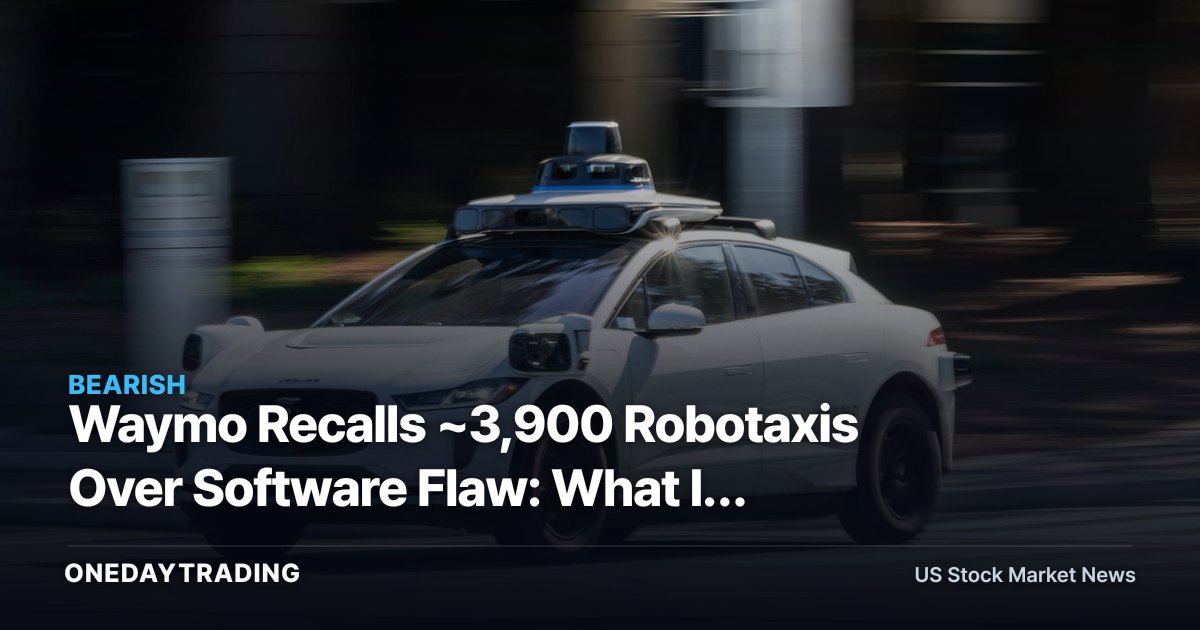
Alphabet's Waymo issued a voluntary recall covering roughly 3,900 robotaxis to patch software that allowed some vehicles to drive into closed freeway construction zones. Because the remedy is an over-the-air software update rather than hardware, the direct cost is low, but the episode lands at a sensitive moment for the autonomous-vehicle narrative that supports Alphabet's mobility bet and pressures rivals chasing the same market.
What Happened
Waymo, the self-driving unit owned by Alphabet, recalled approximately 3,900 of its robotaxis after some vehicles drove into freeway construction zones that should have been avoided. The company traced the behavior to underlying software issues and is addressing them through a fix rather than a mechanical repair.
For an autonomous fleet, a recall does not mean cars are pulled off the road and physically serviced one by one. The correction propagates as a software update, so the operational disruption and per-unit cost are far smaller than a traditional automaker recall. The reputational channel matters more than the financial one: regulators, partners and riders judge AV safety on incident patterns, and construction-zone navigation is exactly the kind of edge case that determines whether driverless services can scale beyond mapped urban cores onto highways.
Background & Context
Waymo has been expanding paid driverless rides across U.S. cities and pushing toward freeway operation, which is the higher-speed, higher-stakes frontier of the business. Each disclosed software fault feeds the regulatory record that bodies such as the National Highway Traffic Safety Administration use to assess whether the technology is ready for broader deployment.
Market & Stock Impact
- Alphabet (GOOGL): Waymo is a small line item against search and cloud earnings, so the recall is not a near-term financial event. The risk is to the long-dated optionality investors assign to Waymo as a future mobility platform; repeated safety flags could slow city approvals and the highway rollout.
- Tesla (TSLA): A direct competitor staking its valuation on robotaxi and full self-driving ambitions. Every Waymo stumble cuts both ways — it can dent the broader AV-safety narrative while also reminding markets that the leader in driverless miles still hits edge-case failures.
- Uber (UBER) and Lyft (LYFT): Ride-hail platforms that partner with AV operators. Slower, more scrutinized autonomy timelines preserve their human-driver economics for longer, a mixed signal depending on whether one views AVs as a threat or a supply source.
- Nvidia (NVDA): A core supplier of compute for autonomous driving. AV demand is a secondary growth vector; deployment delays affect sentiment more than current chip revenue.
Investor Checkpoints
- Watch for any NHTSA statement or investigation tied to the 3,900-unit recall and the construction-zone behavior.
- Track Waymo's freeway and new-city expansion announcements — pace signals regulatory confidence.
- Monitor Alphabet's quarterly Other Bets disclosures for Waymo operating losses and ride volume commentary.
- Compare disengagement and incident reporting between Waymo and Tesla as a relative-safety read.
Outlook
The bull case is that a software-only fix demonstrates exactly the advantage of an AV fleet: a fault is identified and corrected across thousands of vehicles at once, and disclosure builds the safety record needed to win highway approval. The risk is that construction zones and other unpredictable environments expose how much edge-case work remains, and that a steady drip of recalls invites tighter regulation that pushes profitable scale further out. For Alphabet holders, Waymo stays an option on the future rather than a number in today's model; the variable to track is regulatory tone, not this quarter's cost.
Market data check: GOOGL
GOOGL last traded near $365.4 (+0.44%). Our composite signal — blending price momentum and news flow — reads 🟡 neutral. Price momentum scores 54/100.
Data as of publication. Price via market feeds; for reference only, not investment advice.
📊 Analysis
Signal Bearish
Why A safety recall tied to software faults in freeway construction zones is a mild negative for the AV narrative and adds regulatory scrutiny risk, even though the financial cost to Alphabet is small.
Tickers$GOOGL$TSLA$UBER$NVDA$LYFT
This article was independently written by OneDayTrading from public reporting. Read the original (CNBC)