Summary
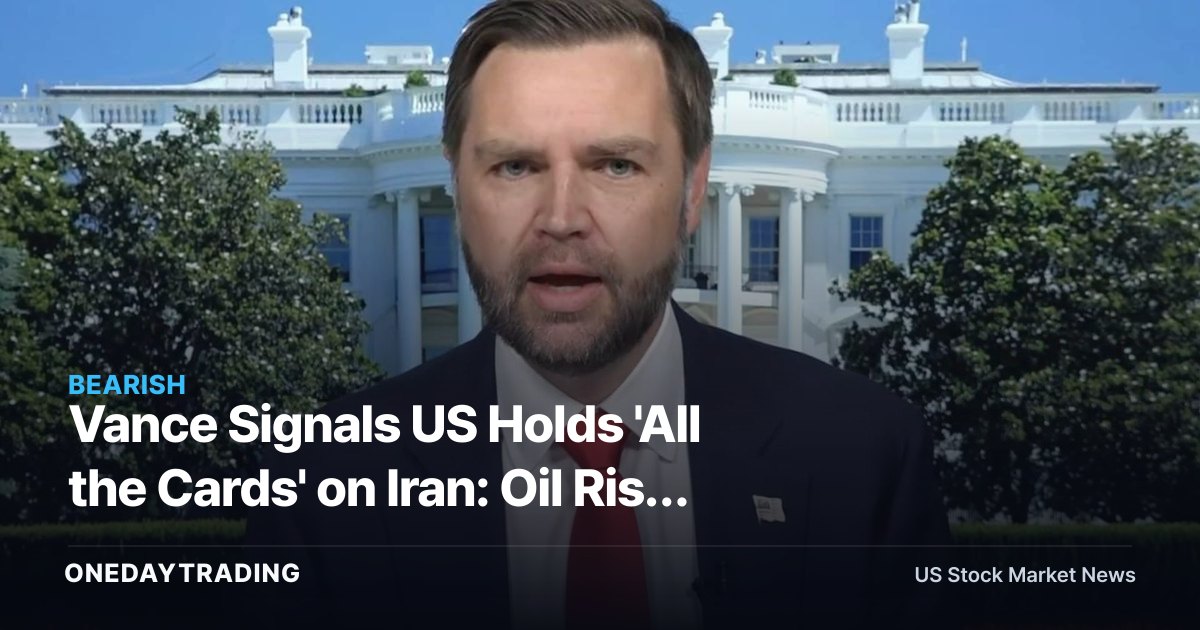
Vice President JD Vance told CNBC's Squawk Box that the United States holds the upper hand in upcoming negotiations with Iran, while acknowledging that many details remain unresolved. For markets, the relevant transmission line is crude oil: diplomacy that lowers Middle East tension tends to bleed the risk premium out of prices, which flows directly into energy-sector earnings.
The Full Story
The headline is political, but the price action it can drive is concentrated in one place. When a senior official frames Washington as negotiating from strength and signals a path toward an agreement, traders read it as a lower probability of supply disruption through the Strait of Hormuz and the broader Gulf. That perceived de-escalation is what compresses the geopolitical premium embedded in Brent and WTI.
Vance's caveat that a lot still has to be figured out matters just as much as his confidence. Talks that stall, or that collapse over enrichment and sanctions terms, would push the premium back in the other direction. So the same comments that sound bearish for crude also keep a two-way risk alive, because nothing has been signed.
Structural Background
Iran sits among the larger crude producers within OPEC, and the question of whether its barrels flow freely under eased sanctions versus stay constrained is a real swing factor for global supply balances. A diplomatic thaw that eventually loosens export restrictions would add barrels to an already well-supplied market; a breakdown would tighten it and revive fears around shipping lanes that carry a large share of seaborne oil.
Stock & Sector Ripple
- ExxonMobil (XOM): Upstream-heavy earnings are highly geared to realized crude prices, so a fading risk premium pressures per-barrel margins even if production volumes hold.
- Chevron (CVX): Similar oil-price sensitivity through its production segment; lower crude weakens cash flow that funds dividends and buybacks.
- ConocoPhillips (COP): As a pure-play explorer and producer, it carries the most direct leverage to spot prices among the majors, amplifying both upside and downside.
- Occidental (OXY): A leveraged, US-focused producer whose equity tends to move more than crude itself on supply-narrative shifts.
- Refiners and airlines: Move the opposite way — cheaper crude can widen refining inputs cost relief and lower jet-fuel expense, a partial offset within the energy complex.
Bull vs Bear Scenarios
Bear case for oil and producers: a credible deal trajectory keeps tension low, supply expectations rise, and the premium drains out, capping crude and energy equities. Bull case: negotiations are long and fragile, and any hint of failure, enrichment disputes, or fresh sanctions snaps the premium back, lifting prices and producer margins. The key variable is execution risk on the details Vance flagged, not the rhetoric itself.
Investor Action Points
- Track WTI and Brent reaction to each round of US-Iran headlines as the cleanest real-time gauge of how markets price the premium.
- Watch for concrete terms on sanctions relief and Iranian export volumes — that is what actually changes the supply balance, not statements about leverage.
- In energy earnings, focus on realized crude prices and free cash flow rather than headline output when the price backdrop shifts.
- Use a defined crude level as a checkpoint for energy-sector positioning, and remember the trade can reverse sharply if talks break down.
📊 Analysis
Signal Bearish
Why Signals of US-Iran de-escalation tend to drain oil's geopolitical risk premium, pressuring crude prices and oil-leveraged producer earnings.
This article was independently written by OneDayTrading from public reporting. Read the original (CNBC)