At a Glance
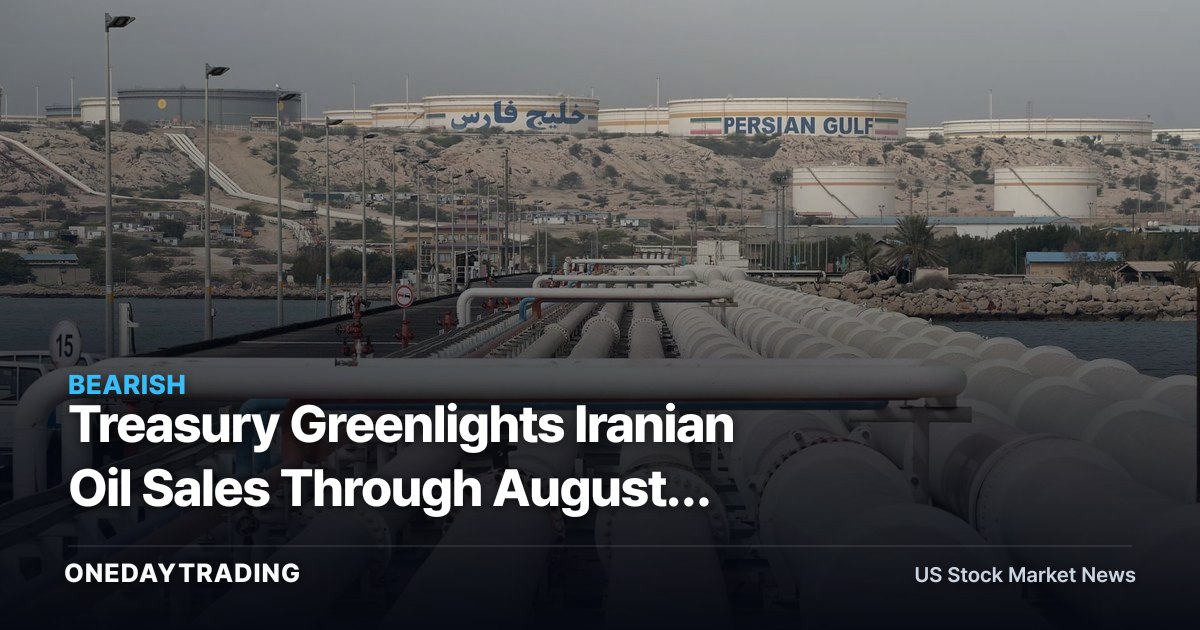
The U.S. Treasury Department has authorized Iranian oil sales through August, and Iranian supertankers that went dark during the recent conflict have switched their transponders back on as they leave the region loaded with crude. For investors, the signal is supply-side: more barrels heading to market lean bearish on oil prices, which directly shapes the earnings math for U.S. producers and the input costs for refiners.
Why It Matters Now
Iranian crude that had effectively vanished from visible flows during the war is re-entering the tracked market. When tankers reactivate transponders and depart fully loaded, it tells traders that physical barrels are moving rather than sitting in floating storage. Incremental supply with no matching jump in demand mechanically caps prices, and oil producers are price-takers whose revenue per barrel falls in lockstep with the benchmark.
The pain is not evenly distributed. Upstream producers such as ExxonMobil, Chevron, ConocoPhillips and Occidental see cash flow compress fastest when realized prices slip, because a large share of their profit sits in the spread between a fixed cost of production and a floating sale price. Refiners run the opposite playbook: cheaper feedstock can widen crack spreads if product demand holds, making names like Valero and Marathon Petroleum a partial hedge against the same move that hurts the drillers.
The policy channel matters too. An authorization that runs only through August is a time-boxed window, not a permanent reopening, so the supply impulse could prove temporary if the license lapses or geopolitical tension flares again. That uncertainty is itself a risk premium that can swing crude in either direction on headlines.
FAQ
- Why does Iranian oil returning push prices down? Added supply without added demand loosens the global balance, and crude is priced at the margin where the last barrel sets the level.
- Who actually benefits? Refiners and heavy crude importers gain from lower feedstock costs, while consumers and transport-heavy businesses see fuel relief.
- Is this a permanent shift? No — the authorization is scoped through August, so the supply effect may reverse if the window is not extended.
- What could offset the bearish read? OPEC+ production restraint, stronger summer demand, or renewed regional conflict could absorb or reverse the added barrels.
Related Stocks & Sectors
- ExxonMobil and Chevron — integrated majors whose upstream revenue tracks the crude benchmark; softer prices pressure per-barrel margins.
- Occidental and ConocoPhillips — leveraged pure-play producers with high sensitivity to realized oil prices.
- Valero and Marathon Petroleum — refiners that can benefit from lower input costs if crack spreads hold.
- Energy sector and oilfield services — capital spending and drilling activity soften when producers expect a weaker price deck.
What to Watch
- Whether the August authorization window is extended, narrowed, or allowed to expire.
- WTI and Brent benchmark levels in coming weeks as tracked Iranian volumes rise.
- OPEC+ supply decisions, which could counterbalance the added barrels.
- Refiner crack spreads and producer guidance at the next round of energy earnings.
Overall Outlook
The bull case for crude rests on resilient summer demand, disciplined OPEC+ output and the chance the license window closes quickly, any of which could re-tighten the balance. The bearish case is straightforward: visible Iranian barrels are back in motion under official sanction, and a market already balancing supply against fragile demand tends to absorb extra crude through lower prices. The asymmetry favors producers as the most exposed group and refiners as the natural offset, with the August deadline functioning as the key variable that decides how durable the supply impulse turns out to be.
📊 Analysis
Signal Bearish
Why Authorized Iranian oil sales add visible supply to an already-balanced market, pressuring crude prices and the realized margins of U.S. producers.
Tickers$XOM$CVX$COP$OXY$VLO$MPC
This article was independently written by OneDayTrading from public reporting. Read the original (CNBC)