Summary
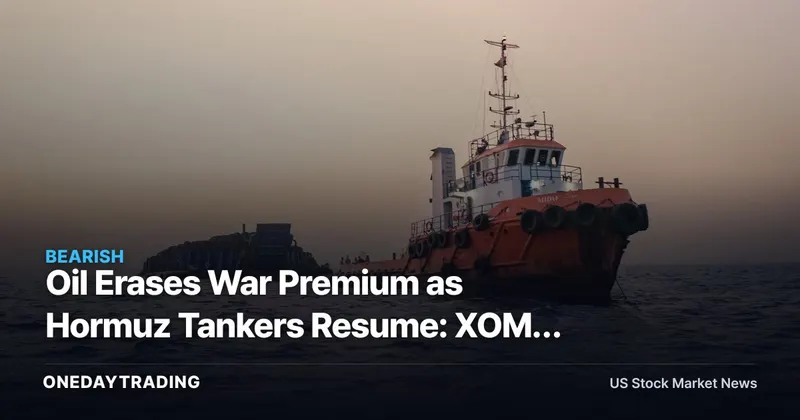
Crude oil has surrendered the gains it built during the recent Persian Gulf conflict, with prices sliding as tankers stranded for months near the Strait of Hormuz begin moving again. The reopening of the world's most critical oil chokepoint removes the supply-disruption premium that had been priced into barrels. For investors, the read-through splits cleanly: upstream producers lose pricing tailwind, while fuel-heavy consumers like airlines and refiners stand to claw back margin.
The Full Story
The catch is that the rally was never about new demand. It was a fear trade built on the threat that traffic through the Strait of Hormuz, the passage handling roughly a fifth of global seaborne crude, could be choked off. With tankers that had been bottled up in the Gulf for months now sailing out, traders are betting physical supply normalizes faster than feared.
That repricing matters more than the headline drop suggests. When a geopolitical premium deflates, it tends to do so quickly and in one direction, because the speculative length that drove prices up unwinds at the same time hedgers re-enter. The same flows that lifted crude during the standoff now work in reverse.
Structural Background
Hormuz has no real substitute. Pipeline bypass capacity around the strait covers only a fraction of the volume that transits it, so any genuine closure would be a supply shock. The flip side is that the market is hypersensitive to signals the lane is clearing, which is exactly what resuming tanker traffic provides. The premium and its collapse are two faces of the same chokepoint risk.
Stock & Sector Ripple
- Integrated majors (XOM, CVX): Upstream cash flow tracks realized crude prices, so a fading war premium trims the earnings tailwind their exploration-and-production segments enjoyed during the spike.
- Oil ETFs (USO): Directly tied to front-month crude futures, these move nearly one-for-one with the price retreat.
- Refiners (VLO, MPC): Lower crude feedstock costs can widen crack spreads if product prices hold, a relative positive versus pure producers.
- Airlines (DAL, UAL): Jet fuel is one of the largest operating costs; cheaper crude flows straight to margin and is a clean cost tailwind.
Bull vs Bear Scenarios
The bear case for crude is that supply fear, not fundamentals, drove the move, so normalization simply returns prices toward pre-conflict levels. The counter-scenario is that the Gulf situation remains fragile: any renewed friction around Hormuz could snap the premium back on within hours, since the underlying chokepoint vulnerability is unchanged. Producers also retain supply discipline as a floor under prices.
Investor Action Points
- Track whether Hormuz tanker traffic stays steady or stalls again, the single variable driving the premium.
- Watch energy-major guidance at the next earnings round for how much realized-price weakness flows through to cash flow.
- For refiners and airlines, monitor crack spreads and fuel-cost commentary as the inverse beneficiaries.
- Use the futures curve and front-month crude as a real-time gauge of how much war premium remains priced in.
📊 Analysis
Signal Bearish
Why Resuming Hormuz tanker traffic removes the supply-disruption premium, pressuring crude prices and the realized-price earnings tailwind for upstream energy producers.
Tickers$XOM$CVX$USO$VLO$DAL
This article was independently written by OneDayTrading from public reporting. Read the original (CNBC)