Federal Reserve Pause Leaves December as the Live Policy Question
The Federal Reserve held interest rates steady at its October meeting, making the next policy decision the immediate issue for rate-sensitive investors. CNBC reported the decision on 2026-10-28 after the central bank had raised rates at its September meeting. The pause does not establish a new direction: the current federal funds rate level was not provided, and the Federal Reserve said further information would guide its effort to return inflation to its goal.
A rate pause means the central bank leaves its policy setting unchanged at a meeting rather than voting to raise or lower it. Here, the significance lies in the sequence. The Federal Reserve raised rates by 25 basis points at the September meeting, then declined to extend that move in October even though the article said U.S. inflation remained above the central bank’s annualized 2% target rate.
That combination creates a narrow, evidence-based thesis. October delivered no additional tightening, while the inflation condition and the probability attached to December leave another increase in contention. The facts support uncertainty between meetings, not a conclusion that the rate cycle has ended or that a December move is assured.
Jeff Gundlach Argues the September Increase Was Too Small
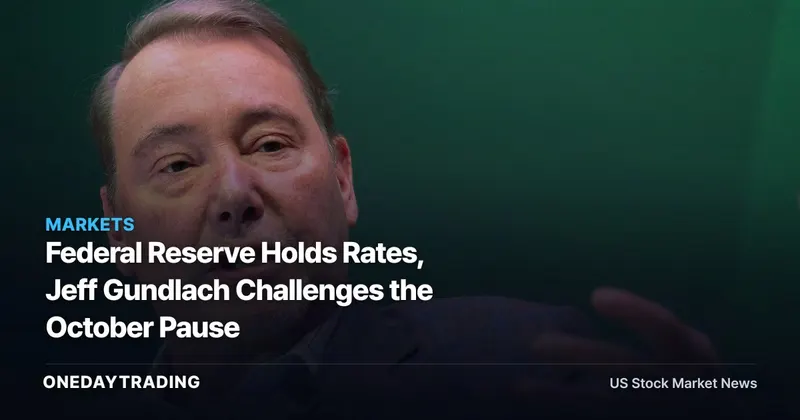
Jeff Gundlach, the founder of DoubleLine, questioned why the central bank was waiting to raise rates further. Speaking to CNBC, he asked, “What are you waiting for?” His criticism focused on the pace and scale of tightening rather than on the fact that September produced an increase.
Jeff Gundlach argued that the Federal Reserve should have raised rates by 50 basis points at the September meeting, instead of the 25-basis-point increase it delivered. His stated concern was that the scale of the U.S. inflation picture was not being fully respected while inflation remained above the Federal Reserve’s annualized 2% target rate.
The distinction matters for interpreting his position. A call for 50 basis points at the September meeting is an argument for a larger move at that meeting; it is not evidence that the Federal Reserve has adopted that view. October’s unchanged decision confirms that the central bank did not continue raising rates at the next gathering.
Nor does Gundlach’s challenge supply the missing inflation figure. The available evidence establishes only that inflation was above the annualized 2% target rate. Without the actual inflation rate or the unchanged federal funds rate level, the size of the policy gap cannot be quantified from the supplied information.
FedWatch Prices a December Increase, Not a Certainty
CME’s FedWatch tool indicated an 85% chance that the Federal Reserve would raise rates by 25 basis points at the December meeting. That is the clearest available measure of what is already reflected in expectations after the October pause. It describes a probability assigned to a specific December outcome, not a completed policy decision.
The remaining uncertainty is economically important even without adding unsupported market forecasts. If the Federal Reserve raises rates by 25 basis points in December, the October pause would stand between the September increase and another tightening step. If it holds again, the outcome would diverge from the scenario carrying the 85% FedWatch probability in the supplied evidence.
The Federal Reserve’s own statement keeps that decision conditional. It said further information would determine the correct policy for returning inflation to its 2% goal. The source does not identify what information will be used, so no particular release, indicator or threshold can be presented as the decisive trigger.
Investors therefore have distinct items to separate. The confirmed fact is an unchanged October decision. The market-based input is CME’s 85% probability of a 25-basis-point December increase. The unresolved policy input is the further information the Federal Reserve said it would assess before deciding how to pursue its inflation goal.
Warsh Reshapes the Meeting Calendar Without Predetermining Rates
Fed Chairman Warsh announced that 1 meeting in 2027 and 2 meetings in 2028 would focus on monetary policy strategy, with no vote at those gatherings on altering the federal funds rate. The Federal Reserve has 8 scheduled gatherings, according to CNBC’s reporting. This announcement concerns the purpose and voting status of selected meetings; it does not state what rate decisions will occur at the other gatherings.
The strategy sessions should also be kept separate from the December question. FedWatch addresses the probability of a 25-basis-point increase at the December meeting, while Fed Chairman Warsh’s announcement concerns designated meetings in 2027 and 2028. Combining those facts into a forecast about the future path of rates would go beyond the evidence.
No specific dates were supplied for the October or December meetings, or for the designated gatherings in 2027 and 2028. The evidence also does not identify individual stocks, industries or listed companies as winners or losers from the pause. Assigning company-specific revenue, valuation or balance-sheet effects would therefore require facts that are absent from the record.
The next concrete checkpoint is the December meeting itself: whether the Federal Reserve delivers the 25-basis-point increase associated with the 85% FedWatch probability, or leaves rates unchanged again. The live risk runs in both directions. Above-target inflation supports Gundlach’s case for stronger action, while the October decision and the Federal Reserve’s dependence on further information prevent that case from becoming a certain outcome.
📊 Analysis
Signal Neutral
Why The October pause leaves policy unchanged, while the FedWatch probability and above-target inflation preserve the possibility of a December increase.
This article was independently written by OneDayTrading from public reporting. Read the original (CNBC)