Key Takeaways
Washington's sweeping rollback of sanctions on Iranian crude reopens a supply channel that had been throttled for years, and more barrels chasing the same demand is fundamentally bearish for oil prices. The clearest losers are U.S. exploration and production names leveraged to the per-barrel price, while fuel-intensive consumers such as airlines stand to gain.
What Happened
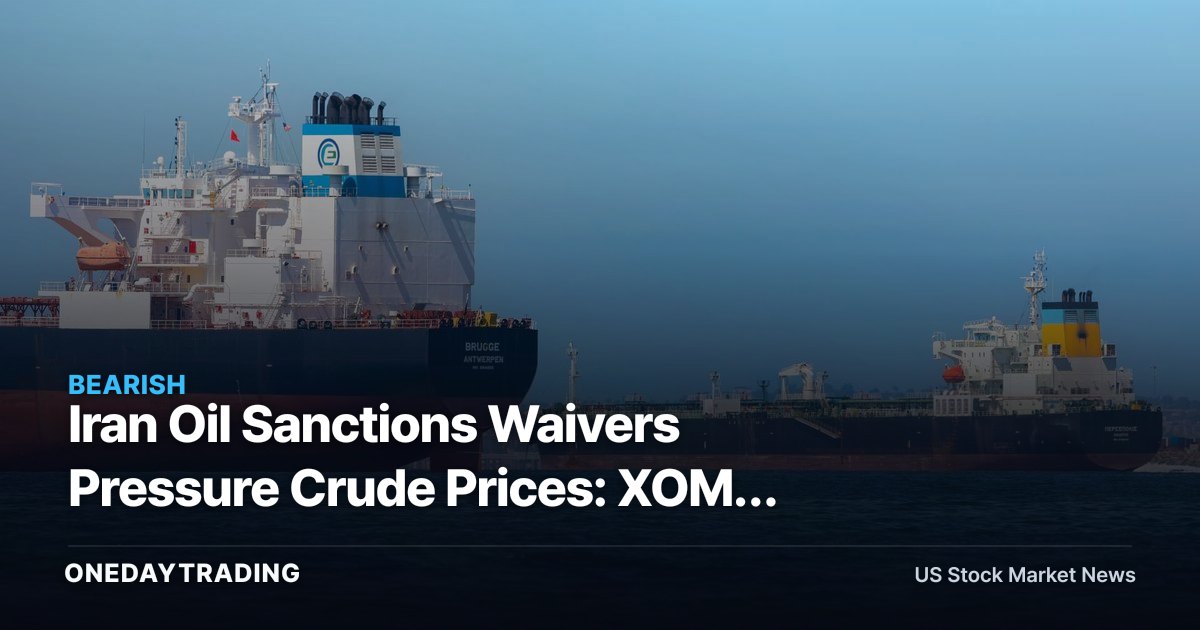
The United States issued a broad set of waivers easing sanctions on Iranian oil, framed as an economic lifeline for Tehran as negotiations toward a peace deal advance. The practical effect is that Iranian crude that had been pushed into discounted gray-market channels can move more freely, unlocking what officials describe as billions of dollars in revenue for Iran.
For the physical market, the question is not whether Iran can pump but whether it can sell openly. Removing the legal friction on buyers, insurers, and shippers lowers the discount Iran must offer and raises effective export volumes. Each incremental barrel reaching the market loosens the global balance at a time when OPEC+ spare capacity is already a recurring overhang on price.
Background and Context
Iran sits among the largest holders of proven oil reserves, and its barrels had been constrained mainly by enforcement rather than geology. Sanctions relief therefore acts faster than new drilling: production that was idled or sold at deep discounts can re-enter legitimate trade within weeks rather than years, amplifying the near-term supply impulse.
Market and Stock Impact
- ExxonMobil (XOM), Chevron (CVX): Integrated majors earn upstream margins tied to realized crude prices; a softer benchmark compresses high-margin production cash flow even if downstream refining partly offsets it.
- Occidental (OXY), ConocoPhillips (COP): Pure-play and production-weighted producers carry the most direct price leverage, so falling crude hits earnings and buyback capacity hardest.
- Airlines (DAL, UAL): Jet fuel is a top operating cost; cheaper crude flows straight to margins and is a counterweight to the energy-sector hit.
- Refiners: Lower feedstock costs can widen crack spreads, making refining-heavy operators relative beneficiaries versus upstream peers.
Investor Checkpoints
- Watch WTI (CL=F) and Brent levels for confirmation that the market is pricing real incremental Iranian barrels rather than just headlines.
- Track whether the peace negotiations actually close; a stalled deal or reimposed sanctions would reverse the supply thesis quickly.
- Monitor OPEC+ messaging, since the cartel could trim output to defend price and blunt the Iranian impact.
- Review next earnings from XOM, CVX, and OXY for realized-price commentary and capital-return guidance.
Outlook
The supply-side logic points lower for crude and pressures U.S. producers, but the bear case is far from locked in. Diplomacy can unravel, OPEC+ can offset added barrels, and global demand or geopolitical flare-ups elsewhere could absorb the surplus. The signal to weigh is execution: legal access matters only if buyers, financing, and shipping follow, and that is where the price reaction will ultimately be settled.
📊 Analysis
Signal Bearish
Why Sanctions relief adds Iranian crude supply to the global market, a downward pressure on oil prices that squeezes U.S. upstream producers' margins.
Tickers$XOM$CVX$OXY$COP$DAL
This article was independently written by OneDayTrading from public reporting. Read the original (CNBC)