At a Glance
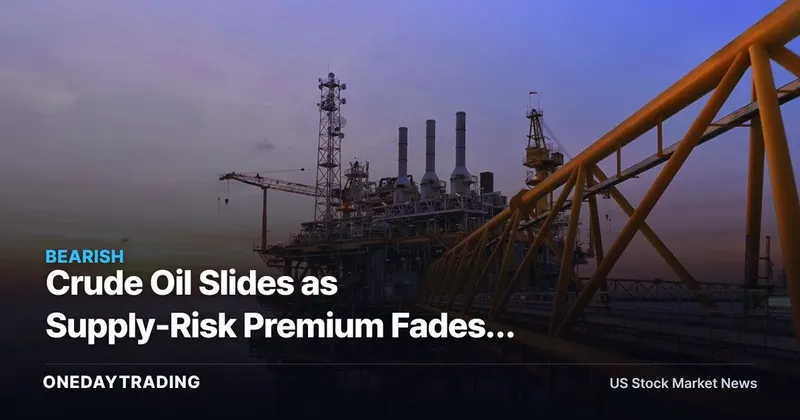
Crude oil fell sharply as the market priced out a chunk of the geopolitical risk premium it had been carrying, on signs that feared disruptions to global supply are less likely to materialize. The move reverses the fear-driven bid and shifts the question from supply scarcity back to demand and inventories. Lower crude is a margin headwind for upstream producers and a cost tailwind for fuel-intensive buyers.
Why It Matters Now
Oil is a price-of-fear asset at the margin. When traders bid crude on the threat of a supply outage, they are paying for a barrel that has not actually gone missing. Once that outage looks improbable, the premium unwinds fast — and the unwind is mechanical, not sentimental. That is the cleanest read of a sharp single-session drop tied to easing supply risk rather than a demand shock.
The capital-cycle reality underneath matters more than the headline. Producer cash flow scales almost linearly with the realized price per barrel against a largely fixed cost base, so a lower strip compresses upstream operating leverage first and hardest. Integrated majors with downstream refining and chemicals cushion some of that, because cheaper feedstock can widen crack spreads even as upstream realizations fall. The pure exploration-and-production names and oilfield-service providers, whose backlogs track drilling budgets, carry the most direct exposure to a softer price deck.
On the other side of the ledger, every fuel-burning business gets a quiet boost. Jet fuel, diesel and bunker costs move with crude, so airlines, trucking and shipping see input relief that flows straight to operating margin if ticket and freight pricing holds. The risk to that bull case: a price drop driven by demand fears would erode the very volumes those carriers need, so the source of the decline — supply relief, not demand collapse — is the variable that decides who actually wins.
FAQ
- Why did oil fall? The market unwound a geopolitical risk premium as fears of global supply disruption eased, removing a fear bid rather than reflecting weaker consumption.
- Who loses from cheaper crude? Upstream producers and oilfield-service firms, whose revenue tracks the realized barrel price against a fixed cost base.
- Who benefits? Fuel-intensive sectors — airlines, trucking, shipping — and refiners that buy crude as feedstock.
- Is this a lasting move or a reversal of fear? A risk-premium unwind can be sharp but shallow; the durable direction depends on inventories, OPEC+ output policy and demand data.
Related Stocks & Sectors
- Exxon Mobil (XOM) — integrated major; upstream realizations fall with crude, partly offset by downstream margins.
- Chevron (CVX) — high upstream weighting leaves cash flow sensitive to the price deck.
- ConocoPhillips (COP) — pure-play E and P with the most direct leverage to lower oil.
- Halliburton (HAL) — oilfield services; activity budgets shrink if a softer strip persists.
- Delta Air Lines (DAL) — jet-fuel relief supports operating margin if travel demand holds.
What to Watch
- Weekly U.S. crude and product inventory builds or draws as confirmation of the supply read.
- The next OPEC+ output decision and any signal on production quotas.
- Whether the decline broadens into demand-sensitive products like diesel and jet fuel.
- Energy producer guidance on capex and breakeven prices at the coming earnings cycle.
Overall Outlook
The bull case for cheaper crude is simple cost relief flowing to consumers and fuel-heavy operators, with refiners potentially capturing wider spreads. The risk is symmetry: a risk-premium unwind can reverse just as fast if the supply threat resurfaces, and producers face genuine cash-flow compression if the lower deck holds. The decisive variable is whether the next inventory and demand prints confirm supply comfort or expose softening consumption — the same drop means very different things depending on which it is.
📊 Analysis
Signal Bearish
Why A sharp crude decline compresses upstream producer cash flow and drilling budgets, the most directly exposed names in the story.
Tickers$XOM$CVX$COP$HAL$DAL
This article was independently written by OneDayTrading from public reporting. Read the original (Yahoo Finance)