What Changes
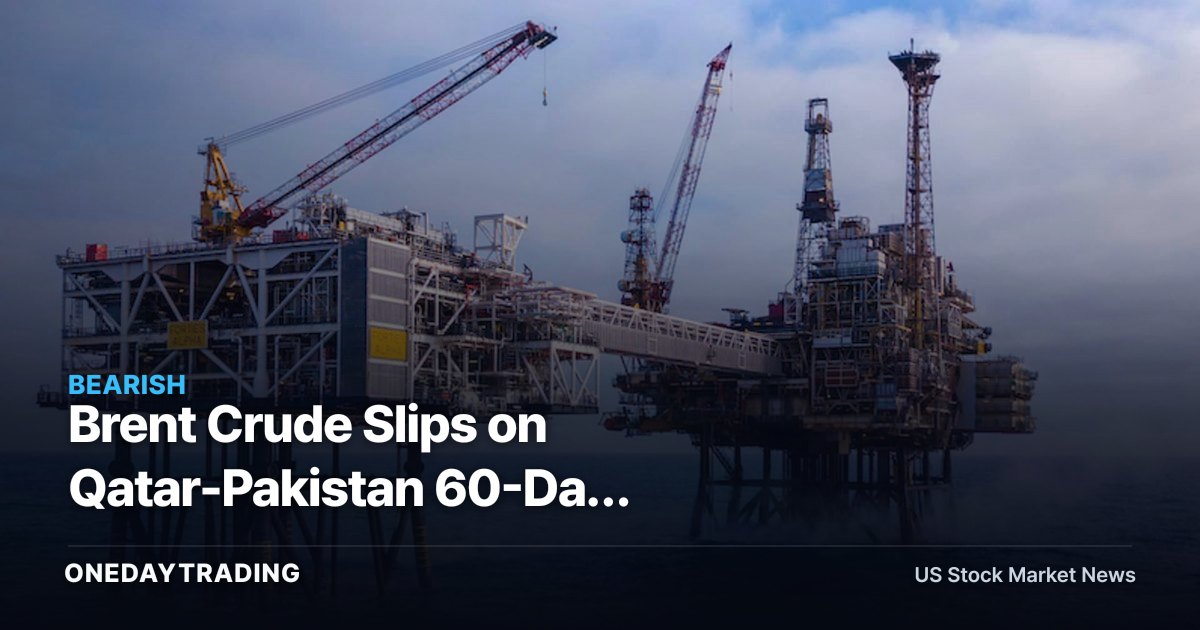
The market reaction is the story here. A direct U.S. military threat against a major OPEC producer would normally lift crude on supply-disruption fears, yet Brent moved lower. That tells you traders are pricing the Qatar-Pakistan mediation as the more probable near-term path, treating Trump's rhetoric as leverage rather than imminent action.
The 60-day framework matters because it converts open-ended tension into a bounded timeline. Markets dislike uncertainty more than bad news with a date attached. A two-month diplomatic window gives oil bears a reason to fade rallies, since any sanctions easing on Iranian barrels would add supply to an already well-stocked market.
The risk is asymmetric, though. Diplomacy that fails near the 60-day mark could snap the risk premium back violently, especially if the military threat is renewed at that point.
By the Numbers
The concrete anchor is the 60-day roadmap timeline set by Qatar and Pakistan, the two named mediators. Brent's slip came on the same session as the Trump threat, the key behavioral signal that supply-risk pricing is currently subordinate to the diplomatic track.
Winners and Losers
- Oil majors (XOM, CVX): Lower Brent pressures upstream realizations and cash flow; their earnings lever directly to the crude price, so a fading risk premium trims the top line.
- Refiners (VLO, MPC): Relative beneficiaries — cheaper crude feedstock can widen crack spreads if product prices hold, improving refining margins.
- Airlines (DAL, UAL): Jet fuel is a top cost line; softer crude is a direct margin tailwind for carriers heading into peak travel.
- Iran-deal sensitivity: Any actual sanctions relief would add Iranian barrels to global supply, a structural headwind for producer pricing power.
Risk Check
- Diplomacy is fragile — a breakdown near day 60 could spike crude and reverse the trade fast.
- The military threat remains live; a single escalation headline can override the mediation narrative intraday.
- OPEC+ output decisions and demand data still drive the longer-term price, independent of Iran.
- Refiner and airline gains depend on product demand holding, not just on cheaper crude.
Bottom Line
The 60-day roadmap gives oil a downside bias as the risk premium deflates, favoring fuel buyers like refiners and airlines over upstream majors — but the same bounded timeline sets up a sharp reversal if talks collapse, so the Iran headline risk has not disappeared, only been deferred.
📊 Analysis
Signal Bearish
Why Brent slipped as a defined 60-day U.S.-Iran diplomatic roadmap deflated the geopolitical risk premium, pressuring oil producer pricing.
Tickers$XOM$CVX$VLO$MPC$DAL$UAL
This article was independently written by OneDayTrading from public reporting. Read the original (CNBC)