Why the 4.3% GDP Reading Matters for Investors
The Commerce Department’s third-quarter GDP revision changes the macro signal more than it changes the known political facts. Real GDP is the inflation-adjusted value of economic output, and an annualized rate expresses a quarter’s pace as though it continued for a full year. The second release therefore describes stronger third-quarter growth than the advance estimate did; it does not settle where the final revised figure will land.
For investors, the central tension runs from growth to Fed policy and then to the assumptions embedded in equity valuations. Stronger activity can support expectations for business conditions, while also giving monetary policymakers more room to raise rates. Jim Baird of Plante Moran Financial Advisors said the release “reinforces an increasingly familiar tension”: the economy is performing well, while that resilience strengthens the Fed’s case for further rate hikes.
The tape appears to have priced the immediate policy direction aggressively. According to the CME FedWatch tool, traders assigned a nearly 100% chance to a rate hike at the Federal Open Market Committee’s December meeting. That pricing leaves less room for the GDP revision itself to create a fresh rates surprise; what remains unpriced is whether the anticipated December or January increases actually occur and how later GDP revisions alter the growth assessment.
President Donald Trump’s Claim Versus the Revision Record
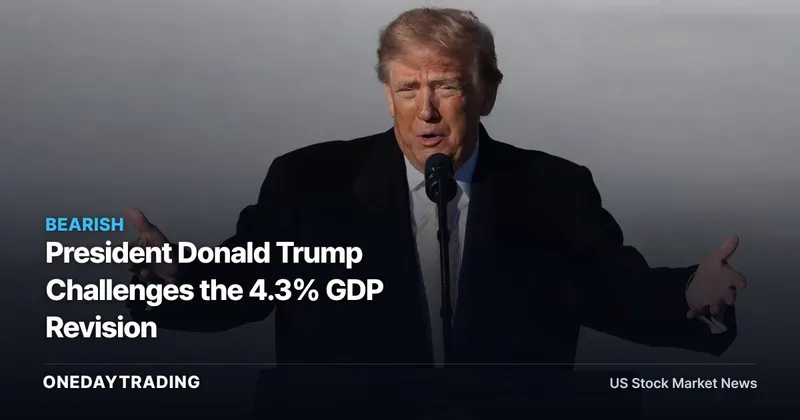
President Donald Trump described the revision as a mistake and demanded an investigation. CNBC reported that his claim of a record-setting error was false. The third-quarter change was 0.9 percentage points, making it the largest revision since the 1.2 percentage point change recorded in the second quarter of 2020.
The longer comparison further narrows the claim. CNBC found that the latest change was tied for 16th on an absolute basis among revisions from the advance estimate to the second release since 1990. The 0.9 percentage point adjustment was roughly twice the average revision of 0.43 percentage points across all 147 quarters analyzed, which makes it large relative to the sample average without making it unprecedented.
This distinction matters for market analysis. The size of the adjustment raises valid questions about how much confidence investors should place in an advance estimate. Its historical rank also prevents an unusually large revision from being treated as evidence, by itself, of a uniquely extreme statistical failure.
How GDP Revisions Work—and What Is Still Unsettled
Initial economic reports rely on partial survey data and early estimates. The figures are updated as additional survey responses arrive, so the advance estimate is designed to be revised rather than treated as a final measurement. U.S. GDP data continue to undergo revisions over a five-year period.
The remaining measurement risk is material. CNBC reported an average absolute error of 1.14 percentage points between the second release and the final revision. That historical average does not predict the direction or size of the eventual third-quarter change; it shows why the current 4.3% annualized rate should be read as a later estimate, not a permanent final figure.
The advance estimate was released days before Election Day in early November and exceeded economists’ expectations at the time. Whether the initial estimate influenced the midterm election results is unknown. It is also unknown whether an investigation will begin or who would conduct one, so neither political claim can yet be translated into a confirmed institutional outcome.
The Rates Trade: What Is Priced and What Is Not
- Already reflected: The CME FedWatch tool’s nearly 100% probability for a rate hike at the Federal Open Market Committee’s December meeting indicates that traders already expect tighter policy at that meeting.
- Still conditional: Market pricing is an expectation, not a decision. The anticipated December and January rate hikes have not been confirmed as outcomes.
- Growth support: Jim Baird said, “The economy isn’t merely hanging in there.” His assessment linked resilience to consumer spending, business investment and limited evidence of restrictive monetary policy creating broad cracks in the expansion.
- Valuation risk: If stronger growth sustains the case for further rate increases, equity valuations that depend on a less restrictive Fed may face pressure. If later evidence weakens that case, the policy tension identified by Baird could ease.
White House Response and the Evidence Boundary
White House spokesman Matthew Middleton told CNBC that the revision showed President Donald Trump’s policies were “delivering results.” That statement is an administration interpretation of the higher growth estimate. The fact sheet confirms the revised GDP rate and Middleton’s attribution, but it does not establish a causal allocation of the revision to any specific policy.
The political dispute therefore sits beside, rather than above, the statistical record. One question concerns whether a large revision followed the advance estimate; the 0.9 percentage point change confirms that it did. A separate question concerns intent, electoral influence or procedural wrongdoing, none of which is established by the available facts.
CNBC identified Jeff Cox and Fred Imbert as contributors to the reporting. The publication date shown in the CNBC URL is 2026-11-26. Those details identify the timing and provenance of the account without resolving the unanswered questions about a possible investigation or the eventual final GDP figure.
Next Checkpoints for the Fed and GDP Debate
- Federal Open Market Committee decision: Compare the December outcome with the nearly 100% rate-hike probability shown by the CME FedWatch tool. The gap between pricing and the actual decision is the immediate market risk.
- January policy outcome: Traders also anticipated an additional January increase, though whether that hike occurs remains unknown.
- Subsequent GDP releases: Track whether the third-quarter growth estimate stays near the Commerce Department’s 4.3% annualized rate or changes as more information enters the calculation.
- Investigation status: Look for confirmation that a review has opened and identification of the body conducting it. President Donald Trump’s demand alone does not establish either development.
Bottom Line: Stronger Growth, Less Policy Relief
The higher third-quarter GDP estimate strengthens the evidence for economic resilience and simultaneously reinforces the Fed’s case for additional tightening. That is the investable tension: growth is stronger than the advance estimate indicated, while traders have already placed a nearly 100% probability on a December rate hike. The next decisive information will come from the Federal Open Market Committee’s actual decision and later Commerce Department revisions—not from treating either the current 4.3% annualized rate or the political response as the final word.
📊 Analysis
Signal Bearish
Why Stronger reported growth reinforces the Fed's case for further rate hikes, while traders already price a nearly 100% chance of a December increase.
This article was independently written by OneDayTrading from public reporting. Read the original (CNBC)