Nvidia’s Rebound Turned Leverage Into the Main Event
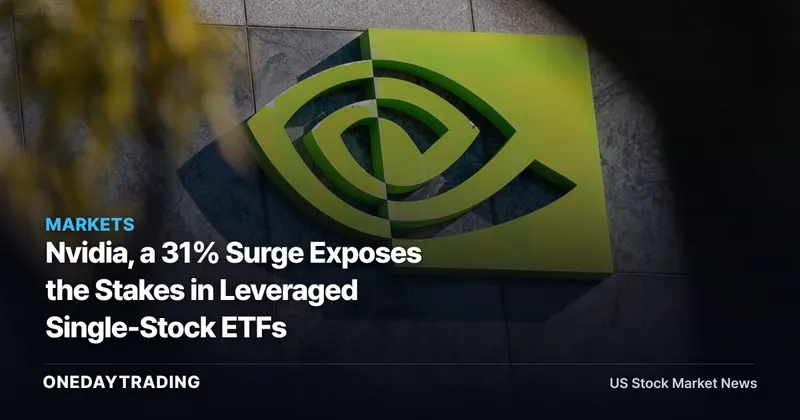
Nvidia’s 31% surge during Monday’s session made leveraged NVDA funds the clearest expression of the stock’s volatility. The move rewarded long exposure and severely damaged short exposure, then lost momentum as Nvidia shares cooled on Tuesday and Wednesday. For investors, the central issue is not simply choosing the right direction; it is recognizing how much the result can change when that direction is expressed through leverage.
CNBC reported that the GraniteShares 2x Short NVDA Daily ETF (NVD) sank 63% on Monday after Jensen Huang was reinstated as Nvidia’s CEO. The 2x Long NVDA ETF (NVDL) rose nearly 62% on the same day. Those opposing moves show that a sharp change in the underlying stock can rapidly separate the outcomes of long and short products tied to the same company.
What Happened Across Nvidia, NVD and NVDL
Nvidia shares soared 31% during Monday’s session, according to CNBC. The short fund moved sharply against that rally, while the long fund moved with it. The contrast placed the exposure design of each ETF—not a separate operating development at the fund provider—at the center of the trading outcome.
The reversal did not continue in a straight line. Nvidia shares cooled on Tuesday and Wednesday, introducing a different directional environment immediately after Monday’s advance. That sequence matters because the week contained both a forceful rise and a subsequent moderation, leaving investors to evaluate a changing path rather than a single isolated move.
As of Wednesday’s close, the GraniteShares 2x Short NVDA Daily ETF had plunged 55% so far that week, while the GraniteShares 2x Long NVDA Daily ETF was up 31%. The gap between Monday’s moves and the week-to-date readings shows that later trading altered the cumulative picture for both sides. It does not establish future performance.
Why the Nvidia ETF Structure Raises the Stakes
A leveraged single-stock ETF is a fund designed to provide amplified directional exposure to one underlying company. In this case, the product names identify both the reference stock and the direction: NVD is tied to short Nvidia exposure, while NVDL is tied to long Nvidia exposure.
The evidence illustrates the practical consequence. When Nvidia climbed on Monday, NVD suffered and NVDL advanced; when Nvidia cooled over the following sessions, the week-to-date results shifted away from Monday’s endpoints. The instruments therefore required investors to be right not only about Nvidia’s direction, but also about how the path unfolded across the sessions described.
Mike Akins, a founding partner of ETF Action, summarized the execution problem in CNBC’s coverage: “timing the market is very, very hard.” That warning is especially relevant when an underlying share move and opposing leveraged exposures produce sharply different outcomes within the same week.
What the Moves Do—and Do Not—Say About the AI Trade
The confirmed figures establish volatility in Nvidia and in the linked GraniteShares products. They do not establish a change in Nvidia’s revenue, orders, shipments, margins or competitive position. None of those operating measures appears in the supplied evidence, so the ETF swings should not be treated as a substitute for semiconductor fundamentals.
The facts also do not explain why Jensen Huang resigned or why he was reinstated. They establish only that his reinstatement preceded Monday’s reported moves. That distinction prevents a sequence of events from being stretched into an unsupported account of motive or broader corporate impact.
GraniteShares also offers leveraged single-stock ETFs tied to Anthropic: the 2x Short Anthropic Daily ETF (ANS) and the 2x Long Anthropic Daily ETF (AIL). Will Rhind, the founder and CEO of GraniteShares, discussed those launches as Nvidia-linked short funds drew attention. The evidence provides no performance figures for ANS or AIL, so no comparison with the Nvidia products can be quantified.
Market Impact: Direction Was Decisive, Persistence Was Not
- Nvidia: The stock’s 31% Monday advance drove the week’s central directional move, followed by cooling on Tuesday and Wednesday. The available record supports a volatility assessment, not a conclusion about the company’s future operating performance.
- GraniteShares 2x Short NVDA Daily ETF (NVD): Its 63% Monday decline shows the damage short exposure faced during Nvidia’s rebound. The 55% loss so far that week as of Wednesday’s close confirms that subsequent cooling changed the magnitude without erasing the adverse weekly result.
- 2x Long NVDA ETF (NVDL): Its nearly 62% Monday gain captured the favorable side of the underlying rally. By Wednesday’s close, the corresponding GraniteShares long fund was up 31% so far that week, demonstrating that the initial surge did not define the entire weekly outcome.
- Leveraged single-stock ETFs: The opposing results make exposure direction and holding path central analytical variables. Karen Finerman, co-founder and CEO of Metropolitan Capital Advisors, framed the risk directly on CNBC: “You can survive anything but leverage.”
Investor Checkpoints After Nvidia’s Volatile Week
- Track the underlying stock first: The next observable check is whether Nvidia extends the cooling seen on Tuesday and Wednesday or changes direction again. The fact sheet supplies no later performance outcome.
- Compare daily and week-to-date readings: Monday’s ETF moves differed materially from the results reported as of Wednesday’s close. Investors should keep the measurement period attached to every percentage rather than treating one session as the whole position outcome.
- Separate market exposure from company evidence: The ETF figures describe trading performance. They provide no trading volumes, assets under management, investor gains or losses, or Nvidia operating metrics.
- Keep product direction explicit: NVD represents the short side of the Nvidia trade and NVDL the long side. Confusing the underlying company view with the ETF’s stated direction can invert the intended exposure.
The Live Question Is Nvidia’s Next Direction
The constructive case for long exposure is visible in Monday’s pairing: Nvidia rose and NVDL surged. The counter-scenario appeared immediately afterward as the shares cooled, reducing the long fund’s reported week-to-date advance while changing the short fund’s cumulative loss. Neither path supplies a reliable forecast by itself.
Guy Adami described using such a fund as part of a portfolio as a dangerous game in CNBC’s account. The sharper analytical point is that leverage made the consequences of direction unmistakable while the underlying direction itself changed across the reported sessions.
The next meaningful evidence is another observable move in Nvidia and the corresponding response in NVD and NVDL. Calendar dates for the cited Monday, Tuesday and Wednesday were not stated in the article body, and no future performance was provided. Until new evidence appears, the defensible conclusion is narrow: Nvidia’s volatile trading produced large, opposing outcomes in leveraged single-stock ETFs, while timing determined which exposure absorbed the damage.
Market data check: NVIDIA Corporation
NVIDIA Corporation last traded near $149.3 (-3.91%). Our composite signal — blending price momentum and news flow — reads 🟡 neutral. Price momentum scores 19/100 (soft).
Data as of publication. Price via market feeds; for reference only, not investment advice.
📊 Analysis
Signal Neutral
Why Nvidia’s rebound favored the long ETF and punished the short ETF, while subsequent cooling left the directional signal unresolved.
This article was independently written by OneDayTrading from public reporting. Read the original (CNBC)