Nvidia’s 12% Drop Reprices More Than Growth
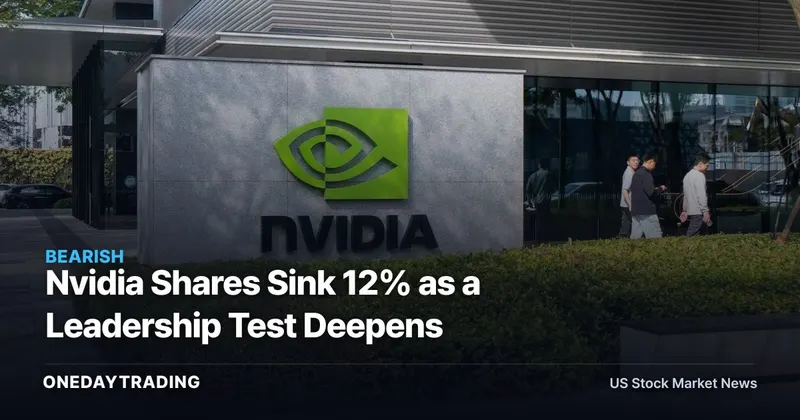
Nvidia shares fell 12% on Friday, extending their decline to seven straight days and putting leadership, financial oversight and AI-chip competition at the center of the semiconductor investment case. CNBC reported that the stock was poised for a seventh consecutive weekly loss, its longest such run since 2008. The immediate issue for investors is no longer whether Nvidia can report growth; it is whether that growth can command the valuation confidence the company previously carried.
A valuation reset is a sustained reduction in the earnings multiple investors are prepared to pay, even when a company continues to expand. Nvidia’s current tension fits that framework: its shares lost 44% during the seven-week period, while its market capitalization fell by $2.5 trillion. Those figures describe the scale of the repricing without establishing where the stock will trade next.
Seven Weeks Changed Nvidia’s Market Position
Nvidia now trades at 9.3 times forward earnings, according to CNBC, while Advanced Micro Devices trades at 29 times profit for the next 12 months. The comparison does not prove that either security is cheap or expensive because the supplied evidence does not provide matching forecasts, risk assumptions or earnings composition. It does show that Nvidia’s multiple has compressed far enough to make valuation a central part of the debate rather than a footnote to the growth story.
The company retains a market capitalization of $3.1 trillion and ranks fourth behind Apple, Microsoft and Alphabet. That ranking keeps Nvidia among the largest listed technology companies even after the drawdown. The contrast matters: a large operating base and a much lower forward multiple can support a recovery case, while the $2.5 trillion loss in market value shows how sharply confidence can change when investors question durability and oversight at the same time.
The historical scale of the business has also changed. In mid-2008, Nvidia generated less than $1 billion per quarter; it now generates more than $1 billion per day. The comparison prevents a superficial reading of the losing streak: the duration matches the longest run since 2008, though the underlying company is far larger by the revenue measure supplied.
Jensen Huang’s Exit Turns Execution Into the Test
Jensen Huang, Nvidia’s co-founder, resigned on Nov. 12. Newly appointed board chair Harvey Jones said the departure followed a “disclosure of personal behavior inconsistent with the company's code of conduct, standards and cultural norms.” The supplied evidence identifies no permanent successor, leaving leadership continuity as an unresolved input rather than a settled transition.
Colette Kress, the longtime CFO, is serving as interim CEO. Her financial experience may offer continuity, yet investors still lack evidence about the permanent leadership structure or how responsibilities will be allocated. For a company whose investment case rests heavily on continued execution, the next useful evidence will be operational delivery under the interim arrangement and clarity on permanent succession.
Internal timing also changed: executives told employees that Nvidia would move its yearly review process from March to December. The evidence does not establish the effect of that decision on retention, compensation or execution. Investors can treat it as a governance and workforce checkpoint, not as proof of either improvement or disruption.
Raised Guidance Meets an Unresolved Accounting Report
Nvidia increased its fiscal 2028 guidance, although the amount of that guidance was not provided. Kress also projected 75% revenue growth for the next fiscal year and closed Tuesday’s analyst call by saying, “we've got this.” These are important positive signals, but they remain forward-looking claims whose weight depends on subsequent reported performance.
A separate uncertainty came from Reuters, which reported that the Securities and Exchange Commission was exploring potential accounting issues at Nvidia. The available evidence gives no outcome from that exploration. Investors therefore cannot treat the report as a finding, nor can they assume that the matter has been resolved.
The combination creates an unusually wide verification gap. The bullish case has raised fiscal 2028 guidance and a 75% growth projection; the bearish case has an unresolved Securities and Exchange Commission report and no permanent successor to Huang. Each side requires new evidence, and neither management confidence nor market anxiety supplies that evidence by itself.
Google and AMD Put AI-Chip Competition in Focus
Google and AMD were identified as emerging competitors to Nvidia in AI chips. That relationship makes competitive positioning a direct checkpoint for the semiconductor sector, though the fact sheet provides no market-share, shipment, order or product-performance figures. Any claim that either competitor has already displaced Nvidia would therefore exceed the evidence.
The broader context is the AI trade, which began taking hold four years ago after OpenAI launched ChatGPT. Nvidia had previously centered its business on graphics cards used for video games; the supplied facts now frame the company around AI. That concentration can magnify upside if projected growth is delivered, and it can increase sensitivity to evidence that competition is strengthening.
- Nvidia: The core stock faces the combined test of leadership continuity, accounting scrutiny, guidance delivery and competitive durability.
- Advanced Micro Devices: AMD is an identified AI-chip competitor, and its 29-times-next-12-month-profit valuation provides a marked contrast with Nvidia’s 9.3-times-forward-earnings multiple.
- Google: Google is also identified as an emerging AI-chip competitor, making evidence of competitive progress relevant to Nvidia’s positioning.
- Apple, Microsoft and Alphabet: These companies rank ahead of Nvidia by current market capitalization; the relationship is one of ranking, not evidence of a direct operating benefit from Nvidia’s decline.
The Bull and Bear Cases Now Require Proof
Bull case: Nvidia’s reduced forward valuation, raised fiscal 2028 guidance and projected 75% revenue growth for the next fiscal year could support a reassessment if later results confirm the operating outlook. The company’s current revenue scale also distinguishes it sharply from the Nvidia of mid-2008. A permanent leadership decision and greater clarity around the regulatory report could remove uncertainties that are currently difficult to quantify.
Bear case: Seven consecutive weekly declines and a 44% loss over that period show that the market has already applied a severe discount. Further pressure could follow if future performance fails to support the growth projection, if Google or AMD provides stronger evidence of competitive progress, or if the accounting exploration produces adverse findings. Those are conditional scenarios, not established outcomes.
The asymmetry is clear. The share-price decline and valuation compression are observable now, while the projected growth, permanent succession and regulatory outcome lie ahead. That means the stock’s lower multiple cannot be interpreted in isolation from the uncertainties attached to the earnings it is intended to value.
What Nvidia Investors Should Check Next
- Test the growth projection: Compare Nvidia’s next reported performance with Kress’s projection of 75% revenue growth for the next fiscal year rather than relying on the statement alone.
- Track fiscal 2028 guidance: Look for the missing guidance amount and any later clarification, since the evidence confirms an increase without quantifying it.
- Demand succession clarity: Monitor whether Nvidia names a permanent successor to Jensen Huang and explains the resulting leadership structure.
- Separate exploration from outcome: Watch for an update concerning the Securities and Exchange Commission report before assigning a definitive financial consequence.
The next decisive signal will not come from the length of the losing streak alone. It will come from whether Nvidia converts its guidance into reported performance while clarifying leadership and financial oversight, with competitive evidence from AMD and Google providing the sector-level cross-check.
📊 Analysis
Signal Bearish
Why A seven-week decline, leadership uncertainty and an unresolved regulatory report outweigh raised guidance and projected revenue growth.
Tickers$NVDA$AMD$GOOG$AAPL$MSFT$GOOGL
This article was independently written by OneDayTrading from public reporting. Read the original (CNBC)