Nvidia’s Earnings Beat Meets a Leadership Discount
Nvidia investors face a split signal: interim CEO Colette Kress addressed employees on Wednesday after founder Jensen Huang resigned, while the shares fell 2% despite third-quarter earnings that topped Wall Street expectations. The immediate issue is not whether the reported quarter was strong. It is whether leadership continuity can preserve execution while the board searches for a permanent CEO.
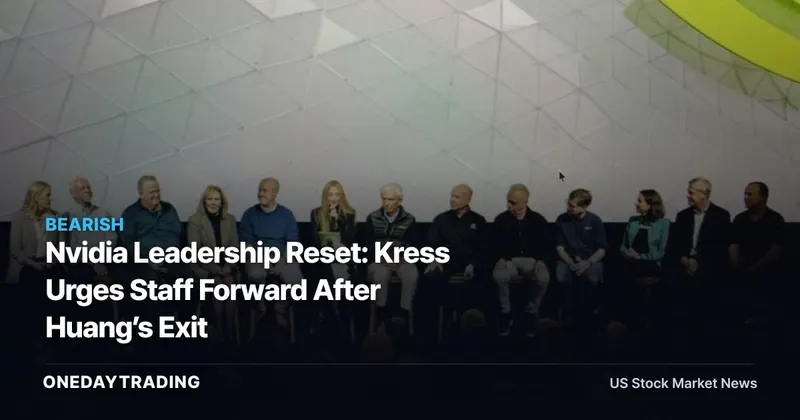
CNBC reported that Nvidia’s meeting lasted about an hour on Wednesday and combined an in-person gathering with a Microsoft Teams stream. Kress opened with “let's move forward,” discussed employee pay raises and recapped the earnings report. Those remarks placed operating continuity and employee confidence at the center of the transition.
A leadership transition is the period in which authority, employee confidence and operating accountability move from a departing chief executive to interim and permanent successors. For Nvidia shareholders, that transition now sits alongside the earnings evidence rather than replacing it: the company delivered an expectations beat, while the market response and analyst downgrades showed that the quarter did not settle the leadership question.
What Colette Kress Put in Front of Employees
Colette Kress did not address the workforce alone. Newly appointed board chair Harvey Jones and hyperscale and high-performance computing head Ian Buck joined her, giving employees visibility into both board oversight and a senior computing function.
The wider speaker group also included long-time company veteran Jeff Fisher, senior vice president of GPU engineering Jonah Alben, operations chief Debora Shoquist and Nvidia co-founder Chris Malachowsky. Their participation matters as a continuity signal because the meeting presented leadership across engineering, operations and institutional experience. It does not establish how authority will be divided or who will make the most consequential decisions during the CEO search.
Kress also raised employee pay increases, though the amount, timing and eligibility terms remain unknown. That distinction is important for investors: discussing compensation can address workforce concerns, but the available facts do not permit a calculation of cost, retention benefit or earnings impact.
Harvey Jones Draws a Firm Line on Jensen Huang
Harvey Jones discussed the search for Nvidia’s next CEO and supplied the board’s clearest formal position. He said, “The Nvidia board unanimously accepted his resignation and does not intend to reinstate Jensen as CEO.” The statement narrows the board’s stated path even though the identity of the next chief executive remains unknown.
Jensen Huang offered a different possibility when he said he would be “honored to answer these calls and return as CEO.” The two statements create an unresolved tension between Huang’s willingness to return and the board’s declared intention not to reinstate him. They do not establish that a return will occur or that Huang will hold another role at Nvidia.
The reasons for Huang’s resignation are also unknown. Without that information, investors cannot responsibly infer whether the departure reflects a strategic disagreement, a personal decision or another cause. The investable question is narrower: whether the interim structure can sustain decision-making until the board names a successor.
Why Nvidia Shares Fell Despite Third-Quarter Earnings
Nvidia reported third-quarter earnings on Tuesday that topped Wall Street expectations, and Kress described the result as a “great quarter.” Nvidia shares were nevertheless down 2% on Wednesday, when Bernstein and Evercore also downgraded the company.
The coexistence of an earnings beat, a lower share price and analyst downgrades suggests that investors were weighing more than the reported quarter. A reasonable interpretation is that leadership uncertainty introduced a separate risk assessment: strong financial results describe completed performance, while the CEO search concerns who will direct future execution. The facts do not establish that the resignation alone caused the 2% decline, so the price move should not be presented as a clean verdict on any single development.
For a semiconductor company, continuity across GPU engineering, operations and hyperscale computing can influence how investors judge execution risk. The meeting’s speaker lineup showed that the executives responsible for those functions remain visible. Visibility is not the same as proof that priorities, decision rights or operating outcomes will remain unchanged.
Bull and Bear Cases for Nvidia’s Transition
Bull case: Nvidia’s third-quarter earnings topped Wall Street expectations, and the all-hands meeting put Kress alongside Jones, Buck, Fisher, Alben, Shoquist and Malachowsky. That combination supports a conditional continuity thesis: the company has an interim chief executive, active board leadership and senior representatives spanning computing, engineering and operations.
The optimistic reading also rests on Kress addressing compensation and recapping the quarter rather than presenting the transition as a halt to ordinary operations. If the existing leadership group maintains clear authority through the search, the earnings performance could remain the stronger signal for investors.
Bear case: The permanent CEO is unknown, the reason for Huang’s resignation is undisclosed and his future relationship with Nvidia has not been established. Those gaps matter because investors cannot yet assess the successor’s mandate or whether the leadership structure will retain the confidence associated with the founder.
The 2% Wednesday decline and downgrades from Bernstein and Evercore show that the earnings beat did not prevent a negative market response. If uncertainty over leadership persists, investors may continue to separate confidence in the reported business from confidence in the governance transition.
Investor Checkpoints After Nvidia’s All-Hands Meeting
- The CEO search: Watch for Nvidia’s identification of a permanent chief executive and for the board’s explanation of that person’s authority. No successor has been confirmed.
- Huang’s status: Treat Harvey Jones’s statement that the board does not intend to reinstate Jensen Huang as the board’s current position. Any future Nvidia role for Huang remains unknown.
- Operating continuity: At the next earnings event, compare management’s discussion with the third-quarter performance that topped Wall Street expectations. The key test is whether the leadership transition changes the company’s account of execution.
- Employee compensation: Look for the amount, timing and eligibility conditions attached to the pay raises Kress discussed. Until those terms are provided, neither the workforce effect nor the financial cost can be measured.
The Live Risk After Kress’s “Let’s Move Forward” Message
Kress delivered the immediate message Nvidia needed: leadership was visible, senior executives participated and the company reviewed an expectations-beating quarter. The market’s 2% Wednesday decline shows that visibility alone did not close the credibility gap created by Huang’s resignation.
The next decisive evidence will come from the board’s CEO selection and Nvidia’s next earnings discussion. Investors should test whether the operating narrative remains consistent, whether responsibility is clearly assigned and whether the pay-raise proposal receives concrete terms. Until those checkpoints arrive, the third-quarter beat and the leadership discount remain competing signals in Nvidia shares.
📊 Analysis
Signal Bearish
Why Leadership uncertainty, a 2% Wednesday share decline and downgrades from Bernstein and Evercore outweighed the support from better-than-expected third-quarter earnings.
This article was independently written by OneDayTrading from public reporting. Read the original (CNBC)