Nvidia Investors Face Two Competing AI Signals
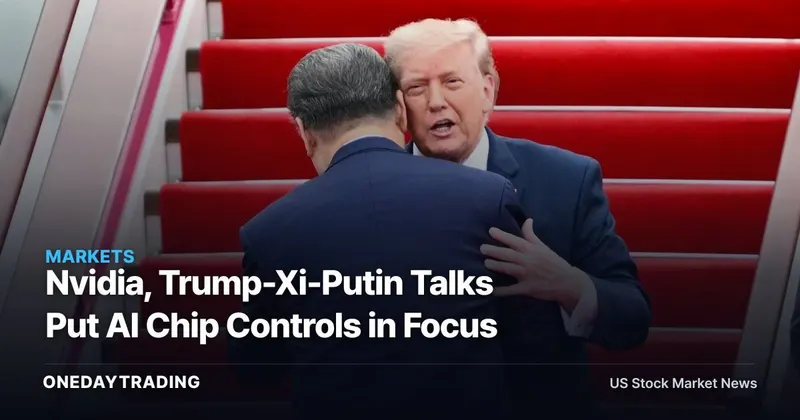
Nvidia investors received a mixed policy signal on 2026-11-18, when CNBC reported that President Donald Trump had landed in Shenzhen for planned trilateral talks with Xi Jinping and Vladimir Putin during the APEC summit. The meeting could shape the political environment around artificial intelligence and trade, while the confirmed facts stop short of establishing any change to U.S. restrictions on AI-chip exports.
The central tension is straightforward. President Xi called for deeper cooperation in artificial intelligence and the digital economy, while the U.S. continued seeking to curb exports of artificial intelligence chips. For Nvidia, supportive language about AI development does not neutralize the separate policy constraint governing whether advanced chips can reach China.
What President Donald Trump’s Shenzhen Visit Changes
CNBC reported that APEC comprises 21 member economies and that President Donald Trump was in China for the summit. The trilateral meeting with Xi Jinping and Vladimir Putin was scheduled for Thursday, so the confirmed event at publication was Trump’s arrival and the planned discussion—not a completed negotiation or agreement.
CNBC also said President Donald Trump began a three-day visit to Asia and met regional allies including Japan, India and Australia before flying from Manila. That sequence places the China talks within a wider regional visit, although the available facts do not establish how those earlier meetings affected the trilateral agenda.
Trump was separately due to hold bilateral talks with Chinese President Xi Jinping. Hopes centered on a lasting U.S.-China trade truce beyond January 2027, but neither the terms nor the duration of such a truce were known. Investors therefore have a diplomatic checkpoint, not a confirmed policy outcome.
APEC’s AI Message Meets the Chip-Control Constraint
APEC is a forum of member economies in which leaders discuss regional economic cooperation. At the summit, President Xi advocated free trade and closer collaboration in scientific innovation, the digital economy, artificial intelligence and a green transition.
Shenzhen’s description as one of China’s “Silicon Valleys” reinforces the event’s technology setting. The investment relevance comes from the collision between that cooperation message and Washington’s effort to restrict exports of artificial intelligence chips. One encourages broader AI activity; the other limits the movement of a critical computing input.
That distinction matters for semiconductor analysis. Demand for artificial intelligence does not automatically become addressable revenue for Nvidia when export policy constrains product access. Cooperation language could improve the backdrop only if subsequent talks produce concrete, applicable rules; the fact sheet identifies no such change.
Concerns also existed that Nvidia chips might have been diverted to China. Diversion was not confirmed, so it cannot be treated as evidence of shipments, revenue or regulatory failure. It remains a policy risk because any future official response could affect how chip controls are interpreted or enforced, though no response was reported.
Xi Jinping’s Bilateral Meetings Broaden the Trade Context
Xi Jinping held bilateral meetings with several leaders around the summit. He discussed trade and commerce with South Korean President Lee Jae Myung on Wednesday. Seoul’s account also referenced peace on the Korean Peninsula, while Beijing’s record omitted that subject, showing that the two official summaries did not fully align.
Xi also met Canadian Prime Minister Mark Carney and Vietnamese President To Lam earlier in the week. He met Vladimir Putin earlier Wednesday and called for greater cooperation and a more stable, predictable business environment. Putin said Russia sought expanded cooperation in trade, energy and education.
Putin separately told the summit that sanctions on Russia had backfired and strengthened the country. His position adds a dispute over sanctions to an agenda already containing trade and technology controls, although the supplied evidence does not connect that statement directly to Nvidia or to a change in U.S. chip policy.
Kim Jong-Un’s attendance was uncertain. That unknown should remain separate from the semiconductor thesis because the fact sheet establishes neither his presence nor a direct relationship between possible attendance and AI-chip controls.
Market and Nvidia Stock Transmission Channels
- Nvidia policy access: The most direct channel is export eligibility. If bilateral or trilateral diplomacy changes the treatment of artificial intelligence chips, Nvidia’s addressable access to China could change. No policy revision was confirmed, so investors cannot yet translate the summit into shipments, orders or revenue.
- Artificial intelligence demand: President Xi’s push for cooperation in AI and the digital economy signals policy interest in continued development. That can support the demand narrative, but demand and lawful supplier access are separate variables.
- Trade visibility: A truce lasting beyond January 2027 could reduce one source of uncertainty if its terms cover technology trade. The specific provisions remain unknown, leaving the semiconductor read-through conditional.
- Enforcement risk: Unverified concerns about diverted Nvidia chips could keep compliance and export enforcement in focus. Without confirmation, investors should not infer either diversion volumes or financial impact.
Checkpoints After the Trump-Xi-Putin Talks
- Thursday’s meeting: Confirm first whether the scheduled trilateral talks occurred and whether they produced an agreement. A statement of intent would carry less commercial weight than an applicable policy decision.
- Trump-Xi bilateral language: Check whether the two leaders specify terms for a trade truce beyond January 2027 and whether artificial intelligence chips are explicitly included.
- U.S. export-control treatment: Look for a concrete change, clarification or continuation of restrictions. Summit rhetoric alone does not alter product eligibility.
- Nvidia diversion claims: Separate substantiated findings from concerns. The current record does not establish that Nvidia chips were diverted to China.
Outlook for Nvidia After the APEC Summit
The constructive case is that free-trade language, AI-cooperation priorities and bilateral engagement create room for clearer commercial rules. For Nvidia, clarity could matter even without broad diplomatic alignment because investors need to distinguish potential Chinese AI demand from demand the company may legally serve.
The risk case is that the meetings yield no applicable change, leaving export restrictions and diversion concerns as the dominant company-specific facts. The trilateral meeting’s outcome, Kim Jong-Un’s attendance, the details of any trade truce and the alleged chip diversion were all unresolved in the supplied evidence.
The next investable signal is therefore not the summit’s symbolism. It is whether Thursday’s talks and the Trump-Xi bilateral meeting produce explicit language on trade duration, artificial intelligence chips or export controls. Until then, Nvidia’s demand opportunity and its policy-limited market access point in opposite directions.
Market data check: NVIDIA Corporation
NVIDIA Corporation last traded near $155.46 (-0.44%). Our composite signal — blending price momentum and news flow — reads 🟡 neutral. Price momentum scores 47/100.
Data as of publication. Price via market feeds; for reference only, not investment advice.
📊 Analysis
Signal Neutral
Why AI cooperation could support demand, while U.S. export controls and unresolved diversion concerns leave Nvidia’s China exposure uncertain.
This article was independently written by OneDayTrading from public reporting. Read the original (CNBC)