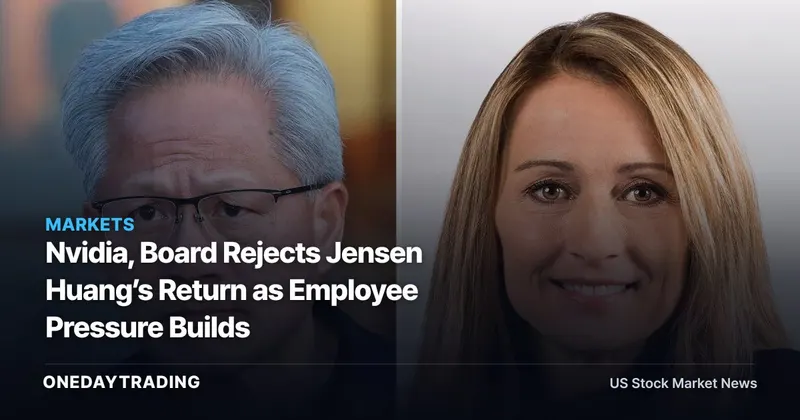
Nvidia’s Board Decision Meets Employee Resistance
Nvidia investors face a leadership test that strong earnings alone cannot settle. In a CNBC report whose article URL is dated 2026-11-18, interim CEO Colette Kress was preparing to address employees as internal calls grew for former CEO and founder Jensen Huang to return, even though the board said it would not reinstate him.
The investment issue is execution continuity. Nvidia reported better-than-expected earnings, providing evidence that the business was still delivering during the transition. Employee grievances and visible support for Huang introduce a separate question: whether the organization can preserve commitment and decision-making stability after the departure of a deeply involved founder.
A leadership transition is the transfer of operating authority and employee confidence from a departing executive to a successor. For Nvidia, that transfer remains contested inside the company even as the board’s formal position appears settled.
Colette Kress Has Financial Continuity, Not Yet Organizational Consent
Colette Kress was serving as Nvidia’s interim CEO after working as the company’s CFO since 2013, according to CNBC. That tenure gives her institutional familiarity, while her new role requires a broader form of authority: aligning employees, customers and shareholders behind a company operating without Huang as CEO.
Kress framed the break directly, saying, “This is a new era for Nvidia.” She also told Jim Cramer that the board had determined it would not reinstate Jensen Huang. Those statements remove ambiguity from management’s public position, but they do not establish whether employees broadly accept the transition.
Her message on the workforce was affirmative. Kress described employees as “committed to doing their life's work at Nvidia” and ended the earnings call by saying, “Our customers and our partners are with us. And employees are committed. We've got this.” For investors, those are management assertions to test against employee behavior rather than operating metrics by themselves.
The Jensen Huang Petition Is Large but Not a Verified Workforce Vote
CNBC reported that an online petition calling for Jensen Huang’s return had gathered nearly 200,000 signatures since the weekend. More than 10,000 signers claimed to be current Nvidia employees, while Nvidia had roughly 42,000 employees at the time of the report.
The figures demonstrate the scale of public attention, not the verified position of the workforce. The identities of signers claiming Nvidia employment had not been verified, so comparing more than 10,000 claimed employee signatures with roughly 42,000 employees cannot establish a reliable internal support rate.
Huang said he would be “honored” to return. Support was not limited to the petition: CNBC said at least two major investors had called for his reinstatement. Those facts keep the succession dispute visible, although they do not override the board’s stated decision or prove that a return will occur.
Why Nvidia’s Better-Than-Expected Earnings Do Not Close the Debate
Better-than-expected earnings strengthen the case that Nvidia can continue operating through the leadership change. They are the clearest confirmed business signal in the available evidence, and they give Kress a concrete result around which to direct attention.
Earnings and organizational cohesion answer different questions. Financial performance records what the company delivered, while employee commitment affects whether teams continue executing under new authority. The supplied evidence contains no shipment, order, margin, yield, utilization or guidance figures, so it cannot support a detailed semiconductor demand or supply-chain conclusion.
The constructive scenario is straightforward: operating performance remains resilient, employees accept the board’s decision, and management keeps customers and partners aligned. The risk scenario is that dissatisfaction persists and weakens internal coordination or retention. The facts do not quantify either outcome, so investors should resist treating the petition as proof of operational damage or the earnings result as proof that the transition is complete.
Harvey Jones Draws a Firm Governance Line
Harvey Jones, the newly appointed chair of Nvidia’s board, said the board unanimously accepted Huang’s resignation and did not intend to reinstate him as CEO. Kress delivered the same core message separately, making the no-reinstatement position a board-level decision rather than an isolated comment from the interim chief.
That clarity can reduce uncertainty over who holds formal authority. It can also sharpen the internal conflict when employees pressing for Huang’s return see no open route to reversal. The relevant investor question is therefore shifting from whether the board has stated a position to whether Kress can make that position workable across the organization.
Nader Khalil, identified as a senior Nvidia employee, warned of losing “irreplaceable talent.” A former Nvidia employee with more than 15 years at the company described engineering employees as “extremely devoted to him, almost like a demigod.” These accounts indicate the intensity of loyalty around Huang, though they do not measure companywide sentiment.
The All-Hands Meeting Becomes the Next Evidence Point
- Employee participation: Employees told CNBC they planned to share grievances at the all-hands meeting. Whether they would be permitted to ask questions was unknown.
- Management’s operating message: Kress needs to connect the board’s settled position with a credible account of how Nvidia will execute without Huang as CEO.
- Workforce response: The next useful evidence is not another raw petition total, but whether employee opposition persists after management addresses the company.
- Business confirmation: Subsequent earnings should be examined for continued execution. The supplied facts provide no detailed operating metrics, making the next reported business results the appropriate place to test durability.
Nvidia’s Balanced Investor Outlook
The bull case rests on confirmed performance and governance clarity. Nvidia delivered better-than-expected earnings, Kress brings company experience dating to 2013, and both she and Jones communicated the same board decision. That combination may support continuity if employees, customers and partners remain engaged.
The counterweight is a founder-centered workforce dispute whose commercial effect cannot yet be measured. Nearly 200,000 petition signatures create public pressure, while more than 10,000 unverified claims of Nvidia employment make the internal dimension impossible to dismiss and equally impossible to quantify reliably.
The decisive signal will come from execution after the all-hands meeting. Investors should track whether grievances subside, whether management demonstrates stable authority, and whether later business reporting continues to show operational delivery. Until those checks arrive, Nvidia’s earnings support confidence in the business, while the leadership transition keeps the stock’s organizational risk unresolved.
Market data check: NVIDIA Corporation
NVIDIA Corporation last traded near $155.46 (-0.44%). Our composite signal — blending price momentum and news flow — reads 🟡 neutral. Price momentum scores 47/100.
Data as of publication. Price via market feeds; for reference only, not investment advice.
📊 Analysis
Signal Neutral
Why Better-than-expected earnings support operational confidence, but unresolved employee resistance creates an unquantified execution and retention risk.
This article was independently written by OneDayTrading from public reporting. Read the original (CNBC)