Commerce Department Chip-License Briefing
Nvidia and AMD investors now face a sharper export-policy risk after the House Foreign Affairs Committee released documents covering approvals and requests for U.S. AI-chip sales to China.
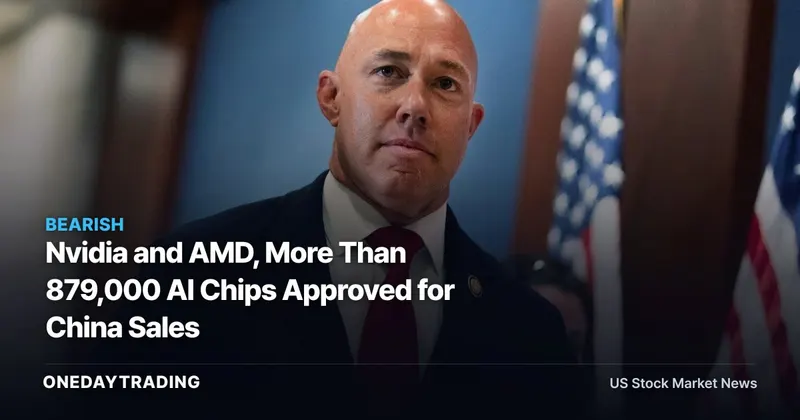
- CNBC reported that Bureau of Industry and Security approvals covered more than 879,000 AI chips for Chinese companies including Alibaba and Tencent as of May 2026.
- The House Foreign Affairs Committee reported 3.4 million requested sales of U.S. AI chips to China from December through May, citing requests involving Nvidia and Advanced Micro Devices.
- The Commerce Department also issued an interim final rule intended to close a route through which Chinese companies lease Nvidia computing power from data centers in third countries.
Why the House Foreign Affairs Committee Disclosure Matters
An export license is government authorization for a controlled sale; it does not by itself establish that the approved shipment was completed. That distinction is central to the investment reading. The documents reveal the scale of approvals and requests, while leaving actual completed sales and the allocation among customers unknown.
The immediate issue for Nvidia and AMD is therefore policy exposure, not a quantified change in delivered chips. The disclosed requests connect both suppliers to Chinese demand, and the interim final rule shows that scrutiny extends beyond direct hardware sales to access through third-country data centers. If oversight produces tighter licensing or enforcement, the addressable route to those customers could narrow; the supplied evidence does not establish that outcome.
The customer list also broadens the relevance of the review. Released license requests included Bytedance, Tesla (Shanghai) and Baidu, while Alibaba and Tencent were among the Chinese companies covered by approved AI-chip sales. The documents do not disclose how many approved chips were associated with any individual company, preventing a customer-by-customer exposure estimate.
More Than 879,000 Approved Chips Versus 3.4 Million Requests
The two disclosed totals measure different stages of the licensing process. The Bureau of Industry and Security approved sales of more than 879,000 AI chips to Chinese companies including Alibaba and Tencent as of May 2026, according to documents released by the House Foreign Affairs Committee and reported by CNBC.
Separately, the House Foreign Affairs Committee cited 3.4 million requested sales of U.S. AI chips to China from December through May involving Nvidia and Advanced Micro Devices. Requested sales should not be treated as approvals, just as approvals should not be treated as completed shipments. Without company-level allocations or completion data, the figures establish regulatory scale rather than recognized commercial results.
The documents also raised a classification question that cannot yet be resolved from the supplied evidence: which approvals, if any, involved companies designated as Chinese Military Companies by the Department of Defense. That missing link matters because it could shape the intensity of congressional review, though it cannot support a company-specific conclusion today.
Nvidia and AMD Carry the Direct Equity Exposure
- Nvidia: The company was associated with requested U.S. AI-chip sales to China, and the new Commerce Department rule specifically addresses Chinese access to Nvidia computing power through data centers in third countries. Jensen Huang, identified as Nvidia’s former head and former CEO, was scheduled for a closed-door transcribed interview on Dec. 1. Nvidia general counsel Tim Teter was scheduled to appear on Dec. 2. The years for those appearances were not specified.
- AMD: Advanced Micro Devices was also associated with the requested sales. Hunterbrook Media separately alleged that IEIT Systems continued receiving newer AMD firmware after being blacklisted, though CNBC said it had not independently verified that allegation. This claim should not be incorporated into an operating forecast without verification.
- Tesla: Tesla (Shanghai) appeared among the entities in released license requests. The evidence does not state whether its request was approved, completed or associated with a disclosed chip quantity, so the direct financial significance for Tesla cannot be measured.
- Chinese customers: Alibaba, Tencent, Bytedance and Baidu appear in the disclosed approval or request records. Their inclusion identifies potential demand endpoints, not the quantity received by each company or confirmation that any approved sale closed.
Commerce Department Rule Tightens the Access Question
The interim final rule targets a loophole involving Chinese companies leasing Nvidia computing power from data centers in third countries. This shifts the policy focus from the physical destination of a chip to the location and identity of the user accessing its computing capacity. For semiconductor investors, that makes license enforcement and remote access part of the same policy channel.
The Bureau of Industry and Security said the rule was written by and at the direction of the Treasury Department and the White House National Security Council. That institutional involvement indicates that the issue spans export administration and national-security policy. The fact sheet does not specify the rule’s commercial effect, implementation results or any resulting change in Nvidia demand.
The Commerce Department, AMD and Nvidia did not immediately respond to CNBC’s requests for comment. Their eventual explanations could clarify how they distinguish requested licenses, approved transactions and completed deliveries, as well as how the interim final rule changes customer access.
Smuggling Allegations Remain Unproven
- Mast described Maginfra and New Matrix as suspected smuggling fronts and said, “Both are fake companies.” Whether either company actually operated as a smuggling front remains unknown.
- Whether Nvidia chips were diverted to China through Megaspeed has not been established. Alice Huang was an executive at Megaspeed until 2025, but that relationship alone does not prove diversion.
- Whether IEIT Systems continued receiving newer AMD firmware after being blacklisted is also unresolved because CNBC did not independently verify the Hunterbrook Media allegation.
- The documents do not show how many approved sales were completed, making shipment realization the central missing commercial variable.
Next Checks for Nvidia and AMD Investors
The first checkpoint is testimony and document clarification. Jensen Huang’s scheduled Dec. 1 interview and Tim Teter’s scheduled Dec. 2 appearance could address Nvidia’s licensing controls, while any statements involving Tim Scott or Howard Lutnick could further define the scope of congressional scrutiny. Because the years of the scheduled appearances are absent from the evidence, they should not be assigned to a calendar year.
The second checkpoint is implementation of the Commerce Department’s interim final rule. Investors need evidence on whether it changes approvals, customer access through third-country data centers or the handling of pending requests. The supplied facts confirm the rule’s purpose, not its eventual enforcement outcome.
The third checkpoint is disclosure quality. A useful update would separate requested sales, approved licenses and completed shipments, then identify the chips associated with each customer. Until that information appears, the headline totals cannot be translated responsibly into company revenue, shipment volume or market share.
Bottom Line for AI-Chip Stocks
The disclosure confirms substantial Chinese demand moving through the U.S. licensing system and places Nvidia and AMD at the center of a widening policy review. That demand can represent commercial opportunity when licenses are valid and sales close, while tighter rules or enforcement could restrict access before approvals become shipments. With completed sales, company-level quantities and several allegations unresolved, the defensible near-term stance is bearish on policy risk rather than a claim of proven financial damage.
📊 Analysis
Signal Bearish
Why Disclosure of broad China license activity, congressional scrutiny and a new Commerce Department rule raise policy risk for Nvidia and AMD.
This article was independently written by OneDayTrading from public reporting. Read the original (CNBC)