What Changes
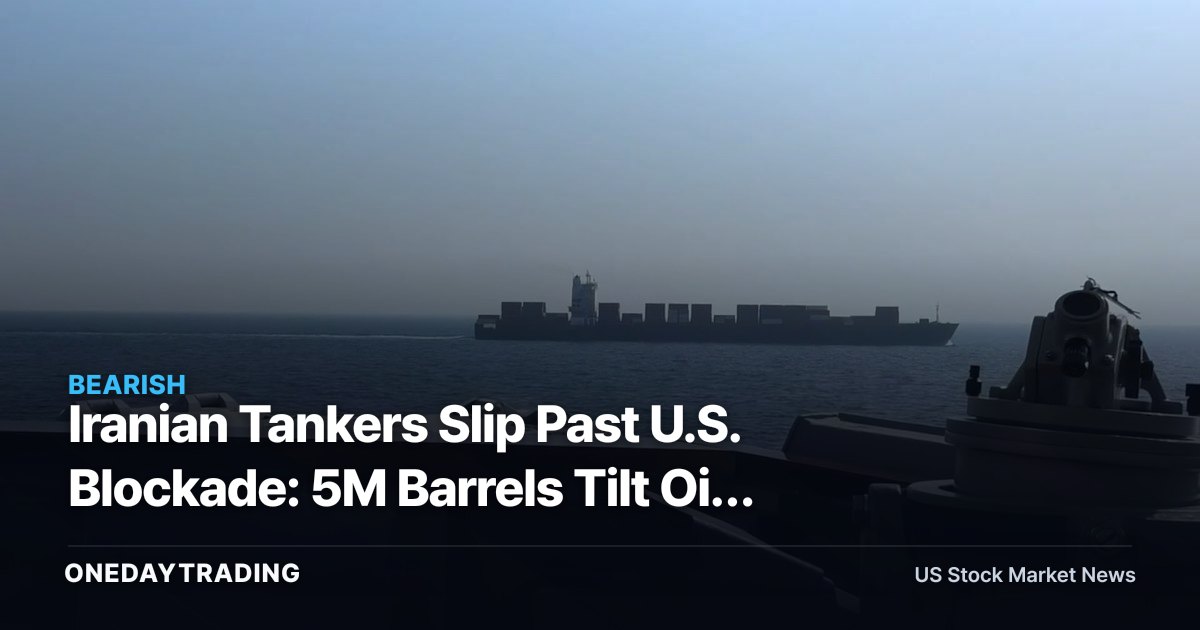
The core variable here is not the three ships themselves but what they imply: a blockade that had bottled up Iranian crude is leaking. Roughly 5 million barrels is a single-cargo-scale figure, not enough to move the global balance alone, but the precedent matters more than the volume. If enforcement is loosening, the market must price the possibility that previously stranded Iranian supply finds its way to refiners, mostly in Asia.
That works through two channels. First, physical supply: extra barrels compete with marginal exporters and cap price upside. Second, the risk premium: much of oil's recent strength has rested on fear that a Hormuz flashpoint could choke a fifth of seaborne crude. Tankers moving without incident chips away at that fear trade, which can pull prices lower even before a single extra barrel clears.
By the Numbers
The concrete data point is narrow but specific: three vessels, close to 5 million barrels, and a breakout described as the first in months. The absence of further detail on destination or buyer is itself the key uncertainty — without confirmed discharge, this is a signal about enforcement posture rather than a settled supply increase.
Winners & Losers
- Exxon Mobil (XOM), Chevron (CVX) — upstream-heavy majors see realized prices track crude; softer benchmarks compress the per-barrel margin that drives their cash flow and buyback capacity.
- Valero (VLO), Marathon Petroleum (MPC) — refiners can benefit from cheaper feedstock if crude eases while product prices hold, widening crack spreads.
- Occidental (OXY) — high operating leverage to oil prices makes it more sensitive to a supply-driven pullback than the diversified majors.
- Tanker operators (FRO) — mixed: normalized Hormuz transit lowers war-risk and detour economics, but added sanctioned-fleet competition can pressure clean rate structures.
Risk Check
- One breakout is not a trend; renewed enforcement could reverse the supply read overnight.
- OPEC+ output decisions and demand from China still dominate the balance far more than a few cargoes.
- Any fresh Hormuz incident would snap the risk premium back and overwhelm the supply story.
- Destination and payment for these barrels remain unconfirmed, so the actual market impact is unverified.
Bottom Line
The breakout leans bearish for crude and oil-price-sensitive producers like XOM, CVX and OXY by hinting at looser enforcement and a thinner Hormuz risk premium, while refiners could quietly gain on cheaper feedstock — but with volumes small and the policy backdrop volatile, this is a signal to track, with the next OPEC+ meeting, Brent and WTI levels, and any follow-on tanker departures as the metrics that confirm or kill the thesis.
📊 Analysis
Signal Bearish
Why Iranian crude slipping past the blockade adds marginal supply and erodes the Hormuz risk premium, a headwind for oil prices and upstream producers.
Tickers$XOM$CVX$OXY$VLO$MPC$FRO
This article was independently written by OneDayTrading from public reporting. Read the original (CNBC Markets)