At a Glance
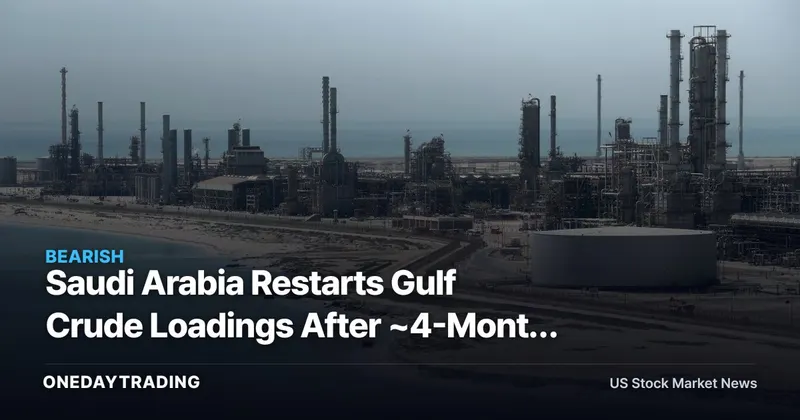
Saudi Arabia has restarted crude loadings at a major Gulf export terminal after a halt of nearly four months. Returning barrels to the seaborne market eases a supply pinch and tilts the marginal price signal lower, even as the volume ramp and refiner pull determine how much actually clears.
For US-listed energy, the channel is realizations: softer benchmark crude compresses upstream margins, while higher loading activity lifts tanker ton-mile demand.
Why It Matters Now
A four-month interruption at a major Gulf terminal is not a rounding error in physical balances. When a swing exporter pulls cargoes from the water, freight tightens, differentials for competing grades firm, and the front of the futures curve leans into backwardation. Restarting loadings reverses that mechanically: more crude chasing the same refining slots pressures spot premiums first, then the flat price.
The investor read-through splits by position in the chain. Integrated and pure-play producers such as ExxonMobil and Chevron see the move through price realizations on their own output and equity-method barrels, where every dollar off the benchmark flows close to dollar-for-dollar into upstream cash flow given fixed lifting costs. Refiners face the opposite vector: cheaper feedstock can widen crack spreads if product demand holds, a tailwind for Valero and Marathon Petroleum. Crude tanker owners like Frontline sit on the volume side, where resumed Gulf liftings extend voyages and support day rates regardless of where flat price settles.
The counterweight is that a restart signals intent to defend market share, not necessarily a flood. Actual export volumes, the destination mix, and whether OPEC+ offsets elsewhere will decide if this is incremental supply or a swap that nets to neutral.
FAQ
- Is returning Saudi supply bearish for oil? Directionally yes at the margin, since added seaborne barrels ease scarcity, but the magnitude depends on the ramp rate and refiner appetite.
- Who benefits? Tanker owners from more loadings, and refiners if feedstock costs fall faster than product prices.
- Who is pressured? Upstream producers whose cash flow tracks the benchmark price.
- Does this change OPEC+ policy? A single terminal restart is a logistics event, not a quota decision; watch whether other Saudi flows adjust to keep total exports steady.
Related Stocks & Sectors
- XOM, CVX — upstream realizations fall with any benchmark softening; high operating leverage to flat price.
- VLO, MPC — refiners gain if cheaper crude widens crack spreads while gasoline and diesel demand holds.
- FRO — crude tankers capture higher ton-mile demand as Gulf loadings resume.
- Oil & Energy sector — sentiment hinges on whether this adds net supply or merely normalizes a prior outage.
What to Watch
- Confirmed export volumes from the terminal versus the pre-halt baseline in coming weeks.
- Brent and WTI front-month spreads for any flattening of backwardation.
- Crude tanker spot rates and Saudi official selling prices for the next loading month.
- Whether OPEC+ messaging frames this as added barrels or an internal swap.
Overall Outlook
The bull case for crude rests on resilient demand and a slow, partial ramp that keeps balances tight; the restart then reads as routine normalization. The risk case is that returning Gulf barrels meet a softening demand backdrop, pushing differentials and flat price lower and squeezing upstream cash flow. Position in the chain matters more than the headline: the same event that trims producer realizations can lift refiner margins and tanker rates.
📊 Analysis
Signal Bearish
Why Restarting halted Saudi Gulf crude exports adds seaborne supply that pressures benchmark prices and upstream producer realizations at the margin.
Tickers$XOM$CVX$VLO$MPC$FRO
This article was independently written by OneDayTrading from public reporting. Read the original (Yahoo Finance)