Summary
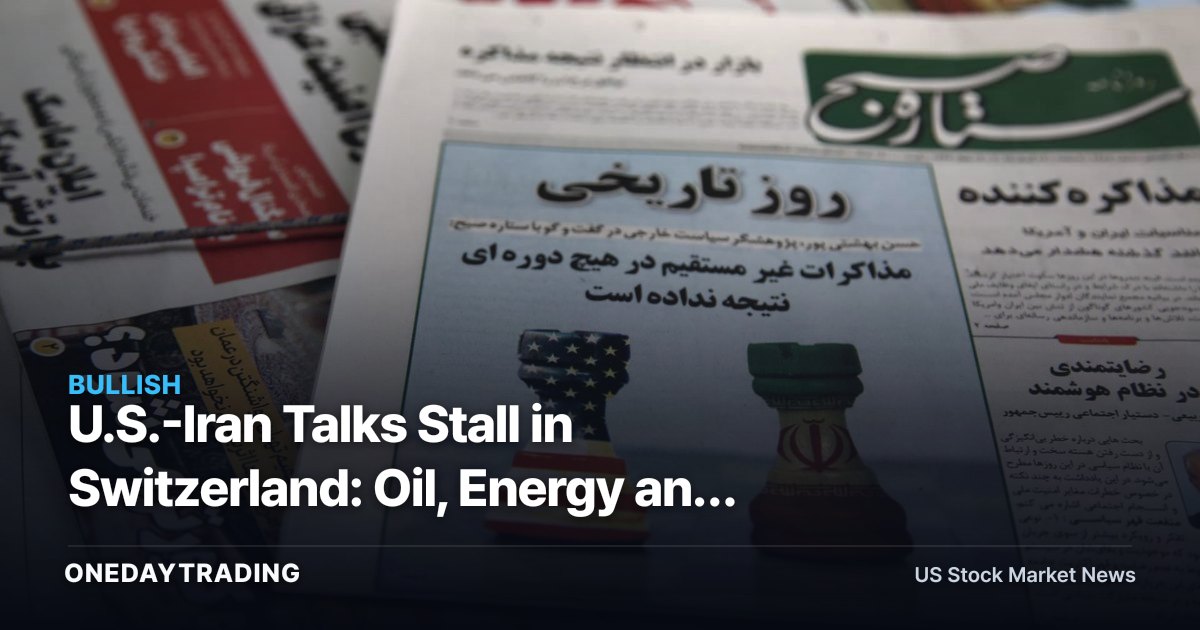
The early breakdown in U.S.-Iran negotiations, after talks in Switzerland failed to advance as planned, reinstates a geopolitical risk premium that markets had begun to fade. For investors, the practical read-through runs through crude oil first, then energy producers and defense contractors that benefit when Middle East tension lingers rather than resolves.
The Full Story
The core development is not an escalation but a delay: a framework that markets had treated as a path toward de-escalation hit a snag almost immediately, and the read from analysts is that any durable resolution to the broader Middle East conflict will take meaningful time to come together. That matters because oil and risk assets had partly priced in a smoother diplomatic track.
When a negotiated outcome slips from weeks to an open-ended horizon, the market mechanism is straightforward. Traders rebuild a risk premium into crude to compensate for the tail risk of supply disruption through the Strait of Hormuz and surrounding shipping lanes. That premium is a price, not a forecast of actual disruption, which is why it can build and unwind quickly on headlines.
The asymmetry is what investors should focus on: failed talks raise the probability-weighted cost of an adverse outcome without yet changing physical supply. Energy equities tend to capture that premium with leverage, while transport-heavy and consumer-discretionary names sit on the other side of higher fuel costs.
Structural Background
Iran sits among the largest holders of proven oil reserves, and any normalization scenario carries the prospect of more barrels reaching global markets, which is structurally bearish for crude. A stalled accord removes that supply-easing catalyst, so the immediate price effect skews the other way. The longer diplomacy drags, the more the market treats sanctions-constrained supply as the baseline rather than a problem about to be solved.
Stock & Sector Ripple
- ExxonMobil (XOM), Chevron (CVX): Integrated majors with large upstream exposure see cash-flow leverage to a higher crude price; a sustained risk premium lifts realized prices on existing production without added capex.
- Defense primes (LMT, RTX): Prolonged regional tension supports munitions, missile-defense and replenishment demand, where order backlogs convert tension into multi-year revenue visibility.
- Refiners and airlines: Carriers such as those with heavy jet-fuel exposure face margin pressure when crude rises, the mirror image of the energy trade.
- Broad market (^GSPC): A rebuilt oil premium feeds into headline inflation expectations, a channel that can pressure rate-sensitive equities if it persists.
Bull vs Bear Scenarios
The bull case for energy and defense rests on time: the longer talks stay stuck, the longer the premium holds. The counter-scenario is that these snags are routine in multi-party diplomacy, and a single constructive headline can compress the premium fast, leaving late buyers of oil-levered names exposed. A genuine breakthrough that reopens Iranian barrels would be the sharpest reversal, pressuring crude and the same energy stocks that just rallied.
Investor Action Points
- Track the crude curve (CL=F) for whether the risk premium holds beyond a few sessions or fades, the cleanest real-time gauge of how seriously markets take the stall.
- Watch for the next scheduled round of talks and any official statements on Strait of Hormuz shipping as binary catalysts.
- Size energy and defense exposure as headline-driven and reversible, not as a structural thesis, given how quickly diplomatic tone can shift.
- Monitor energy producers' next earnings commentary on realized prices to separate durable demand from a transient geopolitical bid.
📊 Analysis
Signal Bullish
Why Stalled U.S.-Iran diplomacy rebuilds a Middle East risk premium into crude, a near-term tailwind for oil producers and defense contractors.
This article was independently written by OneDayTrading from public reporting. Read the original (CNBC)