At a Glance
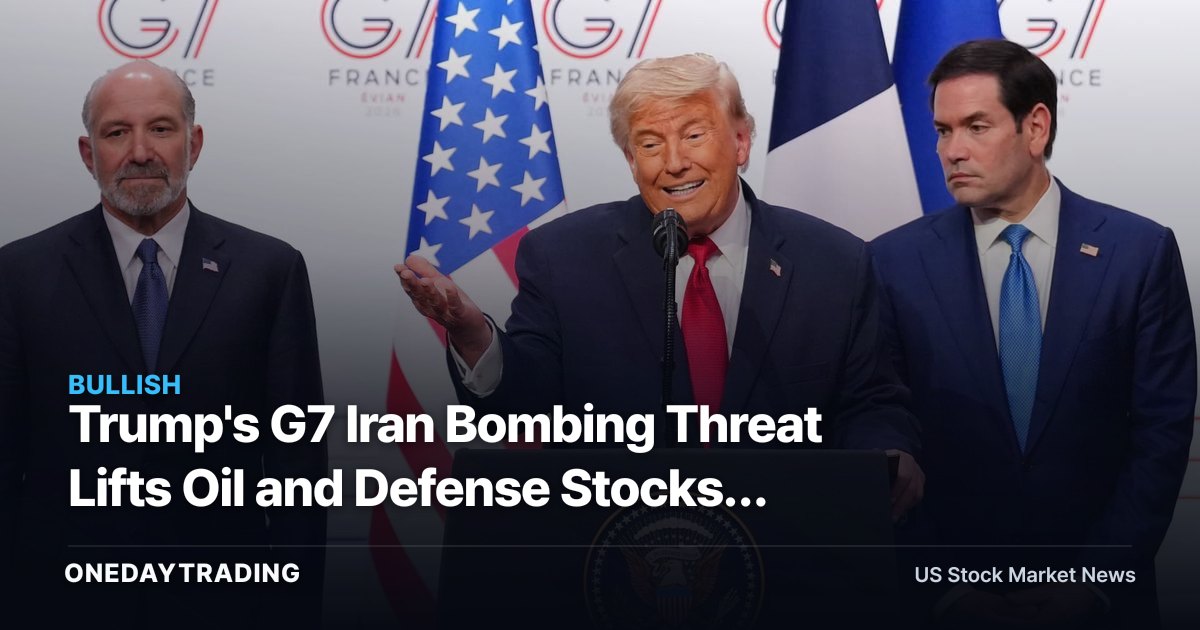
President Trump told reporters at the G7 summit that the U.S. is prepared to go right back to dropping bombs on Iran if a deal does not meet his terms. For markets, the headline matters less as policy than as a fresh injection of Middle East tail risk into crude pricing and defense order books.
Why It Matters Now
Iran sits on the Strait of Hormuz, the chokepoint through which roughly a fifth of global seaborne oil flows. Any credible threat of renewed U.S. military action against Tehran raises the implied probability of supply disruption, and that probability is what oil traders price in real time. The mechanism is direct: a higher geopolitical risk premium pushes Brent and WTI futures up before a single barrel is actually lost, which flows straight into the realized prices that upstream producers book.
The transmission to equities is uneven. Integrated majors with large upstream exposure capture price upside fastest because incremental crude revenue drops to the bottom line with little added cost. Defense primes benefit through a slower but stickier channel — escalation rhetoric tends to firm political support for procurement budgets and munitions replenishment rather than producing an immediate revenue jump. The risk for investors is that this is a headline, not a confirmed strike: if talks proceed and the rhetoric cools, the premium can unwind as quickly as it built, leaving late buyers holding stocks that have already moved.
FAQ
- Why does oil react before anything happens? Futures price the probability of supply loss, not just actual loss. A threat near Hormuz raises that probability immediately.
- Who benefits most among energy names? Upstream-heavy producers, because higher crude prices lift revenue with minimal incremental cost.
- Is this a guaranteed defense catalyst? No. Rhetoric supports the procurement narrative but does not convert to bookings without actual conflict or budget action.
- What is the main reversal risk? A diplomatic path or a deal that satisfies Washington would deflate the risk premium fast.
Related Stocks & Sectors
- Exxon Mobil (XOM) — large upstream output means crude-price upside flows quickly to earnings.
- Chevron (CVX) — integrated major with similar leverage to higher realized oil prices.
- Lockheed Martin (LMT) — missile and air-defense exposure tied to escalation and replenishment demand.
- RTX (RTX) — munitions and missile-defense systems benefit from heightened conflict risk.
- Energy and Defense sectors broadly — classic risk-premium and budget-narrative beneficiaries.
What to Watch
- WTI and Brent futures for the size of the risk premium and whether it holds or fades.
- Any concrete signal on the Iran deal terms or a strike decision, which would confirm or kill the trade.
- Shipping and insurance rates near the Strait of Hormuz as a real disruption gauge.
- Defense order announcements or budget commentary, the metric that turns rhetoric into revenue.
Overall Outlook
The bull case for energy and defense rests on escalation becoming reality; the rhetoric alone is enough to lift crude on probability. The counterweight is that headline-driven premiums are fragile — a deal or de-escalation removes the catalyst, and oil names that ran on fear can give it back. Position sizing here is a bet on the durability of geopolitical risk, not on confirmed supply loss.
📊 Analysis
Signal Bullish
Why Renewed U.S. military threats against Iran inject a geopolitical risk premium that favors oil and defense stocks.
Tickers$XOM$CVX$LMT$RTX$NOC
This article was independently written by OneDayTrading from public reporting. Read the original (CNBC)