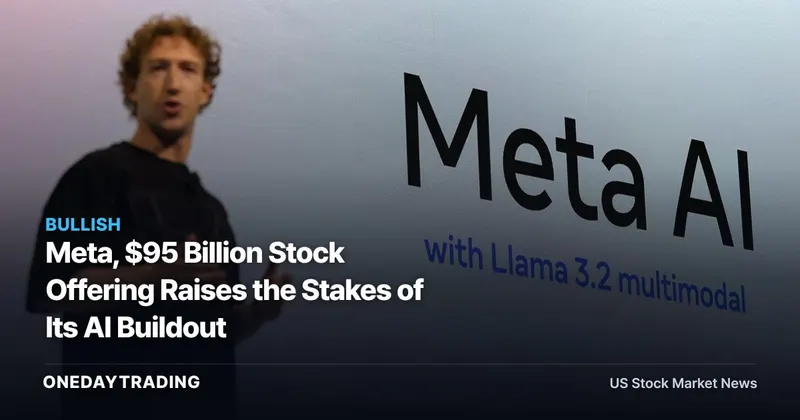
Meta’s $95 Billion AI Financing Resets the Investment Debate
Meta’s planned $95 billion stock offering, announced in CNBC’s Oct. 26, 2026 report, gives the company another funding channel for AI infrastructure and superintelligence while increasing investors’ exposure to a much larger capital cycle. The immediate market response was positive: Meta shares rose 1.6% in premarket trading after the announcement.
The sharper read is not simply that Meta wants more computing capacity. It is that the company is matching an aggressive physical buildout with an equally deliberate financing structure. For investors in Meta, Nvidia, AMD and Broadcom, the critical divide is now between funding availability and economic return: the offering can support construction, but the supplied facts do not establish how much revenue or cash generation the resulting infrastructure will produce.
The proposed financing is a two-part equity-capital plan supporting Meta’s family of apps, AI agent Muse and data-center business. That definition matters because the capital is not tied to one disclosed product, supplier order or completion date; it backs a portfolio of what Meta calls “emerging AI opportunities.”
How Meta Plans to Assemble the Capital
Meta intends to raise $35 billion first through underwritten public equity offerings, followed by another $60 billion through an at-the-market program, according to CNBC. The company said the broader investment program will combine operating cash flow, investment-grade debt, partnerships and equity capital rather than depend on a single source.
That mix separates the ability to finance the buildout from the performance of any one funding channel. Equity capital can add funding capacity, while the operating-cash-flow component ties part of the plan to the underlying business. Partnerships and investment-grade debt add further routes, although the fact sheet provides no amounts for those components.
Nvidia, AMD and Broadcom have expressed interest in purchasing up to $5 billion in shares, Meta said. Their contemplated participation is relevant because all three are directly identified with the planned offering, but the announcement does not state individual purchase amounts or binding commitments. Interest in equity therefore should not be read as a completed investment or as evidence of disclosed commercial orders.
Revenue Strength Meets a Steeper Capital Requirement
Meta entered the financing announcement with third-quarter revenue of $64.60 billion, a 26% year-on-year increase and above analysts’ expectation of $63.37 billion. Those figures establish that the funding plan accompanies reported growth rather than a revenue shortfall. They do not, by themselves, show that future AI infrastructure spending will earn an adequate return.
The pressure point is the size of the capital program. Meta now expects full-year capital expenditure of $135 billion to $145 billion after increasing the bottom of its previous range from $130 billion. The combination of a higher spending floor and a large equity raise moves the investor question from whether Meta can build infrastructure to whether its apps, Muse and data-center business can absorb that capacity productively.
Meta said it is building four superclusters, each with more than one gigawatt of capacity, and is on track to nearly double total infrastructure capacity in 2026 from the prior year. The unit that matters here is physical computing capacity: four large installations create a visible scale target, while the financial return attached to each cluster remains undisclosed.
The AI Infrastructure Funding Cycle Beyond Meta
Goldman Sachs estimates that AI-related capital spending across compute, data centers and power could reach about $7.6 trillion from 2026 through 2031, CNBC reported. Meta’s financing plan sits inside that broader capital requirement, but the estimate is a spending projection rather than a guarantee of demand, utilization or investment returns for any participant.
Ben Wood of CCS Insight said the offering “reflects the eye-watering levels of investment required to keep up in the AI arms race.” His observation frames the competitive funding environment: Alphabet, Google’s parent company, said it would seek to raise $85 billion in June, while SpaceX closed a $40 billion debt financing to purchase graphics processing units.
Other disclosed plans point in the same capacity-intensive direction without establishing identical strategies. Anthropic is preparing for an IPO, and TikTok U.S. is seeking multiple gigawatts of computing capacity over the coming years. These examples show that Meta is not alone in pursuing external capital or large-scale computing resources, though the supplied evidence does not permit direct comparisons of project economics.
Stock and Sector Read-Through
- Meta: The offering could strengthen the funding base for its family of apps, Muse, data centers and superintelligence investments. The counterweight is that neither the offering price nor the number of shares has been disclosed, leaving the eventual equity impact unquantified.
- Nvidia, AMD and Broadcom: Their direct connection to the event is expressed interest in buying up to $5 billion of Meta shares. The fact sheet does not assign amounts among the companies or describe binding commitments, so the signal is strategic interest rather than a completed transaction.
- Alphabet: Google’s parent provides a separate funding comparison through its stated plan to raise $85 billion in June. That places Meta’s financing decision within a wider competition for AI capital without proving that the companies will deploy funds on the same terms.
- AI infrastructure: Meta’s four planned superclusters, each above one gigawatt, connect the financing directly to physical capacity. Goldman Sachs’ estimate of about $7.6 trillion in AI-related capital spending from 2026 through 2031 underscores the scale, while offering no assurance that spending will translate into proportional revenue.
The Bull and Bear Cases for Meta’s Offering
Bull case: Meta is pairing 26% year-on-year third-quarter revenue growth with several funding sources and a defined infrastructure program. A successful $95 billion equity raise could give the company greater capacity to pursue its apps, Muse, data-center business and superintelligence plans while four superclusters move the strategy from broad ambition toward identifiable infrastructure.
Bear case: Full-year capital expenditure is now expected at $135 billion to $145 billion, and the company has not disclosed the specific allocation of offering proceeds. Without a share price, share count, timetable or project-level economics, investors cannot quantify the equity impact or connect the new capacity to a measurable financial return.
The 1.6% premarket rise indicates a favorable initial reaction, not a settled verdict on the capital cycle. The investment case depends on whether Meta’s growing infrastructure can support durable activity across the identified businesses and whether the eventual financing terms preserve an acceptable balance between additional capital and shareholder exposure.
Next Checks for Meta Investors
- Offering terms: Look for the share price, number of shares and timing for both the $35 billion underwritten offerings and the additional $60 billion at-the-market program.
- Strategic participation: Check whether the interest from Nvidia, AMD and Broadcom becomes binding and how the up to $5 billion in contemplated purchases is divided.
- Capital deployment: Track any allocation of proceeds among Meta’s family of apps, Muse, data-center business and superintelligence investments.
- Execution evidence: At the next company update, compare infrastructure progress with the plan for four superclusters, more than one gigawatt of capacity each, and nearly double total infrastructure capacity in 2026 year over year.
The decisive next signal will come from disclosed terms and operating evidence, not the headline size alone. Meta has specified the capital it wants and the capacity it intends to build; investors still need the transaction details and business results that connect those two commitments.
Market data check: Meta Platforms, Inc.
Meta Platforms, Inc. last traded near $631.34 (-1.76%). Our composite signal — blending price momentum and news flow — reads 🟡 neutral. Price momentum scores 36/100 (soft).
Data as of publication. Price via market feeds; for reference only, not investment advice.
📊 Analysis
Signal Bullish
Why The planned financing expands Meta's capacity to fund AI infrastructure, while higher capital expenditure and uncertain offering terms temper the positive signal.
Tickers$META$NVDA$AMD$AVGO$GOOGL
This article was independently written by OneDayTrading from public reporting. Read the original (CNBC)