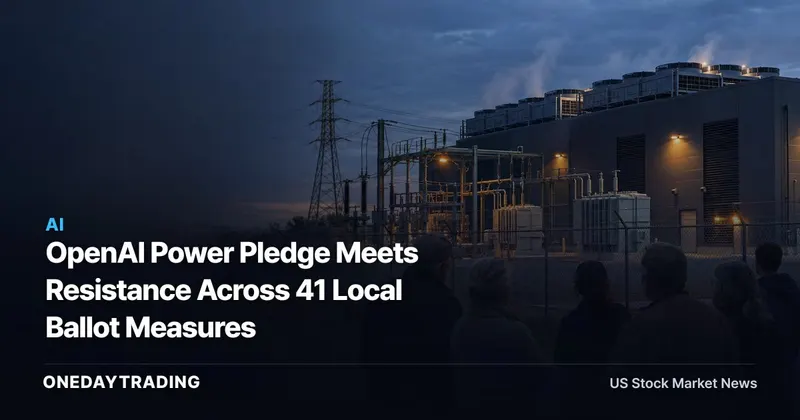
OpenAI’s Power Pledge Meets a Local Expansion Test
OpenAI published commitments Thursday that could reshape the execution risk around AI infrastructure: the company reaffirmed that it will pay the full cost of powering data centers it owns and operates, seek community input and publish construction plans. For investors, the immediate issue is not whether demand for compute exists, but whether the physical infrastructure required to serve customers and develop new models can advance under clearer local conditions.
CNBC reported that voters backed restrictions or rejected pro-development measures in all but one of 41 local ballot measures across 10 states on Tuesday. That result puts a measurable political constraint beside an exceptionally large capital ambition, even though the eventual effect on individual projects cannot yet be calculated.
What OpenAI Has Actually Committed To
An AI data-center commitment is a set of operating and disclosure promises governing how facilities are powered, planned and discussed with affected communities. OpenAI said its commitments apply to data centers it owns and operates, an important boundary because the available facts do not identify every facility covered.
The company reaffirmed that it would bear the full cost of powering those facilities and protect ratepayers. It also committed to soliciting community input, publishing construction plans and avoiding non-disclosure agreements with public officials. Those provisions address financing, visibility and public engagement as separate parts of the same infrastructure problem.
OpenAI went beyond its own operating practices by encouraging policymakers to enact similar commitments as laws. The distinction matters: a corporate pledge sets terms for the company’s covered projects, while legislation could establish requirements more broadly. The facts do not show which provisions, if any, policymakers will adopt.
The Ballot Results Change the Infrastructure Lens
Ballotpedia analyzed the local votes, and CNBC gathered additional results Wednesday: Americans supported restrictions or rejected pro-development measures in every case except one among the 41 local ballot measures across 10 states decided Tuesday. The pattern does not determine the fate of OpenAI’s announced projects, but it shows that local approval conditions deserve the same attention as compute-spending targets.
This is the central investor tension. OpenAI depends on AI data centers to serve customers and develop new models, so physical deployment is integral to its operating model. Community input and published construction plans could make proposed projects easier to evaluate, while additional legal requirements could add conditions that must be addressed before expansion proceeds.
The commitments therefore function as an execution framework rather than proof of execution. They establish principles for cost responsibility and transparency. They do not disclose how the company will calculate power costs, how payments will be structured or how local feedback will affect a particular construction decision.
A $600 Billion Compute Target Meets Physical Constraints
OpenAI told investors in February that it was targeting $600 billion in total compute spending by 2030, according to CNBC. The scale makes the policy blueprint financially relevant: commitments concerning power costs, construction disclosure and community engagement sit directly alongside the infrastructure needed to support that spending objective.
The target is not an achieved expenditure, and it does not specify the portion assigned to data centers owned and operated by OpenAI. Investors should therefore avoid treating the full amount as spending governed by the new commitments. The more defensible conclusion is that a large compute ambition increases the importance of clearly defining which facilities are covered and how the promises will be implemented.
OpenAI has announced data-center projects in Georgia and Ohio. Their construction schedules and capacities are not provided, preventing a project-level estimate of power requirements, covered costs or timing. Those omissions are material because the pledge can be assessed economically only when its scope and application become visible.
How the Policy Channel Reaches AI Infrastructure
- OpenAI: The company faces the direct task of translating its commitments into project terms while pursuing its compute-spending target. Paying full power costs may protect ratepayers, though the financial effect cannot be quantified without the calculation method and facility coverage.
- AI data centers: The ballot results establish local policy risk around the infrastructure on which OpenAI relies. Published plans and community consultation may clarify proposed development, while restrictions could narrow or condition what proceeds.
- Policymakers: OpenAI has asked them to convert similar commitments into law. The investable significance depends on the language ultimately considered and whether any provision is enacted.
- Georgia and Ohio projects: These announced developments are concrete checkpoints for testing how the commitments operate. The available information does not provide schedules or capacities.
The Constructive and Adverse Cases for OpenAI
Constructive case: OpenAI’s willingness to fund the full power cost of owned and operated facilities, disclose construction plans and gather community input could provide clearer terms for evaluating projects. A more explicit framework may help public officials and communities distinguish defined commitments from open questions as proposals advance.
Adverse case: The ballot record shows resistance across nearly the entire set analyzed by Ballotpedia and supplemented by CNBC. If policymakers turn that resistance into binding restrictions, OpenAI’s infrastructure program could face more demanding approval conditions. The facts do not establish whether that scenario will occur or how it would affect the $600 billion target.
The balance turns on implementation, not the wording alone. The pledge becomes analytically useful when OpenAI identifies covered facilities, explains the power-cost calculation and connects published plans to project decisions. Until then, the commitments reduce ambiguity about intent without resolving cost, capacity or schedule uncertainty.
Chris Lehane’s Policy Timeline and the Next Checks
Chris Lehane, OpenAI’s Chief Global Affairs Officer, told reporters Wednesday that the blueprint was intended to apply lessons the company had learned and establish a high baseline for future conduct. He said the work began in August and included meetings with dozens of lawmakers and candidates.
Lehane also framed the period before Congress returns in late January as time for policy discussions to advance. That makes the next phase observable through proposals and project disclosures rather than slogans.
- Coverage: Check which owned and operated data centers OpenAI places under the commitments.
- Power accounting: Look for the method used to calculate and pay the full cost of electricity for covered facilities.
- Project disclosure: Monitor construction plans, schedules and capacities for the announced Georgia and Ohio projects.
- Policy conversion: Track whether lawmakers translate any part of the blueprint into proposed or enacted law after Congress returns in late January.
The decisive signal will be whether OpenAI converts a broad policy promise into facility-level obligations that investors and communities can examine. Until those details arrive, local resistance is the visible risk and the company’s implementation record is the next test.
📊 Analysis
Signal Bearish
Why Broad local resistance creates policy and execution risk for AI data-center expansion, while the cost and scope of OpenAI’s commitments remain undefined.
This article was independently written by OneDayTrading from public reporting. Read the original (CNBC)