CoreWeave and the Post-Midterm AI Divide
CoreWeave fell around 10% Wednesday as U.S. midterm results raised the prospect of tighter data center scrutiny, while Microsoft and Amazon each gained more than 6%, according to CNBC. The split points to a sharper distinction within the AI infrastructure trade: capacity already being built may become more valuable if permits become harder to obtain, while operators dependent on new construction and external financing may face pressure from both regulation and capital costs.
A neocloud is an AI-focused cloud infrastructure operator whose expansion depends heavily on adding computing capacity. That model becomes more exposed when permitting delays postpone projects or wider borrowing spreads make incremental capacity more expensive to finance. Hyperscalers, by comparison, have broader cloud businesses and more internally generated cash flow, according to JPMorgan Asset Management.
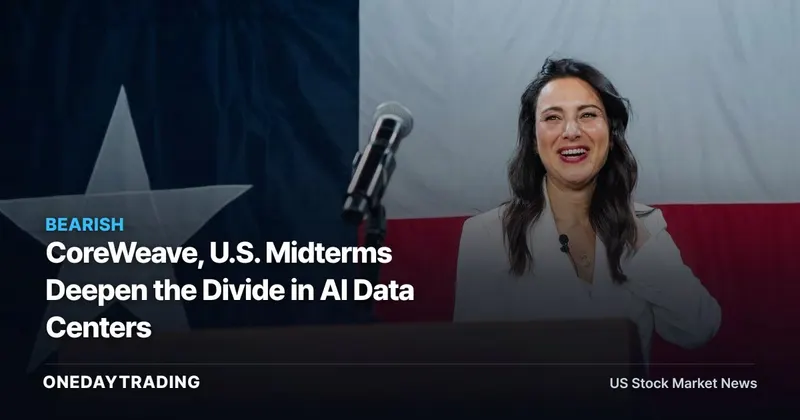
Gina Hinojosa Puts Texas Permits in Focus
Democratic victories in key gubernatorial races raised the prospect of tougher scrutiny for data center projects. Gina Hinojosa proposed a statewide moratorium on new data center permits in Texas, with projects already under construction reportedly exempt from the proposal.
The distinction between proposed and enacted policy is essential. Whether the Texas moratorium will take effect is unknown, and the midterm results have not established the exact permitting rules that projects will face. Investors are therefore pricing exposure to a possible constraint rather than a confirmed shutdown of new development.
The exemption for construction already underway creates the central dividing line. An operator with capacity in progress may retain a clearer path to completion, whereas a planned project still awaiting permits carries more regulatory uncertainty. That makes project status—not simply total AI demand—the relevant operating variable.
Why Existing Data Center Capacity Carries a Premium
James Sullivan, managing director and co-head of global fundamental research at JPMorgan, told CNBC that borrowing spreads had widened significantly for neocloud companies. He attributed the divergence in equity performance largely to a market view that existing capacity has become more valuable as incremental supply constraints increase.
This mechanism links policy directly to company financing. A permit delay can defer the point at which a planned facility becomes usable capacity. If the operator also faces higher borrowing costs, the same expansion becomes harder to fund or refinance before it contributes operating capacity. Companies able to finance projects from internally generated cash flow have more room to absorb that timing mismatch.
CoreWeave’s five-year credit default swap spread surged past 1,100 basis points, CNBC reported. A credit default swap spread represents the cost of protection against a potential default; the move therefore signals elevated concern in the company’s credit risk rather than merely volatility in its shares.
JPMorgan Asset Management’s Oct. 20 research note identified the balance-sheet divide. It said hyperscalers benefit from broader cloud operations and internally generated cash flow, while lower-rated neoclouds are more exposed to borrowing costs, energy prices and refinancing conditions. Under tighter permitting, those financial differences can determine which companies can continue funding capacity through delays.
Microsoft, Amazon and AI Infrastructure Stocks Diverge
- Microsoft and Amazon: Each rose more than 6% Wednesday, CNBC reported. The market response was consistent with a preference for hyperscalers whose broader cloud businesses and internal cash generation can reduce dependence on additional borrowing.
- CoreWeave: The Nvidia-backed neocloud dropped around 10% Wednesday. Its five-year credit default swap spread moving past 1,100 basis points adds a credit-market signal to the equity decline, placing financing conditions at the center of the investment case.
- Micron: Shares declined 7% Wednesday. The move shows that the market did not treat tighter prospective capacity as uniformly favorable across the AI supply chain, even though the supplied evidence does not establish the company-specific cause of Micron’s decline.
- Nvidia: Shares fell 3.17% Wednesday. Nvidia backs CoreWeave, connecting it directly to the neocloud at the center of the financing debate, though the evidence does not quantify the effect of permitting uncertainty on Nvidia.
- Nebius and Iren: CoreWeave, Nebius and Iren each fell at least 30% in October as questions intensified over financing for AI infrastructure projects. The common pressure point is exposure to capital availability rather than a confirmed change in data center demand.
The 2027 and 2028 Construction Split
The construction pipeline limits the immediate regulatory effect. Much of the data center capacity expected to come online in 2027 was already under construction, according to CNBC, which could place it within the reported exemption contemplated for the proposed Texas moratorium. The exact amount of that capacity is not available.
Projects planned for 2028 carry greater exposure to permitting delays and regulatory uncertainty, Nomura said in its Wednesday note on the midterm results. The firm said tighter construction regulations could become a more significant headwind to AI investment from 2028. This timing argues against treating the election result as an immediate, uniform reduction in capacity.
BMI warned that a sharp slowdown in data center construction and AI investment could produce a greater-than-expected decline in overall investment, The Business Times reported, citing BMI’s post-midterm analysis. That is a conditional risk: it depends on a sharp construction slowdown, while the duration and ultimate impact of any permitting delays remain unknown.
Investor Checkpoints for CoreWeave and Hyperscalers
- Texas policy status: Track whether Gina Hinojosa’s proposed permit moratorium is enacted and whether the reported exemption for projects already under construction survives in the final rules.
- Project stage: Separate capacity already being built for 2027 from projects planned for 2028. The latter group has greater stated exposure to permitting uncertainty.
- Credit conditions: Monitor whether CoreWeave’s five-year credit default swap spread remains past 1,100 basis points and whether borrowing spreads for neocloud companies continue to widen.
- Funding resilience: Compare reliance on borrowing and refinancing with the internally generated cash flow available to hyperscalers. Energy-price exposure also belongs in that assessment for lower-rated neoclouds.
What Could Change the K-Shaped AI Trade
The constructive case for existing capacity is straightforward: stricter permitting could limit incremental supply, increasing the relative value of projects already under construction. Microsoft and Amazon fit the financially stronger side of that divide because hyperscalers have broader cloud businesses and more internal cash generation. This is an advantage in resilience, not proof that any specific permitting outcome will occur.
The risk case concentrates in debt-funded expansion. CoreWeave combines a sharp Wednesday equity decline with a five-year credit default swap spread past 1,100 basis points, and its October performance moved in the same direction as Nebius and Iren. If permits take longer and refinancing conditions remain difficult, planned capacity carries both execution and funding exposure.
The next decisive evidence will come from policy language, project classifications and credit markets. Enactment of the Texas proposal would clarify the regulatory channel; confirmation that construction-stage projects remain exempt would define which capacity is protected. Until those details emerge, the strongest supported distinction is between capacity already underway and projects that still require permits and financing.
Market data check: CoreWeave, Inc.
CoreWeave, Inc. last traded near $47.25 (-2.42%). Our composite signal — blending price momentum and news flow — reads 🟡 neutral. Price momentum scores 31/100 (soft).
Data as of publication. Price via market feeds; for reference only, not investment advice.
📊 Analysis
Signal Bearish
Why Potential permitting constraints and elevated borrowing costs create greater pressure on debt-funded neoclouds than on hyperscalers with existing capacity and internally generated cash flow.
Tickers$CRWV$MSFT$AMZN$NVDA$MU$NBIS
This article was independently written by OneDayTrading from public reporting. Read the original (CNBC)