Summary
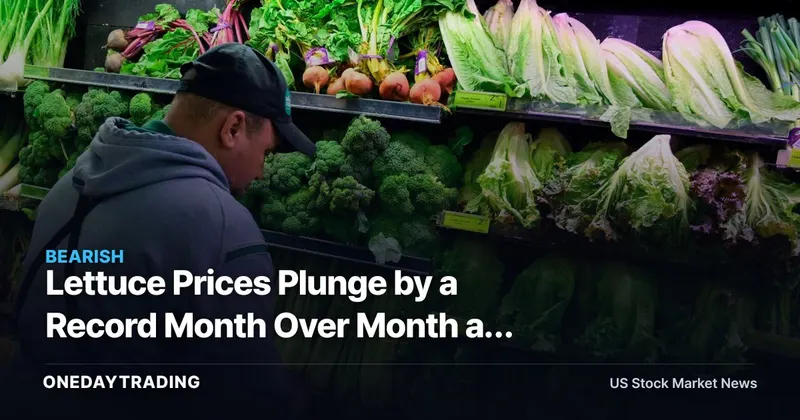
Lettuce prices posted their sharpest month-over-month decline on record because consumers pulled back from the vegetable during a cyclospora outbreak, per CNBC Markets, and the investor signal is a demand shock moving through fresh produce before it reaches restaurant food costs, grocery margins and distributor volumes.
For retail investors, the key read is not simply cheaper lettuce. The sharper point is that a food-safety scare can break demand faster than farms, wholesalers and food-service buyers can rebalance supply.
The Full Story
CNBC Markets reported that lettuce prices recorded their steepest month-over-month drop on record as diners reconsidered lettuce during the cyclospora outbreak. Cyclospora is a foodborne parasite that can cause intestinal illness, and the market impact comes through consumer avoidance, not just crop supply.
The phrase nobody wants it captures the balance-sheet problem for the lettuce chain: perishable inventory loses pricing power when buyers hesitate. A grocer can promote packaged goods later, but fresh lettuce has a short selling window, so weak traffic at the produce case can become markdown pressure quickly.
Restaurants sit on the other side of the same move. Lower lettuce costs can help near-term food input expense, but a demand scare changes the menu equation if diners avoid salads, wraps and lettuce-heavy items rather than simply buying them at a lower price.
Structural Background
Lettuce is a high-velocity fresh produce item, which means price is set by daily buyer confidence as much as by acreage or harvest volume. When CNBC Markets reports the sharpest month-over-month decline on record, the mechanism is a sudden clearing-price reset for a product that cannot be stored like grain or frozen protein.
For the broader Consumer and Food & Beverage sectors, the outbreak shows how behavior reaches the income statement. Consumer caution lowers willingness to buy, retailers discount to move inventory, and food-service operators decide whether cheaper input costs offset weaker demand for lettuce-based menu items.
Stock & Sector Ripple
- Fresh produce suppliers: Lettuce growers and distributors face the cleanest negative read-through because a record month-over-month price drop directly compresses revenue per unit unless volume absorbs the shock.
- Grocery retailers: Supermarkets may benefit from cheaper wholesale lettuce, but consumer hesitation during the cyclospora outbreak can reduce produce-section traffic and force markdowns on perishable inventory.
- Restaurants and fast casual: Salad, sandwich and wrap sellers can see lower ingredient costs, but the benefit weakens if diners substitute away from lettuce-heavy orders.
- Food-safety services: Testing, traceability and sanitation demand become more relevant when a foodborne illness changes consumer behavior at national scale.
Bull vs Bear Scenarios
The bull case for restaurants and grocers is straightforward: if consumer concern fades quickly, record-low lettuce pricing becomes a temporary gross-margin tailwind for buyers that can maintain menu prices or retail shelf prices.
The bear case is also direct: if diners keep avoiding lettuce after the cyclospora outbreak, the price decline signals demand impairment rather than a bargain input cost. In that scenario, volume, waste and discounting matter more than the lower headline price.
Investor Action Points
- Track whether the next reported lettuce price data stabilizes after the record month-over-month decline cited by CNBC Markets.
- Listen for restaurant earnings commentary on salad, sandwich and wrap demand, not just food-cost inflation.
- Watch grocery-margin language for produce markdowns, shrink and traffic effects tied to consumer caution.
- Separate a temporary food-safety shock from a lasting demand change; the investment impact depends on duration, not the headline drop alone.
FAQ
Why did lettuce prices plunge by a record month over month?
Lettuce prices posted their sharpest month-over-month decline on record because consumers reconsidered the vegetable during a cyclospora outbreak, per CNBC Markets. The price move reflects demand hesitation in a perishable market where sellers must clear inventory quickly.
What is cyclospora and why does it affect lettuce demand?
Cyclospora is a foodborne parasite that can cause intestinal illness, and CNBC Markets linked the outbreak to diners pulling back from lettuce. For investors, the relevance is behavioral: food-safety concern can lower fresh-produce demand before companies report the effect in sales or margin.
What stocks or sectors are affected by falling lettuce prices?
The most direct impact falls on fresh produce suppliers, grocery retailers, restaurants and food-safety services because lettuce prices, consumer traffic and perishable shrink all connect to operating margins. The clearest checkpoint is whether future earnings calls mention lettuce demand, produce markdowns or menu-item substitution after the outbreak.
📊 Analysis
Signal Bearish
Why The record month-over-month lettuce price plunge signals demand damage from a food-safety scare, which is negative for fresh produce economics even if some buyers see lower input costs.
This article was independently written by OneDayTrading from public reporting. Read the original (CNBC Markets)