Summary
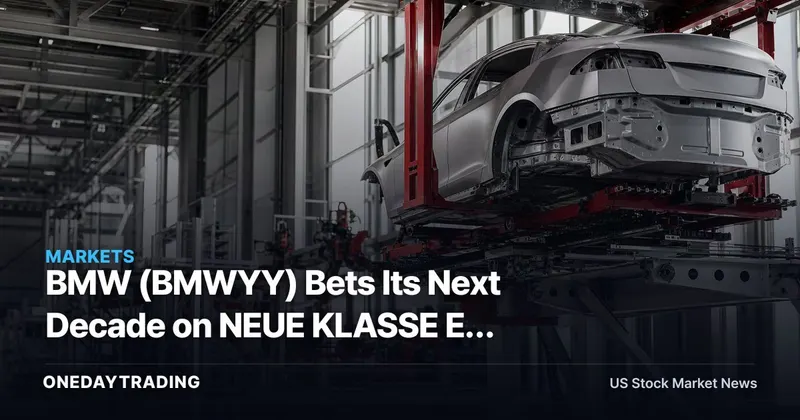
BMW's investment story is shifting from heritage and pricing power to a single operational question: can it execute NEUE KLASSE, the clean-sheet electric architecture meant to carry the brand through the next decade. For holders of the U.S.-listed ADR (BMWYY), the catalyst is no longer demand for the badge but the company's ability to industrialize a new platform on cost and on time.
The Full Story
NEUE KLASSE is not a facelift. It is a ground-up vehicle architecture spanning electric drivetrain, software stack and a redesigned battery system, intended to underpin a large share of BMW's future lineup rather than a single halo car. That breadth is the point and the risk. When a legacy automaker re-platforms, the payoff scales with volume, but so does the exposure if production ramp, software integration or battery supply stumbles.
The thesis here is execution, not novelty. Premium German automakers do not lack engineering or brand. What they have struggled with is converting electric ambition into margins that rival their combustion franchises, where pricing, parts complexity and dealer economics are decades-refined. NEUE KLASSE is BMW's attempt to reset the EV cost base low enough that electric vehicles stop diluting group profitability and start defending it.
The competitive backdrop sharpens the stakes. Tesla still sets the software and cost benchmark in the premium-adjacent tier; Mercedes-Benz is pushing its own EV architecture; and Chinese makers led by BYD are exporting price and feature velocity into Europe. A new platform that lands late or over budget cedes ground in exactly the segment where BMW's margins are richest.
Structural Background
Automaker re-platforming is a capital-cycle event. Heavy upfront spend on tooling, battery sourcing and software precedes any unit economics, and the market typically pays only once the ramp proves out. The investment debate around BMW therefore hinges less on whether NEUE KLASSE is good engineering and more on whether the fixed-cost base it creates is absorbed by enough profitable volume to lift group returns rather than weigh on them during the transition years.
Stock & Sector Ripple
- BMW (BMWYY) — the subject. Re-rating depends on EV gross margin trajectory and ramp discipline; smooth execution defends premium mix, a stumble pressures group profitability during the spend-heavy phase.
- Tesla (TSLA) — the cost and software yardstick; a credible premium EV platform from BMW narrows Tesla's differentiation in the upper segment.
- Mercedes-Benz / German premium peers — direct read-through; NEUE KLASSE sets the bar German rivals must match on EV cost and software.
- Battery and EV supply chain — new cell formats and sourcing decisions shift volume toward chosen cell and component suppliers.
- Ford (F), GM (GM) — legacy peers navigating the same EV margin problem; BMW's outcome informs the broader transition playbook.
Bull vs Bear Scenarios
Bull: NEUE KLASSE ramps on schedule, EV margins converge toward combustion levels, and BMW preserves premium pricing while expanding its electric mix, turning the platform into a multi-year earnings tailwind.
Bear: ramp delays, software friction or battery cost overruns compress margins through the heavy-spend window, while BYD's price pressure and Tesla's software lead erode the segment before the new platform reaches scale.
Investor Action Points
- Track NEUE KLASSE production ramp milestones and any timeline revisions in quarterly updates.
- Watch reported EV versus group margins for evidence the new platform lifts rather than dilutes profitability.
- Monitor European EV pricing and BYD's import share as a gauge of segment pressure on BMW's richest markets.
- Compare capital spending and battery sourcing commitments against ramp progress to judge whether fixed costs are being absorbed.
📊 Analysis
Signal Neutral
Why The story frames NEUE KLASSE as a high-stakes execution bet with credible upside but real ramp and cost risk, so the directional impact is genuinely two-sided.
This article was independently written by OneDayTrading from public reporting. Read the original (Investing.com)