At a Glance
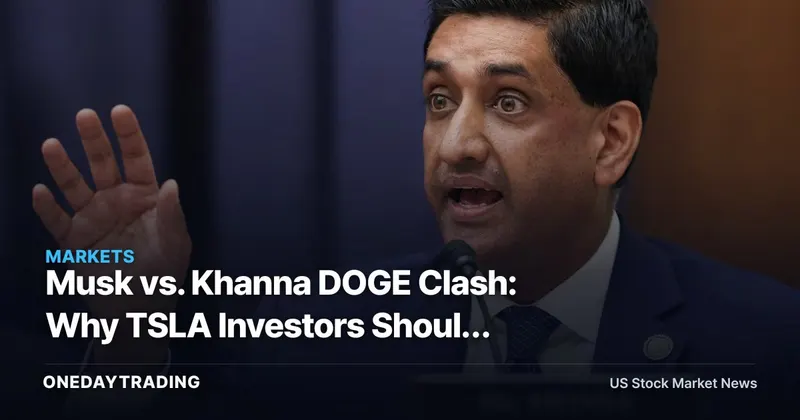
Rep. Ro Khanna, a California Democrat and vocal critic of the Elon-Musk-led Department of Government Efficiency, has publicly challenged Musk to a televised debate over DOGE spending cuts. The dispute is political theater, but for equity investors the relevant signal is how deeply Tesla's chief executive is now embedded in partisan conflict.
Why It Matters Now
Tesla is unusual among large-cap names in that its valuation has long carried a CEO premium tied to Musk's reach and credibility. The same visibility that fuels the narrative cuts both ways: when Musk steps into government cost-cutting and trades barbs with sitting members of Congress, Tesla's brand inherits the polarization. The channel to fundamentals runs through demand. Autos are a discretionary, brand-sensitive purchase, and a meaningful share of Tesla's buyer base skews toward the same urban, climate-conscious demographic that tends to oppose aggressive federal cuts.
There is also an attention-cost argument. A founder-led growth story trades partly on the assumption that the CEO is focused on the product roadmap. Every hour spent on DOGE politics and debate challenges is an hour not spent on the next vehicle cycle, energy storage, or the autonomy and robotics ambitions that underpin the bull thesis. None of this shows up in a single quarter's numbers, but it shapes how the market discounts execution risk.
FAQ
- Is this debate challenge itself market-moving? Directly, no. It is a political event with no earnings, guidance, or policy figure attached. The relevance is cumulative brand and distraction risk, not a one-day catalyst.
- How does DOGE connect to Tesla's business? It does not touch the income statement directly, but it ties Musk to contentious federal spending decisions, which can color consumer sentiment toward the brand in a competitive EV market.
- Why does CEO politics matter more for Tesla than peers? Tesla's premium reflects confidence in Musk personally; legacy automakers carry no equivalent key-person concentration.
- What would neutralize the concern? Strong delivery and margin data would let fundamentals reassert over headlines.
Related Stocks and Sectors
- Tesla (TSLA) - The core exposure; brand polarization and CEO attention are demand-side and sentiment variables layered on top of pricing and margin pressure.
- Legacy and EV peers (GM, F, RIVN) - Any softening in Tesla's brand among certain buyers is a competitive opening in a market already fighting on price.
- Chinese EV competitors - Global share dynamics matter more to the long thesis than U.S. political noise, but brand friction at home does not help abroad.
What to Watch
- The next Tesla delivery and earnings release, where demand trends and automotive gross margin will show whether brand effects are material or noise.
- Whether Musk escalates or steps back from DOGE and partisan disputes, signaling how much CEO bandwidth stays on operations.
- Survey and registration data on brand consideration in key U.S. regions.
- Order trends and incentive levels, which reveal whether discounting is offsetting any demand softness.
Overall Outlook
The bull case is that Tesla is an execution and technology story, and that political headlines fade once delivery and margin data arrive. The risk is that a CEO increasingly defined by partisan fights erodes brand neutrality in a discretionary category where rivals are eager to convert any hesitation into share. This single debate challenge changes nothing fundamental, but it is another data point in a pattern that investors pricing a CEO premium cannot ignore.
Market data check: TSLA
TSLA last traded near $394.38 (-2.64%). Our composite signal — blending price momentum and news flow — reads 🟡 neutral. Price momentum scores 29/100 (soft).
Data as of publication. Price via market feeds; for reference only, not investment advice.
📊 Analysis
Signal Neutral
Why A political debate challenge carries no earnings or policy figure and is not a direct market catalyst, though it adds to an ongoing brand and CEO-distraction overhang for Tesla.
This article was independently written by OneDayTrading from public reporting. Read the original (CNBC)