What the Montana Plan Changes
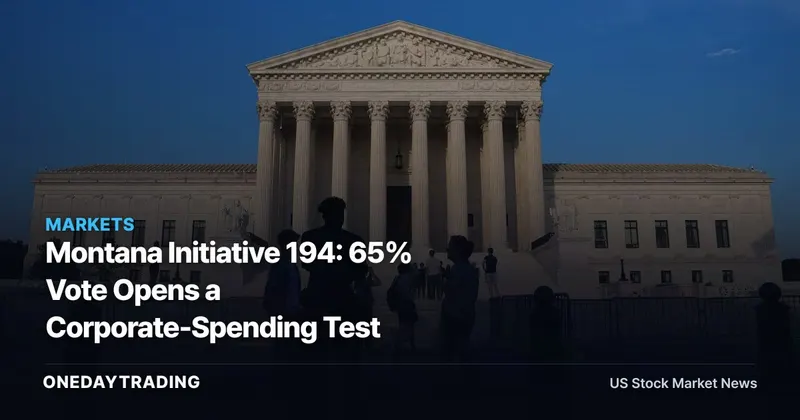
Initiative 194 is a state-law strategy for restricting election spending through corporate powers rather than directly limiting political speech. Corporations and other covered organizations that spend money to influence Montana elections could lose state-granted corporate privileges until improperly spent funds are surrendered and applicable legal conditions are satisfied.
The restriction also covers trade associations, labor unions and nonprofits. Individuals, political committees and government entities remain exempt, as do bona fide news, commentary and editorial content. That distinction matters because the measure changes which legal forms may fund political activity without removing wealthy individuals from the system.
Elon Musk illustrates the boundary. The Tesla and SpaceX CEO was the largest known individual donor in the 2026 election, with at least $474 million in political giving, according to CNBC’s analysis; Initiative 194 exempts his personal spending while subjecting corporate spending by his companies to the broader restriction.
Montana’s Vote Meets a Much Larger Spending Market
The vote arrives after $11.87 billion in political advertising nationwide this election cycle, according to AdImpact. That nationwide total should not be mistaken for spending covered by Montana’s measure, but it establishes the scale of the political-media market surrounding the legal dispute.
OpenSecrets data cited by CNBC show known corporate contributions to outside groups in federal elections rising from $13 million in 2010 to more than $600 million by September 2026. The figures exclude money routed through nonprofits that conceal their donors, so they describe known contributions rather than the entire flow of funds.
The political breadth of the result is also notable. Donald Trump won Montana by nearly 20 points in 2024, while roughly 65% of Montanans subsequently backed Initiative 194. The facts establish support for this ballot measure across a state with that electoral profile; they do not establish how voters would decide a future legislative revision or court-driven replacement.
Corporate Exposure Is Uneven by Design
The cleanest investor read-through is not a revenue estimate. It is a distinction between corporate money and personal money, with potential consequences for organizations that want to influence Montana candidates or ballot issues. The fact sheet provides no company-level spending, earnings exposure or valuation effect, so Initiative 194 cannot support a quantified impact on Tesla or any other listed stock.
- Tesla: Tesla is directly relevant because Elon Musk is its CEO. His personal political spending remains exempt, while corporate election spending falls within the type of activity Initiative 194 restricts.
- Covered organizations: Corporations, trade associations, labor unions and nonprofits face the loss of state-granted privileges if they violate the measure and fail to surrender improperly spent funds or meet legal conditions.
- Individuals and political committees: These participants retain an avenue for election spending because the measure expressly exempts them.
- News and commentary organizations: Bona fide news, commentary and editorial content are excluded, separating covered political spending from protected publishing activity under the measure’s terms.
The Funding Structure Complicates the Narrative
Corporate-spending restrictions attracted support from individuals connected to major companies. Samantha Walton, the wife of Walmart heir Lukas Walton, contributed $722,300 to groups supporting the plan, while LinkedIn co-founder Reid Hoffman contributed $150,000.
Transparent Election Initiative, the campaign’s organizing nonprofit, is not generally required to identify its donors. The identities of any undisclosed contributors therefore remain unknown. That gap does not alter the reported vote, though it limits a complete assessment of the campaign’s financial backing.
The exemptions also create a structural counterweight to the restriction. Brad Smith, who leads the Institute for Free Speech, said, “Billionaires will find loopholes.” His criticism focuses on the possibility that restricting organizations while exempting individuals changes the channel of political spending rather than removing large private fortunes from elections.
Hawaii Provides the First Legal Checkpoint
Hawaii lawmakers enacted a similar law in May, and litigation is already underway. The U.S. Chamber of Commerce sued to block that law, while the Institute for Free Speech represents the Grassroot Institute of Hawaii in a separate challenge. The ACLU has argued in a court brief that Hawaii’s measure violates the First Amendment.
Those proceedings offer the next observable legal evidence for investors assessing Montana’s policy risk. A decision addressing whether states may restrict corporate powers in this manner could clarify the durability of the Montana strategy, although the fact sheet does not establish that one state’s litigation will determine the other’s outcome.
Michael Kang of Northwestern Pritzker School of Law described the corporate-code approach as “a distinction without a difference,” arguing that courts would view it as an attempt to bypass Citizens United. Tom Moore, a former Federal Election Commission official and Center for American Progress senior fellow who helped develop the plan, framed the dispute differently: “The way we look at it, this is states’ rights vs Citizens United.”
Montana’s Legislative and Supreme Court Risks
- State-law risk: Montana’s Republican-controlled legislature could amend or repeal Initiative 194. If that occurs, proponents have pledged to return the issue to voters in 2028.
- Court risk: Whether courts will uphold the measure is unknown. It is also unknown whether the dispute will reach the Supreme Court.
- Judicial backdrop: The Supreme Court has a 6-3 majority and in June struck down limits on coordinated spending by political parties. That decision does not by itself resolve Initiative 194’s corporate-powers theory.
- Precedent risk: Montana voters banned corporate campaign spending in 1912; the prohibition lasted a century before the Supreme Court struck it down in 2012 under the Citizens United framework.
More Than 30 States Could Expand the Stakes
Similar measures are being explored in more than 30 states. That makes Montana potentially important beyond its own elections, provided the legal structure survives both political revision and court review. Replication is a possible outcome, not an established one.
Kal Munis of Montana State University reduced the measure’s enforcement logic to a direct warning: “Keep your campaign cash out of Montana.” For corporations, the material question is whether that warning becomes durable law, is narrowed by the legislature or fails in court before it can influence broader corporate political-spending policies.
Bottom Line: A Legal Catalyst Without an Earnings Number
Initiative 194 creates a new policy constraint for corporate political activity in Montana, while its exemptions preserve spending by individuals and political committees. The vote is not sufficient evidence for a directional earnings call on Tesla or another listed company. The investable signal will come from the measure’s treatment by Montana lawmakers, the conditions applied when it takes effect on Jan. 1, and the legal reasoning produced by the Hawaii challenges; those checkpoints will show whether the Montana Plan remains a state-specific rule or becomes a model considered elsewhere.
Market data check: Tesla, Inc.
Tesla, Inc. last traded near $350.9 (+2.10%). Our composite signal — blending price momentum and news flow — reads 🟡 neutral. Price momentum scores 67/100 (firm).
Data as of publication. Price via market feeds; for reference only, not investment advice.
📊 Analysis
Signal Neutral
Why Initiative 194 creates potential regulatory exposure for corporations operating in Montana, though legislative action and unresolved court challenges prevent a clear stock impact.
This article was independently written by OneDayTrading from public reporting. Read the original (CNBC)