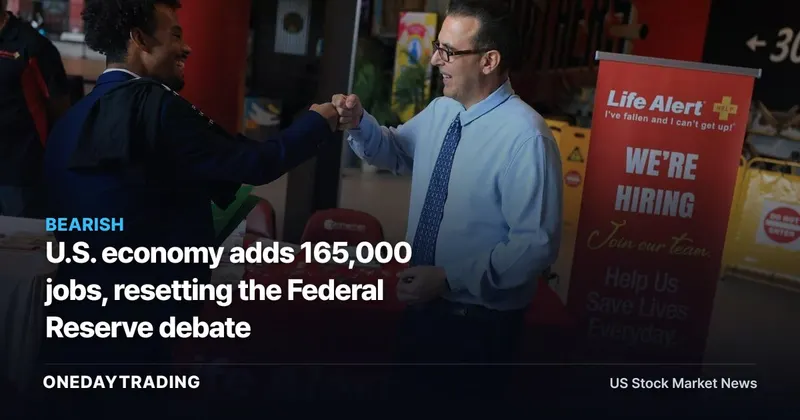
U.S. economy jobs surprise changes the policy question
The U.S. economy added a seasonally adjusted 165,000 nonfarm payroll jobs in October 2026, a result that shifts investor attention from labor-market weakness toward the risk of tighter Federal Reserve policy. CNBC identified the Bureau of Labor Statistics as the agency reporting the figures on Friday. For equity investors, the immediate tension is clear: stronger employment supports economic activity, while persistent wage growth may leave less room for policy relief.
Nonfarm payrolls measure the monthly change in paid employment outside the farm sector, adjusted for recurring seasonal patterns. The October gain exceeded the Dow Jones estimate of 59,000 jobs, while the unemployment rate declined to 4.1% against a forecast of 4.2%. Those two readings describe a labor market that was stronger than expected on both job creation and headline unemployment.
Payroll strength extended beyond the headline
The report did not rely on October alone. The U.S. economy's August 2026 payroll figure was revised to 186,000 jobs, an upward revision of 53,000, while September 2026 was revised to 60,000 jobs after a 31,000-job increase. Upward revisions make the sequence more important than a single monthly surprise because the previously reported employment base also strengthened.
The details were not uniformly tight. A broader measure of labor underutilization reached 7.9% in October 2026, rising by 0.3 percentage point, as the civilian labor force expanded by 421,000 people. That combination introduces a useful counterweight to the headline unemployment rate: the workforce grew, while the wider measure captured labor conditions not visible in the 4.1% figure.
The full Bureau of Labor Statistics report is not included in the supplied data, so the internal composition of those broader measures cannot be assessed here. The October payroll figure also may be revised later, although the available information does not state whether or in which direction any revision could occur.
Wages keep the Federal Reserve channel open
Average hourly earnings rose 0.4% in October 2026 from the prior month and 3.1% annually, CNBC reported, exceeding estimates of 0.3% monthly and 2.9% annually. The average work week was unchanged at 34.4 hours. Wage growth therefore supplied a second source of strength without an increase in average hours worked.
For markets, this is the report's critical transmission channel. If stronger wages contribute to persistent price pressure, the Federal Reserve may have less flexibility to ease financial conditions; if wage growth moderates without a deterioration in employment, that constraint could fade. This is conditional analysis, not a reported policy outcome, and the supplied evidence gives no final decision for the next meeting.
The Federal Reserve's stated inflation target is 2%. The gap between that target and the reported 3.1% annual increase in average hourly earnings is not a direct inflation comparison because earnings growth and inflation are different measures. It does explain why investors should treat the wage data as a policy input rather than assume that a strong payroll result is unambiguously positive for equity valuations.
Federal Open Market Committee expectations moved toward a rate increase
The clearest available pricing signal comes from CME Group's FedWatch tool. It assigned a 76.8% probability to a Federal Reserve rate increase at the Federal Open Market Committee's Dec. 8-9 meeting. That probability is an estimate of market expectations, not the committee's decision.
A higher expected policy path can pressure equity multiples because future cash flows become less valuable under a higher discount rate. At the same time, the employment data can support expectations for business demand and household income. The market question is not simply whether 165,000 jobs are “good” or “bad”; it is whether the growth benefit outweighs the valuation cost implied by policy expectations.
The evidence does not show how much of the jobs surprise was already embedded in individual stock prices, and it provides no final market outcome. Investors can observe the 76.8% probability as a benchmark for expectations, then test whether later information strengthens or weakens the case priced into that meeting.
October sector hiring broadens the economic signal
- Professional and business services: The sector led October 2026 gains with 70,000 jobs. That leadership broadens the report beyond health care and may indicate stronger labor demand in business-facing activity, although the supplied facts do not identify individual employers or revenue effects.
- Health care: Employment increased by 42,000 jobs in October 2026. The gain remained substantial, though it was smaller than the increase in professional and business services.
- Transportation and warehousing: The sector added 25,000 jobs in October 2026. For investors, future confirmation would require evidence that employment growth aligns with durable activity rather than treating hiring alone as proof of higher company earnings.
- Manufacturing: Employment rose by 19,000 jobs in October 2026. The increase is a constructive labor indicator, though the facts supplied do not provide production, orders, margins or company-level exposure.
This breadth matters because concentration in one industry would offer a narrower signal about economic demand. October's gains instead covered professional services, health care, transportation and warehousing, and manufacturing. Employment breadth still cannot establish the earnings trajectory of any listed company without revenue, cost and guidance data.
What the bullish and bearish cases require
Bull case: The 165,000-job increase, the decline in unemployment to 4.1%, and the upward August and September revisions support the interpretation that labor demand retained momentum. Broader sector hiring may reinforce that reading. If subsequent data preserve employment strength without intensifying policy concerns, economically sensitive sectors could receive support from the growth side of the equation.
Bear case: Monthly and annual average hourly earnings both exceeded their respective estimates, while FedWatch placed a 76.8% probability on a rate increase at the Dec. 8-9 Federal Open Market Committee meeting. If investors raise the discount rate applied to future profits, valuation pressure could offset the benefit of stronger employment. The broader underutilization measure at 7.9% also prevents a one-dimensional reading of labor conditions.
The dividing line is policy sensitivity. Companies whose valuations depend more heavily on distant expected cash flows may be more exposed to a higher discount-rate assumption, while businesses tied to current economic activity may benefit more from resilient employment. No company-specific conclusion is supportable from the supplied figures, so the actionable judgment belongs at the macro and sector level.
Investor checkpoints before the Dec. 8-9 meeting
- Track revisions: Check whether the October 2026 gain of 165,000 jobs is revised, especially after August and September were raised by 53,000 and 31,000 jobs.
- Separate wages from hours: Compare future earnings growth with the October increases of 0.4% monthly and 3.1% annually, while using the unchanged 34.4-hour work week as a distinct measure of labor input.
- Monitor expectation changes: Use the 76.8% FedWatch probability for the Dec. 8-9 meeting as the current reference point, without treating it as a Federal Reserve commitment.
- Demand company-level confirmation: For professional services, health care, transportation and warehousing, and manufacturing stocks, require earnings, margins or guidance before translating sector job gains into profit assumptions.
The next decisive checkpoint is the Federal Open Market Committee's Dec. 8-9 meeting. Until then, the October jobs report presents a two-sided setup: the U.S. economy delivered stronger employment and wage figures than forecast, while the same strength may sustain the policy risk that challenges equity multiples.
📊 Analysis
Signal Bearish
Why Stronger payroll and wage figures, alongside higher stated odds of a Federal Reserve rate increase, create a conditional valuation headwind for rate-sensitive equities.
This article was independently written by OneDayTrading from public reporting. Read the original (CNBC)