Summary
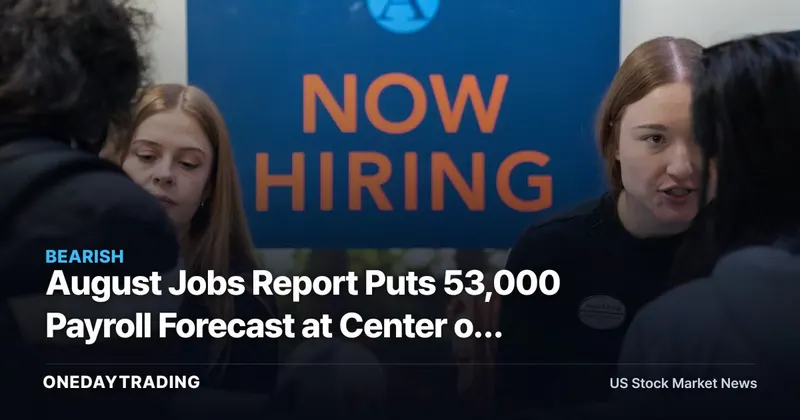
The August jobs report matters because the 53,000 consensus forecast signals weak U.S. hiring, but a soft payroll result alone would not guarantee lower interest rates while the Federal Reserve remains focused on inflation, according to CNBC Markets. For investors, the decisive issue is whether Friday’s data changes the expected rate path enough to support equity valuations without confirming a sharper economic slowdown.
Nonfarm payrolls measure the monthly change in paid U.S. employment outside the farming sector and serve as a broad gauge of labor demand. The market already expects subdued hiring after what CNBC Markets describes as a jobless summer, so the surprise relative to 53,000 matters more than the headline in isolation.
The Full Story
The August nonfarm payrolls forecast of 53,000 creates a narrow path for stocks. A modest undershoot can reduce pressure on interest rates, lower the discount rate applied to future earnings and favor long-duration growth shares; a severe miss can instead shift the debate from policy relief to weakening revenue demand.
An upside surprise would reverse that sequence. Payroll growth materially above 53,000 would suggest labor demand retains more momentum than investors expect, potentially preserving wage and inflation pressure and making rapid Federal Reserve easing harder to justify. Higher rate expectations would then compress price-to-earnings multiples, particularly where valuations depend heavily on profits far in the future.
The report therefore tests two risks at once: persistent inflation and deteriorating growth. CNBC Markets says the subdued labor market has kept Federal Reserve attention focused on inflation, which means investors cannot treat weaker hiring as an automatic policy signal.
Structural Background
Employment data reach markets through both household demand and monetary policy. Slower hiring can restrain income growth and discretionary spending, while lower expected rates can reduce financing costs and raise the present value of corporate cash flows.
The tension explains why the same payroll number can produce different sector leadership. Rate-sensitive growth assets benefit when bond yields fall for benign reasons, while banks and cyclical businesses face pressure if falling yields reflect weaker loan demand, spending or investment.
Stock & Sector Ripple
- Growth equities: A controlled payroll slowdown can support valuation multiples if investors infer less pressure on interest rates without cutting earnings expectations.
- Banks: Softer rate expectations can pressure interest-income assumptions, while a deeper hiring contraction would also raise concern about credit demand and borrower quality.
- Consumer stocks: Employment weakness threatens spending volumes because payroll income anchors household purchasing power.
- Industrials: A large downside surprise would challenge order and capacity assumptions tied to continued economic expansion.
Bull vs Bear Scenarios
Bull case: August payrolls land near or moderately below 53,000, inflation remains the Federal Reserve’s main constraint and markets price a gentler rate path without materially reducing earnings estimates. Bear case: Hiring falls far short of 53,000 and investors interpret the jobless summer as evidence of broader demand erosion, or payrolls beat sharply enough to revive rate pressure and compress equity multiples.
Investor Action Points
- Compare Friday’s payroll result directly with the 53,000 consensus rather than labeling any positive number strong.
- Track the interest-rate reaction to distinguish a valuation tailwind from a growth warning.
- Compare growth-stock leadership with banks, consumer shares and industrials after the release.
- Keep the next inflation reading as the confirmation test because CNBC Markets says Federal Reserve attention remains centered on prices.
FAQ
What is the August jobs report forecast?
U.S. nonfarm payrolls are expected to increase by 53,000 in August, according to CNBC Markets. That forecast reflects a subdued labor market following what the report characterizes as a jobless summer.
Why does the August jobs report matter for stocks?
The August payroll result can alter interest-rate expectations and the valuation multiples investors assign to future earnings. A modest miss can support rate-sensitive shares, while a deep miss can redirect attention toward weaker consumer and corporate demand.
Will a weak jobs report make the Federal Reserve cut rates?
A weak August payroll reading would strengthen the labor-market case for easier policy, but CNBC Markets says Federal Reserve attention remains focused on inflation. If inflation stays restrictive, softer hiring does not by itself settle the timing or scale of any policy response.
📊 Analysis
Signal Bearish
Why The 53,000 payroll forecast points to unusually subdued hiring, creating downside risk for economically sensitive sectors even though lower rate expectations could cushion growth-stock valuations.
This article was independently written by OneDayTrading from public reporting. Read the original (CNBC Markets)