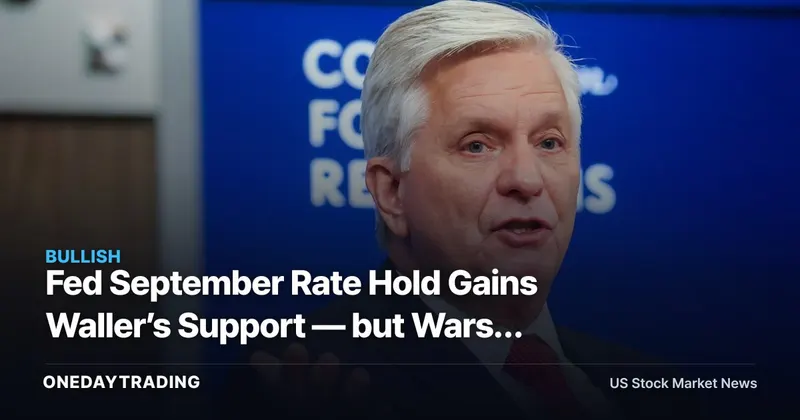
Why would the Fed hold rates steady in September?
A rate hold means the Federal Reserve leaves its policy rate unchanged at a scheduled meeting. Waller’s confidence in current inflation trends weakens the immediate case for additional restraint, although the source provides no inflation figure, target comparison or voting count that would establish committee-wide agreement.
The market channel runs from inflation expectations to interest rates and then to equity multiples. If investors infer that policy rates have peaked, longer-duration growth shares gain support because future earnings face a less punitive discount rate; if Warsh’s position prevails, that valuation relief can reverse without any deterioration in corporate profits.
By the Numbers
The key figure is zero: Waller indicated support for no rate change at the September meeting. CNBC Markets also identified one visible policy split, with Waller’s remarks appearing to contrast with statements Chairman Kevin Warsh made the prior week.
The source supplied no basis-point forecast, inflation reading or market-implied probability. Investors should therefore distinguish a governor’s stated preference from a confirmed Federal Reserve decision.
Winners & Losers
- Growth and technology: A confirmed pause reduces the risk of a fresh rise in discount rates, supporting valuation multiples for companies whose earnings are weighted further into the future.
- REITs and utilities: Stable policy rates ease incremental financing pressure, although existing borrowing costs do not reset automatically when the Fed pauses.
- Banks: A pause can stabilize credit conditions, but it can also limit further asset-yield expansion; net interest margin depends on how deposit and loan pricing adjust.
- The U.S. dollar: A less restrictive expected path removes one potential source of yield support, while a hawkish September message would restore it.
Risk Check
- Warsh’s contrasting stance could signal less confidence in the inflation trend than Waller expressed.
- A September hold would not guarantee a later rate cut or exclude renewed tightening.
- Without inflation data or committee projections in the source, the durability of the pause thesis cannot be quantified.
- Rate-sensitive sectors can underperform if bond yields rise despite an unchanged policy rate.
Bottom Line
Waller’s signal is modestly bullish for rate-sensitive assets because it narrows the immediate path toward another increase, but the market can safely price only a higher probability of a September pause—not a sustained easing cycle. The decisive checkpoint is the September decision and whether the accompanying message resolves the Waller-Warsh divide.
FAQ
Why does Waller support holding Fed rates steady in September?
Fed Governor Waller expressed confidence in current inflation trends, according to CNBC Markets. That assessment supports leaving policy unchanged rather than adding immediate restraint.
What does a September Fed rate hold mean for stocks?
A September hold would remove the near-term shock of another increase and support rate-sensitive equity multiples. The benefit weakens if longer-term yields rise or the Federal Reserve signals tighter policy later.
Is the September Federal Reserve decision already settled?
The September decision is not established by Waller’s remarks alone. Chairman Kevin Warsh made contrasting statements the prior week, leaving the committee’s policy balance uncertain.
📊 Analysis
Signal Bullish
Why Waller’s support for unchanged September rates reduces the immediate tightening risk for rate-sensitive equities, although Warsh’s contrasting stance limits conviction.
This article was independently written by OneDayTrading from public reporting. Read the original (CNBC Markets)