Summary
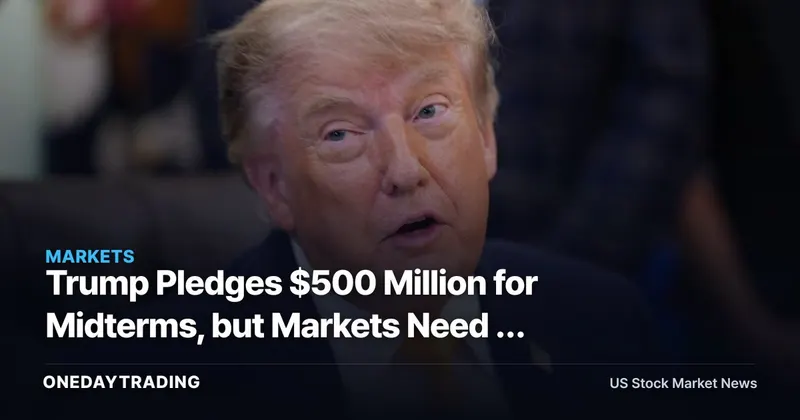
Trump’s proposed spending of up to $500 million to help Republicans in the midterms matters to investors only if the campaign money changes the probability of policies that affect taxes, regulation, trade or federal outlays; the pledge itself does not change corporate earnings, interest rates or government spending.
Per CNBC’s reporting, the commitment would sharply expand the political operation around MAGA Inc. after the Trump-aligned political action committee kept most of its $403 million war chest unused.
The Full Story
A political action committee, or PAC, is an organization that raises and spends money to influence elections. Trump said he would use up to $500 million of his own money to support Republicans in the midterms, according to CNBC.
The scale is the relevant fact: Trump’s maximum personal commitment is $97 million larger than MAGA Inc.’s reported $403 million war chest. That comparison signals potentially heavier election spending, but it does not establish how much will be deployed, where it will go or whether it will change any race.
For equity investors, the transmission mechanism runs from campaign resources to electoral probabilities, then from electoral control to policy, and only afterward to revenue, costs and valuation multiples. The market should not price the $500 million headline like fiscal stimulus because political advertising is not a change in federal tax or spending law.
Structural Background
MAGA Inc.’s decision to keep most of its $403 million war chest on the sidelines created unused campaign capacity. Trump’s separate pledge could increase the resources available to Republican candidates, but the source provides no allocation schedule, recipient list or evidence of electoral impact.
The tape can price expectations before legislation changes, particularly where election outcomes affect policy-sensitive industries. What the headline supplies is funding capacity; what it does not supply is a measurable change in policy odds.
Stock & Sector Ripple
- Broad equities: No direct earnings adjustment is justified until campaign spending produces a clearer electoral or policy signal.
- Rates: The pledge does not alter federal borrowing or inflation by itself, so Treasury pricing needs a fiscal-policy channel rather than a campaign-finance total.
- Policy-sensitive sectors: Tax, trade and regulatory exposure becomes relevant only when specific proposals and credible election probabilities emerge.
Bull vs Bear Scenarios
Bull case: If the additional resources improve Republican electoral prospects and investors associate that outcome with more favorable business policy, policy-sensitive valuations can expand before legislation arrives.
Bear case: If the money remains unspent, is deployed inefficiently or fails to change election probabilities, the $500 million pledge has little market content. Greater policy uncertainty can also restrain multiples even when campaign activity rises.
Investor Action Points
- Track how much of the pledged $500 million is actually contributed and spent.
- Compare future deployment with MAGA Inc.’s $403 million reported war chest.
- Identify named races and policy proposals before assigning sector winners or losers.
- Require movement in election probabilities, rates or earnings expectations before treating the pledge as a tradable catalyst.
FAQ
Why does Trump’s $500 million midterm pledge matter to markets?
Trump’s pledge matters only through its potential effect on Republican election prospects and subsequent policy. The campaign-finance commitment does not directly change federal spending, interest rates or company profits.
How does Trump’s pledge compare with MAGA Inc.’s war chest?
Trump’s maximum pledge of $500 million is $97 million above MAGA Inc.’s reported $403 million war chest. CNBC reported that the Trump-aligned PAC had kept most of that $403 million on the sidelines.
Which stocks benefit from Trump’s midterm spending pledge?
No individual stock can be identified from the reported facts because the source names no corporate beneficiary or specific policy. Investors need campaign allocations, election-probability changes and concrete proposals before mapping the pledge to earnings.
📊 Analysis
Signal Neutral
Why The pledge expands potential Republican campaign resources, but the reported facts establish no direct change to policy, rates or corporate earnings.
This article was independently written by OneDayTrading from public reporting. Read the original (CNBC)